How Many Index Funds Should You Own? Probably Fewer Than You Think


Picture opening your brokerage app on a Sunday night and counting.
An S&P 500 fund. A total market fund. A tech fund someone on YouTube swore by. A dividend fund. A "global leaders" fund your bank sold you. Two robo-advisor portfolios. A small-cap fund you bought after a good year. Eleven funds in all.
It feels safe. It feels diversified. It feels like the opposite of the mistakes that cost you money before.
Here is the uncomfortable truth: most investors need only one to three index funds. One broad fund can be a complete portfolio. Two or three cover almost everyone. Past that, you are usually buying the same companies again and again, paying for the privilege, and giving yourself more buttons to push at exactly the wrong moment.
The Short Answer (Save This) ✔ 1 fund can be enough: a target-date, balanced or all-world fund already holds thousands of companies (and often bonds). ✔ 2 funds works for many: one broad stock fund plus one bond or cash fund. Warren Buffett's own instructions for his wife's money use just two. ✔ 3 funds is the classic "lazy portfolio": home stocks, international stocks and bonds. ✘ 5+ funds usually means overlap: a Nasdaq-100 fund is about 95% the same money as an S&P 500 fund. ✔ The test for any extra fund: does it own something your other funds don't? If not, it's clutter. |
In this article:
Why More Funds Feels Safer (and Why the Feeling Lies)
If you have been burned in the market, you learned a hard lesson: don't put all your eggs in one basket.
That lesson is right. But somewhere along the way it gets twisted into a different rule: own lots of baskets. And that rule is wrong.
Diversification is not about how many funds you own. It's about how many different businesses, countries and types of asset sit underneath those funds.
Think of it like a buffet. One plate can hold rice, chicken, vegetables, fish and fruit. Five plates of fried rice is still just fried rice.
One index fund is already hundreds of baskets
A single S&P 500 index fund owns about 500 of the largest US companies. According to S&P Dow Jones Indices, the index covers roughly 80% of the value of the entire US stock market.
A total US market fund goes further, holding over 3,600 companies, from giants to tiny firms. An all-world fund holds thousands more, across dozens of countries.
So when you buy one broad index fund, you are not putting your eggs in one basket. You are spreading them across hundreds or thousands of baskets in a single move.
That's why the father of the index fund, Vanguard founder Jack Bogle, answered this exact question in a 2014 interview with The Motley Fool by saying, "You can certainly do it with one."
Why we keep adding funds anyway
If one fund works, why do so many of us end up with eight or eleven? It usually comes down to three very human urges:
Fear. After a loss, owning more things feels like protection, even when the things are nearly identical.
FOMO. A fund shoots up, the headlines celebrate it, and we "add a little" so we don't miss out. Usually after most of the gain has happened.
Collecting. Every app, bank and YouTube channel pitches a new fund. Each one sounds sensible on its own. Together they become a junk drawer.
None of these urges makes you foolish. They make you human. (If you want to see how these mental traps cost smart people money, read Why Smart People Lose Money in the Stock Market.)
The Overlap Trap: When Five Funds Are Really One
Here is the part almost nobody checks.
Most popular stock index funds are "market-cap weighted." The bigger a company, the more of your money goes into it. So the same giant companies sit at the top of almost every fund: Nvidia, Apple, Microsoft, Amazon, Alphabet, Meta, Broadcom.
That means funds with different names can hold almost exactly the same thing.

How much of one fund is already inside another. Sources: Morningstar (2025), S&P Dow Jones Indices.
Look at what that chart is saying:
A Nasdaq-100 fund (like QQQ) is about 95% the same money as an S&P 500 fund, by weight, according to a 2025 Morningstar analysis. Only around 5% of it is anything new.
Every company in the S&P 500 is also inside a total US market fund. And because the S&P 500 makes up about 80% of the whole market's value, roughly four-fifths of a total market fund is the S&P 500 again.
A real-world example
Here's the kind of "diversified" portfolio that's common in investing forums:
Fund | What it tracks | What's actually new? |
|---|---|---|
S&P 500 fund | 500 large US companies | The base |
Total US market fund | ~3,600 US companies | Mostly the same 500, plus smaller firms (about 20% of value) |
Nasdaq-100 fund | 100 large Nasdaq companies | Almost nothing; about 95% already in the S&P 500 |
US dividend fund | High-dividend US stocks | Mostly large US companies you already own |
US large-cap growth fund | Big US growth stocks | The same tech giants, again |
Five funds. Five fees. Five lines on your statement. But underneath, this is mostly one bet on large US companies, with an extra-heavy tilt toward a handful of tech giants.
Ironically, owning all five makes you less diversified, not more. You end up with more money in the same few names than a plain S&P 500 fund would give you.
Key insight Overlap doesn't add safety. It adds concentration. When the same giant companies fall, every one of your "different" funds falls together. |
What 200 Hedge Funds Could Not Do Against One Index Fund
If complexity really beat simplicity, the most complex portfolio in the world should win. In 2008, we got to watch that experiment play out with real money.
Warren Buffett bet that a single, low-cost Vanguard S&P 500 index fund would beat a selection of hedge funds over ten years. Ted Seides of Protégé Partners took the bet. He picked five "funds-of-funds," and as Buffett later described in his 2017 shareholder letter, those five held stakes in more than 200 hedge funds.
Two hundred professional managers. Brilliant people, huge research budgets, every incentive to win. Against one boring fund that simply owned the S&P 500.
The hedge funds started well, beating the index fund in 2008, the year of the crash. Then, in every one of the nine years that followed, they trailed it as a group.

Total gain over the 10 years of Buffett's bet (2008 to 2017). Source: Berkshire Hathaway 2017 shareholder letter.
By the end, the index fund had gained 125.8%, or about 8.5% a year. The five funds-of-funds gained between 2.4% and 87.7% in total. Not one came close.
The lesson isn't that professionals are stupid. It's that adding more managers, more funds and more layers of fees does not add more return. It usually subtracts it. (I tell the whole story in Buffett's Million-Dollar Bet.)
The Hidden Cost of Too Many Funds: Your Own Behaviour
Overlap is the obvious problem. The bigger, quieter problem is what a crowded portfolio does to you.
Every extra fund is another price to watch, another line that's red when the others are green, another temptation to "do something."
Morningstar measures this every year in its Mind the Gap study. It compares the return funds actually earned with the return the average investor in those funds actually got, after all their buying and selling.
In the 2026 edition, covering the ten years to the end of 2025, US funds returned 9.9% a year. But the average dollar invested in them earned only about 8.7% a year. That 1.2-point gap, Morningstar says, comes from the timing of investors' purchases and sales. It's about 12% of the funds' total return, simply lost to behaviour.

Yearly gap between what funds earned and what their investors earned, 10 years to Dec 2025. Source: Morningstar, Mind the Gap.
Notice who lost the least: investors in plain, broad US stock funds (a gap of about 0.4 points) and in allocation funds, the "all-in-one" target-date and balanced funds (about 0.7 points). Morningstar's researchers say allocation funds help investors because they rebalance automatically and don't tempt people to tinker.
Sector funds, the narrow, exciting ones like technology or healthcare, had a gap of 1.2 points. Alternative funds were worst at 1.6.
In plain English: the more pieces you have to manage, the more chances you get to manage them badly.
What 1.2 points a year really costs
A 1.2-point gap sounds tiny. Let's put real numbers on it.
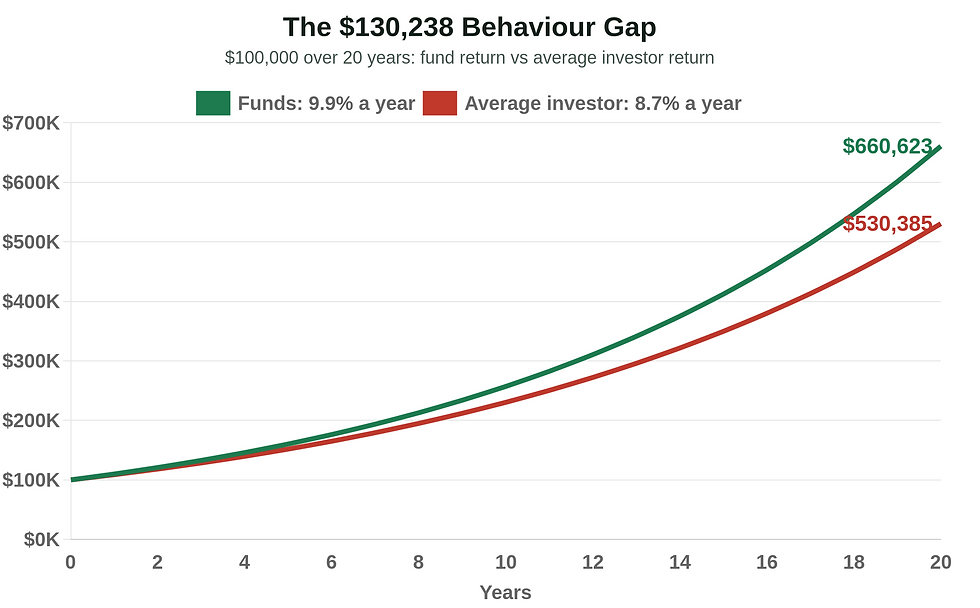
$100,000 growing for 20 years at 9.9% a year (the funds) versus 8.7% a year (the average investor in them). Illustration only; returns are not guaranteed.
After... | At 9.9% a year | At 8.7% a year |
|---|---|---|
5 years | $160,320 | $151,757 |
10 years | $257,026 | $230,301 |
15 years | $412,065 | $349,497 |
20 years | $660,623 | $530,385 |
Same funds. Same market. $130,238 less, purely from behaviour. For someone in their 40s or 50s rebuilding after a loss, that could be several years of retirement.
A simpler portfolio doesn't guarantee better behaviour. But it removes a lot of the temptation. (For more on staying calm when markets drop, see The Market Just Dropped 20%. Here's What Calm Investors Do Next.)
The other hidden costs
Behaviour isn't the only leak. A cluttered portfolio also tends to bring:
Higher fees. Specialty and thematic funds usually charge several times more than a plain broad index fund.
More small transactions. Spreading monthly savings across 8 funds can mean 8 brokerage fees, or tiny amounts sitting in cash.
More tax paperwork, especially if you live outside the US and receive dividends from several US funds.
No clear picture. Ask someone with 11 funds what percentage they hold in stocks versus bonds. Most can't tell you. And you can't manage risk you can't see.
The 1-Fund, 2-Fund and 3-Fund Portfolios
So what should you own instead? Here are the three simple set-ups that cover almost everyone. Each is respected, low-cost and used by millions of people.
The 1-fund portfolio: let one fund do everything
Choose one fund that already holds a full mix:
A target-date fund (for example, a "2040" fund). It holds thousands of stocks and bonds, and gradually shifts toward bonds as the year approaches.
A balanced or "LifeStrategy"-style fund with a fixed mix, such as 60% stocks and 40% bonds.
An all-world stock fund that holds companies across developed and emerging markets, if you want 100% stocks.
This isn't a beginner's shortcut. It's what huge numbers of serious savers do. Vanguard's How America Saves 2026 report found that about six in ten (61%) of the workplace retirement savers it serves held a single target-date fund.
Best for: people who want zero maintenance and are tempted to tinker.
The 2-fund portfolio: Buffett's choice
In his 2013 letter to shareholders, Warren Buffett revealed the instructions he left for the money his wife will inherit. Put 10% in short-term government bonds, he wrote, and 90% in a very low-cost S&P 500 index fund.
The world's most famous investor, with every option on earth, chose two funds. (More on this in Warren Buffett's Advice for 99% of Investors Fits in One Sentence.)
The general shape is simple:
One broad stock fund (an S&P 500, total market or all-world fund)
One bond or cash-like fund for stability, sized to your age, needs and nerves
Best for: people who want a clear stocks-versus-safety dial they can see at a glance.
The 3-fund portfolio: the Bogleheads' classic
The famous "three-fund portfolio" was championed by Taylor Larimore, a World War II paratrooper with the 101st Airborne who fought in the Battle of the Bulge. After reading Bogle's book in 1986, he became one of the founders of the Bogleheads community, and Bogle himself called him the "King of the Bogleheads." His book, The Bogleheads' Guide to the Three-Fund Portfolio, makes the case that three total-market index funds are all most people ever need:
A total home-country stock market fund (for Americans, a total US market fund)
A total international stock market fund (everything outside your home country)
A total bond market fund
Three funds, holding many thousands of stocks and bonds around the world, with almost no overlap between them. That's the point: each one owns something the other two don't.
Set-up | What you own | Upkeep | Who it suits |
|---|---|---|---|
1 fund | Target-date, balanced or all-world fund | Almost none | The "set it and forget it" investor |
2 funds | Broad stock fund + bond or cash fund | Rebalance once a year | Buffett's approach; clear and simple |
3 funds | Home stocks + international stocks + bonds | Rebalance once a year | Hands-on investors who want full control |
Worth remembering None of these is "better" in a way that matters as much as sticking with it. A 1-fund portfolio you hold for 20 years beats a perfect 3-fund portfolio you abandon in the next crash. |
Which One Fits You? A Simple Flowchart
Still not sure? Walk through this in under a minute.

A quick way to choose between 1, 2 and 3 funds.
A note on bonds: how much you hold in bonds or cash is a far bigger decision than how many funds you own. Someone five years from retirement and someone 25 years away need very different mixes. If you're older and rebuilding after a loss, my guide You Lost Money in the Stock Market at 50. Is It Too Late to Retire Comfortably? walks through that.
When a 4th or 5th Fund Actually Earns Its Place
I'm not saying four funds is a crime. Some extra funds do a real job. The question is always the same: does this fund own something my other funds don't, for a reason I can explain in one sentence?
Here are the cases where the answer can genuinely be yes:
Short-term safety money. Cash or a short-term bond fund for spending you need in the next few years, especially close to retirement.
Splitting stocks and bonds you can't get in one fund. For example, if your retirement plan only offers separate funds.
Home-country stocks. If you live outside the US, a fund for your local market can make sense, because your future spending is in your own currency.
Faith-based investing. If you invest according to Shariah or other values, you may need a screened fund in place of a standard one.
The same fund in different accounts. Holding an S&P 500 fund in both a retirement account and a regular account still counts as one fund. That's not clutter; that's housekeeping.
And here are the usual suspects that rarely pass the test:
A second fund tracking the same index from a different company
A Nasdaq-100 or "tech" fund on top of an S&P 500 fund
A US dividend fund or "quality" fund on top of a total market fund
Theme funds (AI, clean energy, robotics) bought after a big run-up
Leveraged funds that promise 2x or 3x the index. These are trading tools, not retirement investments.
The One-Sentence Test Before you add any fund, finish this sentence: "I need this fund because it owns ____, which none of my other funds own." If you can't fill the blank, don't buy it. |
Investing From Outside the US? One Extra Rule
Many readers of this site live in Malaysia, Singapore, the UK, Australia and elsewhere. For you, the number of funds matters less than where those funds are based.
Here's why. US-listed funds like VOO or VTI are US assets. Under US rules, the estate of a non-US person who dies owning more than $60,000 of US-situated assets must file a US estate tax return, according to the IRS, and US estate tax can apply. Tax treaties change the picture for some countries, so the details depend on where you live.
Many international investors avoid this by using Ireland-domiciled "UCITS" versions of the same index funds. They track the same S&P 500 or world index, just from a different home base.
So for international investors, the simple portfolio becomes: the same 1 to 3 funds, but the right versions of them. I explain the options in plain English in How to Invest in the S&P 500 If You Live Outside the United States. Please also check the rules in your own country, or speak to a licensed adviser, before making a big change.
How to Cut 11 Funds Down to 3 Without a Mess
Maybe you've read this far and realised your portfolio is the junk drawer. Good. Here's how to clean it calmly, without panic-selling everything on a Monday morning.
Step 1: List everything in one place
Write down every fund, every account and every robo-advisor. Include old workplace plans and anything your bank sold you. Note the value, the yearly fee (expense ratio) and what index each one tracks.
Step 2: Sort each fund into a bucket
Put every fund into one of four buckets: home stocks, international stocks, bonds/cash, or "other." You'll probably find most of your funds land in the same bucket.
Step 3: Choose your target set-up
Pick the 1, 2 or 3-fund portfolio from the flowchart above. Write your target percentages down, for example 60% stocks and 40% bonds. Make them a decision, not a mood.
Step 4: Stop feeding the clutter first
This is the easiest, cheapest step. Send all new money only to your chosen funds. Over months and years, the clutter shrinks as a share of the whole without you selling anything.
Step 5: Sell the clutter in the cheapest order
When you do sell, start where it costs least:
Funds inside tax-free or tax-deferred retirement accounts, where switching usually has no tax bill
Funds with high fees
Funds sitting at a loss (if you're a US taxpayer, selling may let you claim the loss; be careful with the wash-sale rule)
Funds with large gains in taxable accounts last, possibly spread over more than one tax year
If you're stuck on whether to sell a loser now or wait to break even, my guide Should You Sell at a Loss or Wait to Break Even? gives you a calm way to decide.
Step 6: Move the money once, not in a frenzy
Switch funds into their simpler replacement in one planned move or on a fixed schedule. If your money is going back into the market after selling, the same logic as lump sum or monthly investing after a big loss applies.
Step 7: Rebalance once a year, then leave it alone
Pick one date a year, your birthday works well. Check your percentages. If one has drifted far from target, nudge it back. That's it. That's the whole job.
Your 10-Minute Fund Audit
Do this tonight. It takes about ten minutes and you only need your account statements.
The 10-Minute Fund Audit ☐ How many funds do I own across all my accounts? Write the number down. ☐ Do two or more of them track the same or very similar index (S&P 500, total US, Nasdaq-100, US large-cap)? ☐ Can I state, in one sentence, what each fund owns that no other fund does? ☐ Do I know my total split between stocks and bonds/cash, to the nearest 10%? ☐ Is any fund charging more than 0.5% a year for something a broad index fund already covers? ☐ Did I buy any fund mainly because it had just gone up a lot? ☐ If the market fell 30% tomorrow, would I know exactly what to do with each fund? |
If you answered "yes" to the second, fifth or sixth question, or "no" to the third, fourth or seventh, you have clutter worth clearing.
And notice what simplicity does to that last question. With one to three funds, the crash plan writes itself: keep investing, rebalance once a year, and don't sell. That's the quiet power behind Jack Bogle's 10 rules for investors.
Frequently Asked Questions
How many index funds should I own?
Most investors need one to three. One target-date, balanced or all-world fund can be a complete portfolio. Two funds (stocks plus bonds) or three funds (home stocks, international stocks and bonds) cover almost everyone else. More than that usually means overlap, not extra diversification.
Is one index fund enough?
Yes, for many people. A single broad fund owns hundreds or thousands of companies, and target-date or balanced funds also hold bonds and rebalance automatically. Jack Bogle said you can do it with one. The fund must be broad, though; a single sector or theme fund is not enough.
Is it bad to own both VOO and VTI?
It isn't harmful, but it's mostly pointless. Every S&P 500 company is already inside a total US market fund, and the S&P 500 is about 80% of that fund's value. Owning both adds a second line on your statement, not real diversification. Pick one.
Should I own an S&P 500 fund and a Nasdaq-100 fund?
Usually not. Morningstar found that about 95% of a Nasdaq-100 fund's money is in companies the S&P 500 already holds. Adding it mainly increases your bet on a few large tech companies, which makes your portfolio more concentrated, not less.
How many ETFs is too many?
There is no magic number, but if you own more than four or five broad stock ETFs, check for overlap. The real test is whether each fund owns something the others don't. Five ETFs that all hold the same big US companies are, in effect, one ETF with five fees.
Do I need international index funds?
Many experts suggest owning some, since the US is only part of the world market. You can get it through one all-world fund or a separate international fund. If you live outside the US, a home-country fund may also make sense. How much is a personal choice; consistency matters most.
Is the three-fund portfolio still good in 2026?
Yes. Its strengths, low cost, broad diversification and almost no overlap, don't expire. It was designed to own whole markets rather than predict which part will win. Investors outside the US can build it with locally available or Ireland-domiciled versions of the same funds.
The Simplest Portfolio Is Often the Strongest
If you've lost money before, you might feel you need to work harder, own more and watch closer to stay safe.
The evidence says the opposite. Buffett's index fund beat more than 200 hedge funds. Investors in simple all-in-one funds kept more of their returns than investors in complex, exciting ones. And one of the most loved portfolios in the world fits on a sticky note: three funds.
You don't need eleven funds. You need one to three good ones, a plan, and the patience to leave them alone. That's not settling for less. That's how ordinary people quietly build real wealth, the way I describe in What $500 a Month in an S&P 500 Index Fund Becomes After 10, 20 and 30 Years.
If you want the full picture of what went wrong last time, and why it probably wasn't your fault, I've written a free 38-page report for you.
Why You Lost Money in the Stock Market (And Why It Wasn't Your Fault) shows the hidden traps that catch everyday investors, and the simple index fund path that helps you avoid them next time. If you're starting over, my plain-English guide Index Funds for People Who've Been Burned is a good next read too.
About the Author
Stephen Loke has been a student of the market for more than 15 years. He is also an agritourism entrepreneur whose farm has been featured in Bloomberg News and Asahi Shimbun.
This article is general education, not personal financial advice. I'm not a licensed financial adviser, and nothing here recommends buying or selling any particular fund. Past returns don't guarantee future results. Please consider your own situation, and speak to a licensed adviser before making big changes.
Sources
The Motley Fool (2014): How Many Index Funds Should You Own? Interview with Jack Bogle
Berkshire Hathaway: 2017 Shareholder Letter (the ten-year bet)
Berkshire Hathaway: 2013 Shareholder Letter (instructions for the trustee)
Morningstar: Mind the Gap, investor returns vs fund returns, 10 years to Dec 2025
WealthManagement.com: Morningstar finds investors miss out on 12% of fund returns over a decade
The White Coat Investor: Taylor Larimore 100th birthday interview
IRS: Some nonresidents with US assets must file estate tax returns


Comments