Why Smart People Lose Money in the Stock Market: 8 Mental Traps and How to Escape Them


In the spring of 1720, the smartest man in England made a killing in the stock market.
Sir Isaac Newton, the man who explained gravity, invented calculus and ran the Royal Mint, owned shares in the South Sea Company. The stock was soaring. Newton, being Newton, did the sensible thing. In April he sold, locking in a handsome profit.
Then he watched.
Through May and June the shares kept climbing. His friends were getting rich. The coffee houses of London talked about nothing else. And the greatest mind of his age did what millions of ordinary investors have done in every bubble since: he bought back in, near the very top.
By the end of the year the South Sea bubble had burst. According to the most careful modern reconstruction of his finances, by mathematician Andrew Odlyzko, Newton gave back all of his early profits and a good bit more. His net worth fell by roughly a third. Counting the gains he surrendered, the damage is often put at around £20,000, worth millions in today's money. Newton reportedly said afterward that he "could not calculate the madness of the people."
He could calculate the orbits of planets. He could not out-calculate his own brain.
Hold that thought, because it is the most important idea in this article: intelligence does not protect you in the stock market. Sometimes it makes things worse.
The Expensive Gap Between Smart Investments and Smart Investors
Here is a fact that should stop every investor in their tracks. Investors, on average, earn less than the very funds they own.
Not less than some genius hedge fund. Less than their own funds.
Morningstar measures this every year in a study called "Mind the Gap." It compares the returns funds actually delivered with the returns investors actually received, after all their buying and selling. In its 2026 edition, covering the 10 years to December 31, 2025, the funds earned 9.9% a year. The average dollar invested in them earned just 8.7%.
That 1.2-point gap sounds small. It isn't. It means investors kept only about 88 cents of every dollar of return their funds produced. On a $100,000 investment over 10 years, it is the difference between about $257,000 and about $230,000. More than $26,000 vanished, not because of bad funds, but because of bad timing.

The research firm DALBAR has tracked the same problem since 1994. In 2024, the S&P 500 returned 25.02%. The average stock fund investor earned 16.54%. That is a gap of 8.48 percentage points in a single year, one of the largest of the past decade. Over the 30 years ending in 2022, DALBAR's data showed the average equity fund investor earning 6.81% a year against 9.65% for the S&P 500, according to a report in the Indianapolis Business Journal. On $100,000, that is roughly $721,700 versus $1,585,800. More than half of a lifetime's market wealth was lost, not to crashes, but to behavior.
What a 1.2-point gap costs at 50 Imagine you are 50 with $300,000 invested and 15 years until retirement. If you earn what your funds earn, 9.9% a year, you retire with about $1,236,000. If you earn what the average investor earns, 8.7%, you retire with about $1,048,000. That "small" gap costs you roughly $187,700. Not from bad funds. From bad decisions. (Illustration using Morningstar's reported 10-year rates; real returns will vary.) |
Half a century of market history, from the 1973 bear market to the 1987 crash, the dot-com bust, 2008, the 2020 panic and the meme-stock mania, keeps teaching the same lesson. The market is rarely what ruins investors. Their own minds are.
Key takeaways Investors earned 8.7% a year over the last decade while their own funds earned 9.9% (Morningstar, 2026). The gap is almost entirely behavior. Smart, educated people fall into the same eight mental traps as everyone else, and often fall harder, because they are better at justifying their decisions. The eight traps are overconfidence, loss aversion, get-even-itis, herding, recency bias, anchoring, confirmation bias and the complexity trap. You can't delete these instincts. You can build simple rules that stop them from touching your money. |
Inside this article:
Why Being Smart Can Make It Worse
In almost every part of life, intelligence and effort pay off. Study harder and you get better grades. Work harder and you get promoted. Analyze a problem more deeply and you solve it.
The stock market breaks that rule. More effort, more research and more activity often lead to worse results, because the thing that hurts investors isn't a shortage of information. It is the wiring of the human brain.
Nobel Prize-winning psychologist Daniel Kahneman described two systems in our heads. System 1 is fast, emotional and automatic. System 2 is slow, logical and effortful. Intelligence lives mostly in System 2. But when markets crash or soar, System 1 grabs the wheel. A high IQ doesn't stop that from happening. It just gives System 2 better words to defend whatever System 1 already decided.
That is why smart people are not immune to mental traps. They are often more confident in their reasoning, more willing to act on it, and more skilled at explaining away the evidence that they are wrong.
The good news? Every one of the eight traps below has been studied for decades. Each has a known cause and a known cure.

Trap #1: The Genius Trap (Overconfidence)
In 1981, Swedish psychologist Ola Svenson asked groups of drivers a simple question: how skillful a driver are you, compared with the other people in this room?
Among American drivers, 93% rated themselves more skillful than the median driver. Among Swedish drivers, 69% did. Mathematically, only half of any group can be above the median.
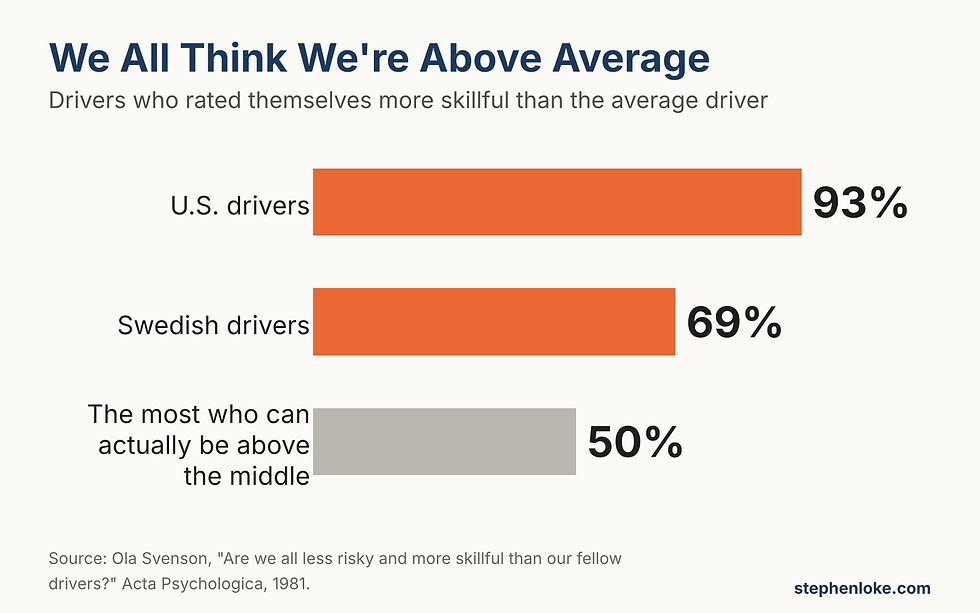
Investors are the same. Most of us quietly believe we are above average at picking stocks and timing the market. That belief has a price.
Professors Brad Barber and Terrance Odean studied 66,465 households with accounts at a large discount broker from 1991 to 1996. The average household turned over more than 75% of its portfolio every year. The busiest 20% of traders earned 11.4% a year after costs. The market earned 17.9%. The people who believed most in their own skill paid the most for that belief.
The same researchers then split investors by gender in a famous paper titled "Boys Will Be Boys." Psychologists have long found that men tend to be more overconfident than women in areas like finance. Sure enough, men traded 45% more than women. Trading cut men's returns by 2.65 percentage points a year, compared with 1.72 points for women. Single men traded 67% more than single women.

Being smart doesn't fix this. In 2001, SmartMoney magazine reported on an investment club run by members of Mensa, the society for people with very high IQs. Over 15 years, the club earned about 2.5% a year and trailed the S&P 500 by almost 13 percentage points a year. A room full of geniuses, and the market beat them by a mile.
Why it happens: Every winning trade feels like proof of skill. Every losing trade feels like bad luck. Over time, the brain keeps the trophies and throws away the receipts.
How to escape it:
Use a "core and explore" setup. Put at least 90% of your money in low-cost, broadly diversified index funds. Allow yourself no more than 10% as "fun money" for individual stock ideas.
Keep an honest scorecard. Compare your stock picks with a simple S&P 500 index fund over three to five years. Numbers don't flatter you the way memory does.
Write down why you bought every position. Six months later, check whether you were right for the reason you thought.
If you suspect your trading has drifted from investing into something closer to betting, read 7 signs you're gambling in the stock market, not investing.
Trap #2: The Pain Trap (Loss Aversion)
In 1979, psychologists Daniel Kahneman and Amos Tversky published Prospect Theory, one of the most cited papers in the history of economics. Its central finding is simple and brutal: losses hurt more than gains feel good.
In a 1992 follow-up, they measured how much more. For the typical person, a loss hurt about 2.25 times as much as a gain of the same size. Lose $1,000 and the pain is more than twice the pleasure of winning $1,000. Kahneman received the 2002 Nobel Prize in economics for this work. Tversky had died in 1996 and could not share it.

In the stock market, loss aversion produces the single most expensive mistake an investor can make: selling in a panic near the bottom.
The real-world numbers are painful. Fidelity studied 7.1 million workplace retirement savers through the 2008 crash. About 117,000 of them sold all their stocks between October 2008 and March 2009. Roughly half never bought back in. By mid-2011, the savers who fled to cash had seen their balances grow about 2% on average. Those who stayed invested were up about 50%, according to a 2011 InvestmentNews report on the study.
The damage comes from timing. The best days in the market tend to arrive right next to the worst ones, exactly when fear is loudest. J.P. Morgan Asset Management calculated that $10,000 invested in the S&P 500 from January 2006 to December 2025 grew to $80,619 if you stayed fully invested. Miss just the 10 best days and you ended with $35,866, less than half. Six of those 10 best days came within two weeks of the 10 worst days.
Old market wisdom The market rewards the investor who can sit still while every instinct is screaming "do something." Panic is not a strategy. It is a price you pay. |
Why it happens: Your brain processes a falling portfolio like a physical threat. Selling ends the pain immediately, even when it locks in the loss permanently.
How to escape it:
Write your crash plan before the crash. Decide in calm times what you will do when the market drops 20% or 30%. For most long-term investors, the answer is "keep buying and do nothing else."
Use a 72-hour rule. Never sell anything in the first three days of a sharp fall. Most panic fades before the waiting period ends.
Look less often. Economists Shlomo Benartzi and Richard Thaler showed that investors who check their portfolios frequently feel more losses and take less risk than is good for them. Checking quarterly is plenty.
Automate your contributions so you keep buying through downturns without having to summon courage.
If a recent loss is keeping you awake, start with 9 things to do before you touch your portfolio again.
Trap #3: The Get-Even Trap (Selling Winners, Hugging Losers)
Here is a pattern almost every investor recognizes. A stock goes up 30% and you sell it quickly, delighted to "lock in" the gain. Another stock falls 30% and you hold on, telling yourself you will sell "once it gets back to what I paid."
Economists call this the disposition effect. Investors call it get-even-itis.
Terrance Odean studied 10,000 brokerage accounts from 1987 to 1993. Over the year, investors cashed in 14.8% of their paper gains but only 9.8% of their paper losses. They were about 50% more likely to sell a winner than a loser.
And here is the twist. The winners they sold went on to beat the losers they kept by 3.4 percentage points over the following year. Investors were systematically selling their best horses and keeping their lame ones.

Why it happens: Selling a winner feels like proof that you were right. Selling a loser forces you to admit you were wrong, and turns a "paper loss" into a real one. The brain will do almost anything to avoid that moment of regret.
How to escape it:
Ask the only question that matters: "If I had cash today instead of this stock, would I buy it at this price?" If the answer is no, the price you originally paid is irrelevant.
Remember that the stock doesn't know you own it. It has no obligation to return to your purchase price.
In taxable accounts, a loss can have real value. Selling a loser and buying a similar fund can let you harvest a tax loss while staying invested. Ask a tax professional about the rules where you live.
Rebalance by rule, not by feeling, so winners are trimmed and laggards are topped up on a schedule.
For a calm framework on this exact decision, see should you sell at a loss or wait to break even? And if a loss has ever pushed you into bigger, riskier bets to win it back, read how a $50K loss quietly becomes $200K.
Trap #4: The Herd Trap (FOMO)
Humans survived for thousands of years by following the group. When everyone in the tribe ran, you ran first and asked questions later. In the stock market, that instinct is a wealth destroyer.
Look at what the crowd did at the peak of the dot-com bubble. In January 2000, investors poured a then-record $40.9 billion into stock mutual funds. In February they topped it with $53.6 billion, as the Christian Science Monitor reported at the time. The Investment Company Institute later counted a record $309 billion flowing into stock funds for the year.
On March 10, 2000, the Nasdaq closed at a record 5,048.62. By October 2002 it had fallen to 1,114.11, a collapse of 78%. The crowd had arrived just in time for the top.
Twenty years later the herd ran the other way. In March 2020, as COVID-19 shut down the world, investors pulled a record $326 billion out of mutual funds and exchange-traded funds, according to Morningstar. That was more than three times the worst month of 2008. The stock market hit its low on March 23 of that very month and then staged one of the fastest recoveries in history.

The pattern repeated in miniature during the 2021 meme-stock frenzy. GameStop shares that had traded at $483 crashed to around $53 within a week. One 21-year-old who bought a share at $380 told the Associated Press he was "a little late to the game." So was almost everyone who joined after the headlines.
Warren Buffett summed up the cure in his 1986 letter to shareholders: try to be "fearful when others are greedy and greedy when others are fearful."
Why it happens: Watching others get rich while you sit out creates real psychological pain. Joining the crowd ends that pain and feels safe, because if you are wrong, at least you are wrong together.
How to escape it:
Use the barbecue rule. When an investment is the main topic at every family gathering, the easy money has already been made.
Rebalance once or twice a year. It forces you to sell a little of what has run up and buy a little of what has fallen, the exact opposite of the herd.
Give every "hot" idea a 48-hour cooling-off period. If it is still a good idea in two days, it will still be a good idea in two weeks.
Buffett's own habits show what anti-herd thinking looks like in real life. Read why Warren Buffett still lives in the same house.
Trap #5: The Rear-View Mirror Trap (Recency Bias)
On October 15, 1929, Irving Fisher, Yale's celebrated economist and one of the most respected financial minds in America, gave a speech in New York. The next day, the New York Times reported his verdict: stock prices had reached what looked like "a permanently high plateau."
Nine days later, the Great Crash began.
Fisher had extended the recent past into the future, and he had his own money on it. His son later estimated his losses at as much as $10 million. According to a Federal Reserve Bank of Dallas profile, Yale had to buy Fisher's house and rent it back to him so he would not be evicted.
Recency bias is the brain's habit of assuming that whatever happened lately will keep happening. After a boom, it feels like prices can only go up. After a crash, it feels like they will never recover.
It catches professionals too. Legg Mason Value Trust manager Bill Miller beat the S&P 500 every single year from 1991 through 2005, a 15-year streak that made him a Wall Street legend. Investors piled in after the streak, and the fund's assets swelled to about $20.8 billion. Then came 2008. The fund lost about 55% that year, and by 2011 its assets had shrunk to about $2.8 billion, as the Wall Street Journal's Jason Zweig documented. Many of its investors bought the past and paid for the future.
Here is what recency bias hides from you. J.P. Morgan's research shows that from 1980 to 2025 the S&P 500 suffered an average drop of 14.2% at some point during each year. Yet 35 of those 46 years still ended with a gain.

Scary drops are normal. Down years are not. And according to Dimensional Fund Advisors, while U.S. stocks have returned about 10% a year on average since 1926, only 7 of the past 100 years actually ended within two points of that average. The "average year" almost never shows up. Big swings are the price of admission.
Why it happens: The brain gives the most weight to the most vivid, most recent memories. Last month's crash feels like the whole story, even though it is one frame of a very long film.
How to escape it:
Zoom out. Before acting on any market move, look at a 30-year chart, not a 30-day one.
Expect a double-digit drop every year. Put it in your plan in writing, so when it arrives it feels like a scheduled event, not an emergency.
Never buy a fund simply because of its recent returns. Last year's star is often next year's laggard.
Trap #6: The Anchor Trap
In a famous 1974 experiment, Amos Tversky and Daniel Kahneman spun a wheel of fortune in front of volunteers. The wheel was rigged to land on either 10 or 65. Then they asked a question that had nothing to do with the wheel: what percentage of United Nations member countries are in Africa?
People who saw the wheel land on 10 gave a median answer of 25%. People who saw 65 answered 45%. A meaningless random number dragged their answers up or down by 20 points.

That is anchoring. In investing, the most powerful anchor is the price you paid. A close second is a stock's old high. "It was $100 last year, so at $60 it's a bargain." Maybe. Or maybe the business is worth $30 now.
The dot-com crash showed how costly anchors can be. Investors who bought tech stocks near the 2000 peak waited for prices to return to their old highs. The Nasdaq as a whole didn't climb back above its March 2000 record until April 2015, 15 years later. Many individual dot-com stocks never came back at all. Pets.com, one of the most famous, shut down in November 2000.
Why it happens: When we are uncertain, the brain grabs the nearest number and adjusts from there, but never adjusts enough.
How to escape it:
Judge every holding by what the business earns and where it is going, never by where its price used to be.
Do a "fresh eyes" review once a year. Pretend your whole portfolio was turned into cash overnight. Which holdings would you buy back today?
Understand the cruel math of losses: a 50% fall needs a 100% gain just to break even. My guide on how long it takes to recover from a 50% stock market loss walks through the numbers.
Trap #7: The Echo Chamber Trap (Confirmation Bias)
Once we form an opinion, we start collecting evidence that supports it and ignoring evidence that doesn't. That is confirmation bias, and the internet has turned it into a superpower.
Researchers studying 502 investors on Naver, South Korea's largest online stock message board, found a striking pattern. Investors with stronger confirmation bias, the ones who sought out posts agreeing with their views, became more overconfident. They traded more often. An early version of the study found they also earned lower realized returns.
Today the echo chamber is far louder. Social media algorithms learn what you like and feed you more of it. Buy a stock, search for it once, and your feeds fill up with videos explaining why it will triple. Every confident voice makes you feel smarter. Very few of them are accountable for your losses.
Charles Darwin had an elegant defense against this trap. Whenever he came across a fact that contradicted his theories, he wrote it down immediately, because he knew his mind would conveniently forget it. Investors can do the same.
Why it happens: Being right feels good. Being challenged feels like a threat. The brain naturally steers toward comfort.
How to escape it:
Before you buy anything, write down three specific reasons you could be wrong. Psychologist Gary Klein calls this a "pre-mortem": imagine the investment has failed, then explain why.
Deliberately read the strongest argument against your position, from a serious source, not a strawman.
Unfollow anyone who never discusses risk. A guru who only talks about upside is selling something.
Trap #8: The Complexity Trap
This is the trap that catches the smartest people of all: the belief that a sophisticated mind needs a sophisticated strategy.
In 1994, a group of Wall Street's most brilliant traders and academics launched a hedge fund called Long-Term Capital Management. Its partners included Myron Scholes and Robert Merton, who would share the 1997 Nobel Prize in economics for their work on pricing derivatives. Their models were elegant. Their leverage was enormous.
In August 1998, after Russia defaulted on its debt, LTCM lost 44% of its value in a single month, according to the Federal Reserve's history of the episode. Between January and September 1998 it lost almost 90% of its capital. On September 23, 1998, fourteen banks and brokerages, brought together by the Federal Reserve Bank of New York, put in $3.6 billion to prevent a disorderly collapse. Two Nobel laureates, and the market still humbled them.
You might think the professionals have learned. The numbers say otherwise. S&P Dow Jones Indices' SPIVA scorecard for year-end 2025 found that 85.6% of actively managed large-cap U.S. funds trailed the S&P 500 over 10 years. Over 20 years, 92.9% did.
Then there is the most famous wager in investing. In 2008, Warren Buffett bet $1 million that a plain S&P 500 index fund would beat a portfolio of hedge funds over 10 years. A professional manager, Protégé Partners, picked five funds-of-funds, which together held stakes in more than 200 hedge funds. After 10 years the index fund was up 125.8%, about 8.5% a year. The five funds-of-funds gained between 2.8% and 87.7% in total, or roughly 0.3% to 6.5% a year. Buffett's winnings, $2,222,279, went to Girls Inc. of Omaha.

His explanation fits in seven words, from his 2017 shareholder letter: "Performance comes, performance goes. Fees never falter."
Why it happens: Smart people equate complexity with quality. A strategy with models, charts and jargon feels more trustworthy than "buy the whole market and wait." But complexity adds costs, leverage and hidden risks, and every extra moving part is another place for a behavioral trap to hide.
How to escape it:
Choose simple, low-cost, broadly diversified index funds as the core of your portfolio.
Keep fees low. A 1% annual fee sounds tiny, but it compounds against you every single year.
If you can't explain an investment to a 12-year-old in two sentences, don't own it.
I explain why the S&P 500 beats most "safe" stock portfolios in why your safe stocks are actually costing you thousands.
How the Traps Team Up: The Investor's Doom Loop
Here is what makes these eight traps so dangerous. They rarely strike alone. They work as a team, and they pass your money from one to the next like a relay baton.
It usually starts with the herd. A stock or a sector is all over the news, friends are boasting, and you finally buy in, near the top. Overconfidence tells you that you picked well, so you buy a little more.
Then the price falls. Anchoring fixes your eyes on what you paid. Get-even-itis tells you to hold until you're back to even. Confirmation bias sends you hunting for videos and posts that say the drop is temporary.
The price keeps falling. Now loss aversion takes over. The pain becomes unbearable, and one awful morning you sell everything, usually close to the bottom. Recency bias then convinces you the market is broken, so you stay in cash while it recovers without you. Finally, the complexity trap whispers that you need a smarter system, and the search for a clever strategy begins the whole loop again.
Every step feels reasonable in the moment. Together they explain how an investor can own good funds in a rising market for 30 years and still end up with half the wealth the market delivered.
The solution is not to fight each trap one at a time with willpower. It is to break the loop with a system that makes the big decisions for you, in advance.
Your Escape Plan: The One-Page Investor Rulebook
In Homer's Odyssey, Odysseus wanted to hear the Sirens, whose song lured every sailor onto the rocks. He knew he could not resist them by willpower alone. So he had his crew tie him to the mast and plug their own ears with wax, with orders to ignore him no matter how much he begged.
That is the secret to beating your own mind. Don't rely on willpower in the moment. Make your decisions in advance, when you are calm, and tie yourself to the mast.
Here are seven rules that do exactly that:
Write it down. One page: your goal, your time horizon, your target mix of stocks and bonds, and what you will do in a 30% crash.
Automate everything. Invest the same amount every month, on the same day, no matter what the headlines say.
Make index funds your core. At least 90% of your stock money in broad, low-cost index funds.
Cap your "fun money." No more than 10% for individual stocks or hot ideas, and only money you could afford to lose.
Use the 72-hour rule. No buying or selling within three days of a big market move or a hot tip.
Look less, rebalance once a year. Review quarterly at most, and rebalance on a fixed date.
Keep an investing journal. Before every decision, note why you're making it and three ways it could go wrong.

For a deeper step-by-step plan, see how to stop losing money in the stock market.
2-minute self-test: Which trap is costing you most? Answer yes or no. Have you ever... 1. Believed you could beat the market, without ever measuring whether you did? (Overconfidence) 2. Sold during a crash and bought back in higher? (Loss aversion) 3. Held a losing stock "until it gets back to even"? (Get-even-itis) 4. Bought something because everyone you know was buying it? (The herd) 5. Expected last year's returns to continue this year? (Recency) 6. Called a stock "cheap" only because it used to cost more? (Anchoring) 7. Only read news that agreed with your position? (Echo chamber) 8. Paid high fees for a strategy you couldn't explain? (Complexity) Each "yes" points to a trap that has already cost you money. Three or more means a written rulebook isn't optional anymore. It is the most profitable thing you will do this year. |
The Bottom Line
Isaac Newton didn't lose money because he lacked intelligence. He lost it because he was human. Fear, greed, pride and the pull of the crowd were wired into his brain long before he discovered gravity, and they are wired into yours.
That is actually good news. It means losing money in the past doesn't prove you are a bad investor. It proves you are a normal one. The investors who build lasting wealth aren't the ones with the highest IQs. They are the ones who accept that their brains will try to trick them, and build simple systems that make those tricks harmless.
You don't need to predict the next crash. You don't need a clever strategy. You need low costs, broad diversification, automatic investing, and a written plan that protects you from yourself on your worst day.
If you are over 40 and worried you've left it too late, you haven't. Read is it too late to retire comfortably after losing money at 50? and then take the first step below.
FREE REPORT: Why You Lost Money in the Stock Market (And Why It Wasn't Your Fault) You've just seen the eight mental traps that quietly drain smart investors. My free report goes one step further. It reveals the 7 Wall Street traps the industry sets for ordinary investors, how a "small" yearly fee can swallow a huge share of a nest egg, why most professional fund managers lose to a simple index, and the one boring strategy the industry hopes you never discover. It's written for investors over 40 who've been burned and want to know whether it's still possible to build real wealth for retirement. It is. Instant download. 100% free. No spam, ever. |
Frequently Asked Questions
Why do smart people lose money in the stock market?
Because markets punish emotional decisions, and intelligence does not switch emotions off. Smart people fall into the same mental traps as everyone else, such as overconfidence, loss aversion and herd behavior. They are often more confident and better at justifying their mistakes. Studies show heavy traders and overconfident investors earn less than the market.
What is the most common bias that costs investors money?
Loss aversion is among the most expensive. Kahneman and Tversky found losses feel about 2.25 times as painful as equal gains feel good, which drives investors to panic-sell near market bottoms and miss the recovery. Overconfidence, which leads to excessive trading, is a close second.
What is the behavior gap in investing?
The behavior gap is the difference between what an investment returns and what investors actually earn after their buying and selling. Morningstar's 2026 study found investors earned 8.7% a year over the decade to 2025, while their funds returned 9.9%.
How can I stop panic selling when the market crashes?
Decide your crash plan in writing before a crash happens. Automate your monthly investments, check your portfolio no more than quarterly, and follow a 72-hour rule before selling anything. Remember that the S&P 500 has averaged a 14.2% drop within the year since 1980, yet still finished positive in 35 of 46 years.
Are index funds better than picking individual stocks?
For most people, yes. S&P Dow Jones Indices found that 92.9% of professional large-cap fund managers underperformed the S&P 500 over 20 years. Low-cost index funds also remove many behavioral traps, because there are fewer decisions to get wrong.
Can you remove emotion from investing completely?
No, and you don't need to. The goal is to stop emotions from making your decisions. Written rules, automation, diversification and limiting how often you check your portfolio let you feel fear or greed without acting on them.
Sources
Indianapolis Business Journal, DALBAR 30-year investor returns
Andrew Odlyzko, Isaac Newton and the perils of the financial South Sea, Physics Today (2020)
Svenson (1981), Are we all less risky and more skillful than our fellow drivers?, Acta Psychologica
Barber and Odean (2000), Trading Is Hazardous to Your Wealth, Journal of Finance
Barber and Odean (2001), Boys Will Be Boys, Quarterly Journal of Economics
CBS MoneyWatch on the Mensa Investment Club (citing SmartMoney, 2001)
Tversky and Kahneman (1992), Advances in Prospect Theory, Journal of Risk and Uncertainty
InvestmentNews, Fidelity study of 401(k) investors who sold in 2008-09
J.P. Morgan Asset Management, Guide to Retirement (Impact of being out of the market)
Odean (1998), Are Investors Reluctant to Realize Their Losses?, Journal of Finance
Christian Science Monitor, April 2000, record stock fund inflows
Fortune (Reuters), Nasdaq surpasses its dot-com peak, April 2015
Institutional Investor, Morningstar data on record March 2020 fund outflows
Associated Press via News4JAX, GameStop investors, February 2021
Federal Reserve Bank of Dallas, Economic Insights on Irving Fisher (2005)
Jason Zweig, The long climb and steep descent of Legg Mason's top stock picker
Dimensional Fund Advisors, The bumpy road to the market's long-term average
Tversky and Kahneman (1974), Judgment under Uncertainty, Science
Federal Reserve History, Near Failure of Long-Term Capital Management
Disclaimer: This article is for general education only and is not personalized financial, tax or legal advice. Investing involves risk, including the loss of principal. Past performance does not guarantee future results. Consider speaking with a licensed professional about your own situation.


Comments