Index Funds for People Who’ve Been Burned: A Plain-English Guide to Starting Over

In 1897, Mark Twain wrote a short warning that every burned investor should tape to the fridge.
Mark Twain, Following the Equator (1897) "We should be careful to get out of an experience only the wisdom that is in it—and stop there; lest we be like the cat that sits down on a hot stove-lid. She will never sit down on a hot stove-lid again—and that is well; but also she will never sit down on a cold one any more." |
Maybe you are the cat.
Maybe a "can't-miss" stock you bought on a tip sank to almost nothing. Maybe you lost a chunk of your savings in crypto, options or a trading app that made it feel like a game. Maybe a smooth-talking adviser sold you a fund that charged 5% upfront and then quietly lagged the market for a decade. Maybe someone promised you 3% a month, guaranteed, and one morning the website and the money were simply gone.
Whatever burned you, the result is usually the same. You swore off the stock market for good. Never again.
Here is the uncomfortable truth I want you to sit with for a moment: that promise to yourself may end up costing you more than the original loss. Not because the stock market is safe. In the short run, it is anything but safe. It is because the thing that burned you was almost never "the stock market" itself. It was one stock. A hot tip. A product stuffed with fees. A person you trusted with your money. A panic sale at the worst possible moment.
This guide is about the cold stove: the plain, boring, low-cost index fund. In plain English, you will learn what an index fund actually is, why it is built differently from almost everything that burns ordinary investors, where it can still hurt you if you use it the wrong way, and a step-by-step plan to start over. That includes starting at 50, 60 or older, starting while you are still scared, and starting after you promised yourself you would never invest again.
Key takeaways in 60 seconds What burned you probably wasn't "the market": It was usually one of five things: putting too much in one company, complex bets like options and crypto, high fees, trusting the wrong person, or selling in a panic. A low-cost index fund removes the first four by design. Being burned changes you for decades: Research on so-called "Depression Babies" shows people who live through bad markets take less risk for the rest of their lives, and often pay a steep price for it. Hiding is expensive: $100,000 that was burned in 2008 and then parked in cash grew to just $79,588 by the end of 2025. Left in an S&P 500 index fund, it grew to $649,783. Time is the cure: Since 1928, the S&P 500 made money in 73.5% of single years, but in 100% of 20-year periods. It is not too late: A 50-year-old with $50,000 left plus $500 a month could have about $294,000 at 65, at a cautious 7% a year. |
Inside this guide:
First, Let's Name What Actually Burned You
Study enough investor disasters and a pattern jumps out. Almost every one of them comes through one of six doors. Find yours in the table below.
What burned you | What really went wrong | How an index fund closes that door |
|---|---|---|
One stock that collapsed | Too many eggs in one basket | You own hundreds of companies, so one failure is a rounding error |
Hot tips, day trading or options | Constant trading against professionals | There is nothing to trade. You buy the whole market and hold it |
Crypto, meme stocks or the "next big thing" | Betting on stories instead of profits | You own real businesses that earn real money |
A scam or Ponzi scheme | Someone else controlled your money | An independent custodian holds the assets and the holdings are public |
An expensive fund or adviser | 2% to 5% in fees ate your returns | Yearly costs can be as low as 0.03% to 0.07% |
Selling in a panic during a crash | Sold near the bottom and missed the rebound | An index fund can't fix this alone. You need a plan (Step 6 below) |
Look closely at that last row. A low-cost index fund shuts the first five doors by the way it is built. The sixth door, your own reaction when markets fall, is the one most of this guide is designed to help you close.
What this means for you Your bad experience was real, and the pain is real. But the lesson is not "the stock market is dangerous." The lesson is "concentration, complexity, high costs and trusting the wrong person are dangerous." Those are two very different lessons, and only one of them leads to a comfortable retirement. |
Why Getting Burned Rewires Your Brain (and Quietly Costs You)
If you feel a knot in your stomach every time someone mentions investing, you are not weak and you are not alone. Economists have measured this effect, and it is powerful.
In 2011, economists Ulrike Malmendier and Stefan Nagel published a landmark study in the Quarterly Journal of Economics with a memorable title: "Depression Babies." Using U.S. household survey data stretching from 1960 to 2007, they found that people who had lived through poor stock market returns were less willing to take financial risk, less likely to own stocks at all, and, when they did own stocks, put a smaller share of their money into them. They were also gloomier about future returns. The scars lasted for decades, and the most recent experiences cut deepest.
A second study, by Markku Kaustia and Samuli Knüpfer in the Journal of Finance in 2008, followed Finnish investors who applied for new stock offerings. People who had personally earned high returns on past offerings were much more likely to sign up for the next one. In other words, we learn from what happened to us, not from what usually happens.
That instinct is perfect for avoiding real hot stoves. It is terrible for money. Researchers Jerker Denrell and James March even gave it a name in 2001: the "hot stove effect." After one bad outcome, we stop trying, so we never collect the evidence that the stove has long since cooled. The cat never learns.
You can see the hot stove effect across an entire country. According to Gallup, 62% of American adults owned stocks in 2007. After the 2008 crash, that number fell to 52% in 2013 and stayed at 52% as late as 2016. It did not climb back to 62% until 2024. Millions of families sat out years of one of the strongest bull markets in history because the memory of 2008 still burned.
And the cost was enormous. Fidelity Investments studied its 401(k) retirement savers through the crash. About 117,000 of them moved every dollar out of stocks between October 2008 and March 2009, and roughly half of those had still not come back by mid-2011.

The savers who kept their stock investments saw their balances grow by an average of 50% by June 2011. Those who sold out and later went back in gained 25%. Those who sold and stayed out gained just 2%. A later Fidelity analysis told the same story over a longer stretch: a hypothetical $10,000 at the end of September 2008 grew to $17,360 by the end of 2015 for savers who had dumped all their stocks, versus $24,800 for those who kept at least some.
Now let me show you what that looks like with real index fund numbers. Imagine someone who put $100,000 into an S&P 500 index fund in January 2008. By December, the crash had cut it to $63,450. Here are three paths they could have taken next.

The investor who moved to cash and never came back finished 2025 with $79,588. They never even got back to their original $100,000. The one who waited four years for things to "calm down" and returned in January 2013 ended with $381,401. The one who simply stayed put ended with $649,783.
Read that again. The crash cost the stay-put investor about $36,500 on paper. Hiding from the next 17 years cost the cash investor about $570,000.
Veteran's note The pain of a loss fades in a year or two. The cost of hiding from the market compounds for the rest of your life. If the loss still keeps you up at night, deal with that first. My guide Can't Sleep After a Big Stock Loss? 9 Things to Do Before You Touch Your Portfolio Again walks you through it. |
The Man Who Invented the Index Fund Got Burned First
Here is a story most people have never heard, and it may be the most encouraging story in investing.
In 1966, a young executive named John C. Bogle was running Wellington Management, a respected but sleepy mutual fund company. He wanted growth, so he agreed to merge with a hot team of Boston money managers, Thorndike, Doran, Paine & Lewis, who ran a fashionable "go-go" fund called Ivest. For a few years it looked brilliant.
Then came the brutal bear market of 1973 and 1974, when U.S. stocks fell by about half. Ivest lost 65%. According to CNBC, the assets of Wellington's flagship fund shrank from a peak of about $2 billion to about $480 million, and Wellington Management's own share price collapsed from $50 to $4.25. On January 23, 1974, the very partners Bogle had invited in voted him out of his job.
Bogle later called the merger "the dumbest move of my career."
He was 44 years old, publicly humiliated and burned. What he did next changed the lives of hundreds of millions of investors.
That same year, the Nobel Prize-winning economist Paul Samuelson published an essay called "Challenge to Judgment." In it, he said he could find no hard evidence that professional managers consistently beat the S&P 500, and he pleaded for someone to start a fund that simply owned the index. Bogle took the essay as a call to action. He founded a new company, Vanguard, in September 1974, and on August 31, 1976, he launched the First Index Investment Trust, a fund that simply bought the stocks in the S&P 500 and held them.
Wall Street laughed. Bogle had hoped to raise $50 million to $150 million. The fund raised about $11 million. Samuelson cheered it in his Newsweek column that August anyway. Fifty years later, that same fund, now the Vanguard 500 Index Fund, is one of the largest investment funds on Earth.
Bogle wasn't the only giant who got burned. Benjamin Graham, the father of value investing and Warren Buffett's teacher, saw his investment partnership lose about 70% between 1929 and 1932, according to a 1977 history published by the Financial Analysts Research Foundation. He rebuilt, wrote the two most famous investing books of the 20th century, and near the end of his life told the Financial Analysts Journal in 1976 that he was "no longer an advocate of elaborate techniques of security analysis." So many professionals were doing it, he explained, that the payoff had mostly disappeared. His answer was a far simpler approach.
Smart move Two of the greatest minds in investing history were badly burned. Neither one concluded "never invest again." Both concluded "invest more simply." That is the lesson of this entire guide. |
What an Index Fund Actually Is (No Jargon, I Promise)
An index is just a list. The S&P 500 is a list of about 500 of the largest companies in the United States, chosen by a committee at S&P Dow Jones Indices. It includes household names like Apple, Microsoft, Nvidia and Amazon, along with banks, supermarkets, oil companies, drug makers and railways.
An index fund is a fund that buys every company on the list, in proportion to its size, and holds them. That's it. There is no star manager guessing which stocks will win. There are no predictions. The fund just owns the list.
Think of it this way. Picking a single stock is like betting on one horse. Owning an index fund is like owning a small slice of the whole racetrack: the ticket sales, the food stalls, the parking and the betting windows. You don't need to know which horse wins. You get paid as long as people keep coming to the races.
Jack Bogle put it more simply: "Don't look for the needle in the haystack. Just buy the haystack!"
Three features make index funds different from almost everything that burns ordinary investors.
They clean themselves. When a company shrinks, fails or gets bought, it drops off the list, and a rising company takes its place. In late 2001, when Enron collapsed, it was removed from the S&P 500. The company that took its spot was a young chip maker called Nvidia.
They are cheap. Because there is no team of analysts to pay, the largest S&P 500 index funds charge as little as 0.02% to 0.03% a year. That is $3 a year on every $10,000 invested.
They are transparent. You can see exactly what you own. There is no secret strategy and no black box.
You can buy an index fund in two main ways. An exchange-traded fund (ETF) trades on a stock exchange like a single share, through any brokerage account. A mutual fund (called a unit trust in Malaysia and some other countries) is bought directly from the fund company or a platform. Both can work well. What matters most is that it tracks a broad index and the yearly cost is very low.
If you want to understand what steady investing in the S&P 500 has done over long periods, my article What $500 a Month in an S&P 500 Index Fund Becomes After 10, 20 and 30 Years runs the numbers through 98 years of history.
Protection 1: One Company Can Never Wipe You Out
Let me tell you about Charles Prestwood.
Prestwood spent 33 and a half years working in the natural gas business, starting at Houston Natural Gas in 1967. That company eventually became part of Enron, one of the most admired companies in America. He retired on October 1, 2000, with his life savings, about $1.3 million, held in Enron stock.
Fourteen months later, Enron was bankrupt.
On December 18, 2001, Prestwood, then 63, sat before the U.S. Senate Commerce Committee and told lawmakers he had lost $1.31 million, almost everything he had saved. He was far from alone. At the end of 2000, about 62% of the money in Enron's 401(k) retirement plan, roughly $1.3 billion of $2.1 billion, was invested in Enron's own stock, according to a lawsuit reported by CNN Money. As the stock collapsed in October and November 2001, employees were locked out of changing their accounts for weeks while the plan switched administrators. Estimates of the total damage to workers' retirement savings run past $1 billion.
Enron's stock peaked at $90.75 in August 2000. On November 30, 2001, it closed at 26 cents. Two days later, the company filed for bankruptcy.
Now look at what the same $100,000 would have done in an S&P 500 index fund, which owned a small sliver of Enron along with about 499 other companies.
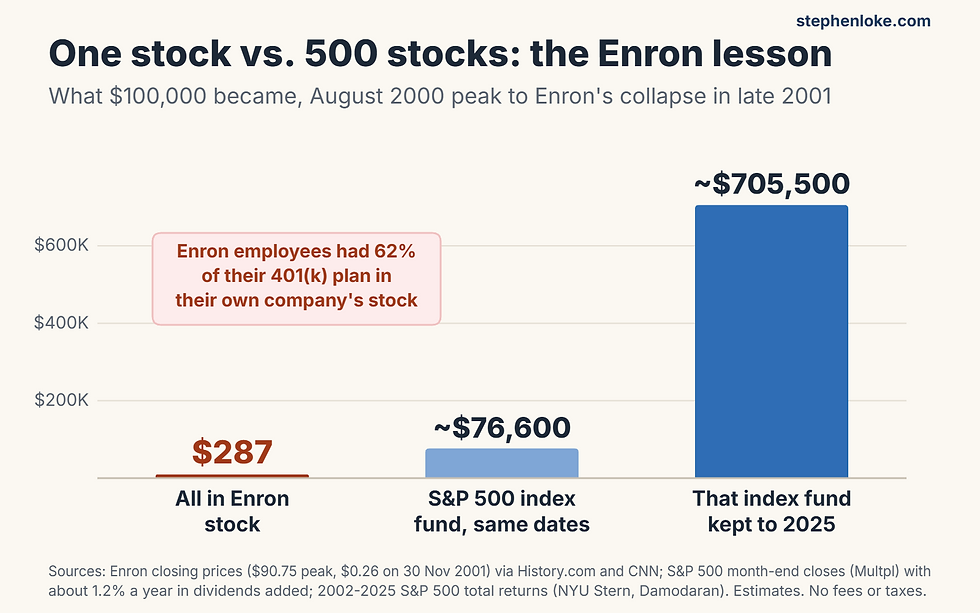
$100,000 in Enron stock at its peak became about $287. The same $100,000 in an S&P 500 index fund over the same 15 months, a terrible time for the whole market, fell to roughly $76,600. Painful, yes. But survivable. And if that index fund investor had simply held on, it would have grown to roughly $705,500 by the end of 2025.
By my rough estimate, Enron made up only about half of one percent of the S&P 500 at its peak. For index fund investors, America's most famous corporate collapse was a bad week, not a ruined retirement.
The same story repeated in 2008. Lehman Brothers' chief executive told Congress that his employees owned close to 30% of the firm. When Lehman failed, that stock became worthless. To an S&P 500 index fund, Lehman was just one more name that dropped off the list.
This isn't rare bad luck. It is what usually happens to single stocks. J.P. Morgan's Michael Cembalest studied every company that was part of the Russell 3000 index of U.S. stocks at any time from 1980 to 2020.

Two-thirds of those stocks did worse than the index. Forty-four percent suffered a fall of 70% or more and never recovered. Forty-two percent lost money outright. Only about one in ten became a big winner.
Professor Hendrik Bessembinder of Arizona State University found something even more striking. Looking at nearly 26,000 U.S. stocks from 1926 to 2016, he found that only 42.6% beat the return of one-month Treasury bills, basically cash, over their lifetimes. Just 4% of companies, about 1,092 firms, created all of the stock market's net wealth. The rest, taken together, did no better than cash.
So if you picked a handful of stocks and got burned, it may not have been bad judgment. The odds were stacked against you from the start. An index fund doesn't need to find the 4%. It owns them automatically, and it also owns the losers, which matter less and less as they shrink.
Reality check If more than 10% of your money sits in any single company, including the one you work for, you are carrying an Enron-style risk. It doesn't matter how strong that company looks today. Fortune magazine named Enron "America's Most Innovative Company" six years in a row. |
Protection 2: You Don't Have to Out-Guess the Professionals
Maybe you weren't burned by one stock. Maybe you were burned by trying to be clever: buying and selling, chasing tips, trading options or day trading.
If so, you were up against a stacked deck. In a famous study called "Trading Is Hazardous to Your Wealth," Brad Barber and Terrance Odean examined 66,465 households at a large U.S. discount broker from 1991 to 1996. The most active fifth of traders, who turned over their portfolios more than 250% a year, earned 11.4% a year after costs. The market earned 17.9%. The more they traded, the worse they did.
Even full-time professionals with research teams struggle. Every year, S&P Dow Jones Indices publishes its SPIVA Scorecard, comparing actively managed funds with their benchmark index after fees.

Over the 20 years to the end of 2025, 92.9% of U.S. large-company stock funds did worse than the S&P 500. That's roughly 13 out of every 14. Over 15 years, it was 89.9%. The latest mid-2026 report shows almost the same picture, with 92.6% trailing over 20 years.
Warren Buffett famously put this to the test. In 2007 he bet a hedge fund firm, Protégé Partners, that a plain S&P 500 index fund would beat a group of hand-picked hedge funds over 10 years. From 2008 to 2017, the index fund gained 125.8% in total, about 8.5% a year. The five funds of hedge funds earned between 0.3% and 6.5% a year. Buffett won, and $2,222,279 went to the charity Girls Inc. of Omaha. His summary in his 2017 letter to shareholders: "Performance comes, performance goes. Fees never falter."
If you have been burned by trading, my article Why Most Day Traders Lose Money, and the Boring Alternative That Quietly Wins explains the math. And if you want 20 years of evidence on stock picking, read Stock Picking vs. the S&P 500: What 20 Years of Results Say About Who Actually Wins.
Protection 3: Your Money Can't Quietly Disappear
For many burned investors, the deepest wound isn't the loss. It is the betrayal. Someone you trusted simply took the money.
On December 11, 2008, Bernard Madoff, a former chairman of the Nasdaq stock market, was arrested in New York. The day before, he had told two senior employees that his investment business was, in his words, "basically, a giant Ponzi scheme." His clients' statements showed about $64.8 billion. Most of it had never existed. Investors lost roughly $17.5 billion to $20 billion of real money they had handed over.
How could it happen? Because Madoff controlled everything. His own firm chose the investments, his own firm held the money, and the "audit" was done by a tiny one-accountant firm that, according to the U.S. Securities and Exchange Commission, never did a meaningful audit at all. When the SEC tightened its custody rules in 2009, its chairman said the changes grew directly out of the Madoff scheme.
Fourteen years later, crypto exchange FTX collapsed in November 2022. Its founder, Sam Bankman-Fried, was convicted of fraud and sentenced to 25 years in prison in March 2024. The U.S. Justice Department said he stole more than $8 billion from customers.
A properly regulated index fund is built so that this kind of disappearance is extremely hard to pull off.
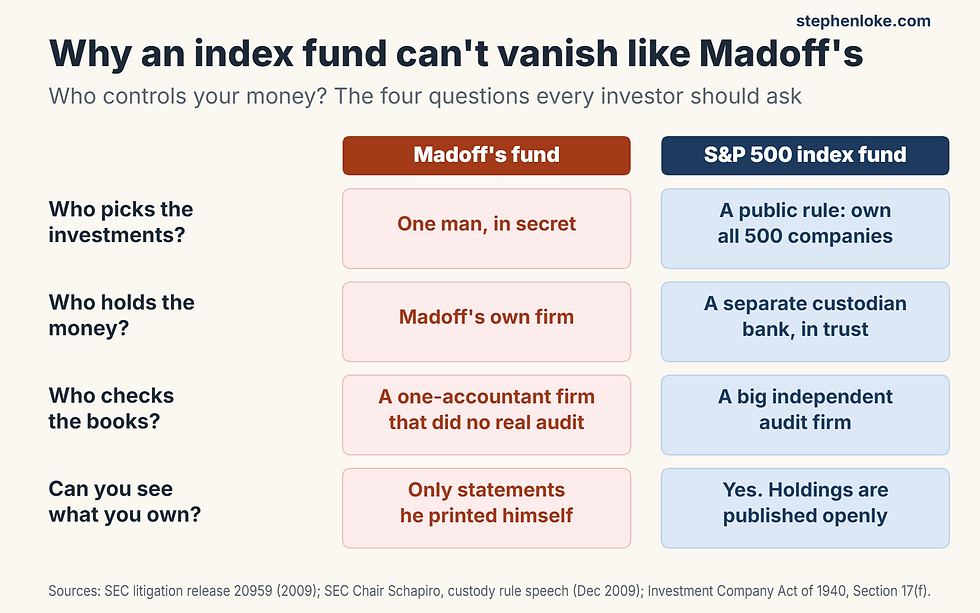
In the United States, the Investment Company Act of 1940 requires a fund's assets to be held by a qualified custodian, usually a large bank, separate from the fund company. The holdings are published, and the books are checked by an independent auditor. In Malaysia, the Securities Commission requires every unit trust fund to have an approved trustee that is legally separate from the management company. If the fund company itself fails, the investments belong to the fund's investors, not to the company's creditors.
There is one more layer in the U.S. If your brokerage firm fails, the Securities Investor Protection Corporation, or SIPC, protects up to $500,000 per customer, including up to $250,000 in cash. Be clear on what this does not do: SIPC does not protect you from market losses. Nothing does. An index fund can fall 30% or 50% in a crash. What its structure protects you from is theft and disappearance, which is exactly what destroyed Madoff's and FTX's customers.
This matters more than ever. The FBI's Internet Crime Complaint Center reported that Americans lost $8.65 billion to investment fraud in 2025, the single biggest category of internet crime, and people aged 60 and over lost $7.75 billion across all scams. In Malaysia, police reported RM1.47 billion lost to investment scams across 9,603 cases in 2025, up from RM848.6 million in 2024. Police figures for January to November 2025, reported by The Vibes, showed that people aged 41 to 60 made up the largest group of victims.
Reality check A real index fund never promises a fixed return, never asks you to pay a "fee" before you can withdraw, and never holds your money in someone's personal account. If any of those three things happens, walk away. It is not an investment. It is a trap. |
Protection 4: The Fees Stop Eating Your Future
Some burns are fast. Others are slow and silent, like a gas leak. High fees are the silent kind.
Many burned investors in Asia first met investing through a unit trust sold by a bank or an agent. According to a 2021 study by the Federation of Investment Managers Malaysia (FIMM), equity funds there may charge an upfront sales charge of up to 5.5%, although discounts brought the average charge actually paid down to 1.2% in 2020. The average total yearly cost of equity funds was about 2.0%. Compare that with about 0.07% a year for a large Ireland-based S&P 500 index ETF.
A 2% difference sounds tiny. Watch what it does over 20 years.

At 8% a year before fees, $100,000 grows to about $459,614 in a low-cost index ETF. In a fund with a 1.2% entry charge and 2% a year in costs, it grows to about $307,435. That is about $152,000 less, a third of your final wealth, gone to fees. At the full 5.5% entry charge, you lose about $165,500.
The U.S. Securities and Exchange Commission makes the same point on Investor.gov. In its example, $100,000 growing at 4% a year for 20 years ends at about $208,000 with a 0.25% yearly fee, but only about $179,000 with a 1% fee.
Fees don't just cost money. They make you feel like investing doesn't work. If you invested for a decade and barely made anything, high fees may be a big part of the reason, not the stock market.
Smart move Before you buy any fund, ask one question and get the answer in writing: "What is the total cost I will pay each year, plus any entry or exit charges?" For a broad index fund, the yearly answer should be well under 0.25%. If it is above 1%, you need a very good reason to say yes. |
The Honest Truth: Index Funds Can Still Burn You
I would be doing you a disservice if I made index funds sound like a magic shield. They are not. Here is the full truth, so nothing surprises you later.
The S&P 500 itself has suffered terrible falls. From its March 2000 peak to its October 2002 low, it fell 49.1%. From October 2007 to March 2009, it fell 56.8%. In early 2020 it fell 33.9% in about a month, and in 2022 it fell 25.4%. Anyone who needed their money at the bottom of those falls got burned, index fund or not.
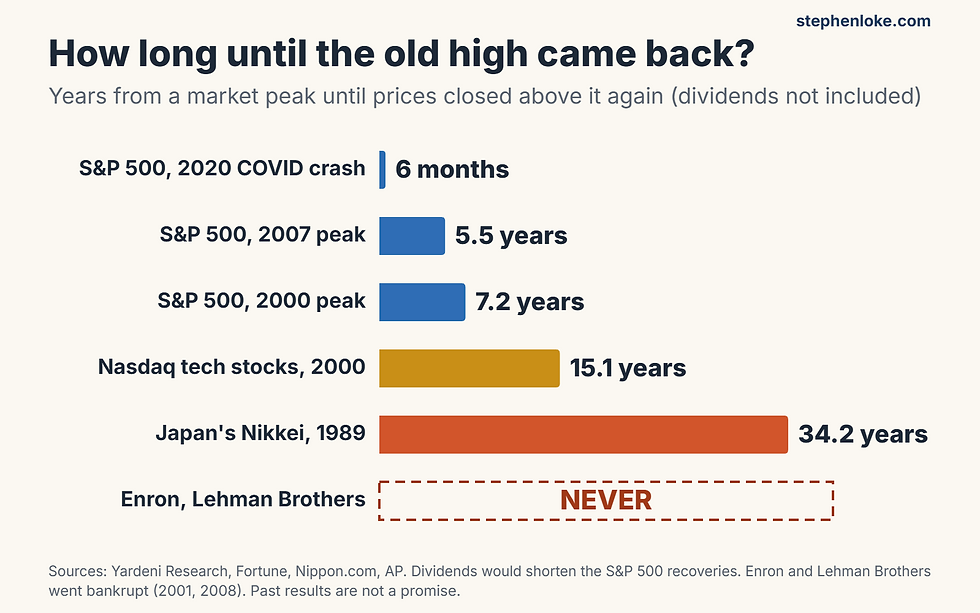
Look at the recovery times. After the 2020 crash, the S&P 500 regained its old high in about six months. After the 2007 peak, it took about five and a half years, until March 2013. Those figures exclude dividends, which shortened the real wait.
Now look at the warnings at the bottom of that chart. The Nasdaq, packed with technology stocks, peaked in March 2000 and took more than 15 years to get back, until April 2015. Japan's Nikkei 225 index peaked at 38,915.87 on December 29, 1989, and did not close above that level until February 22, 2024. That's 34 years.
So here are the four ways people still get burned with index funds, and how to avoid every one of them.
Needing the money too soon. Money you need within the next five years shouldn't be in stocks at all. Keep it in cash or short-term deposits.
Selling in a crash. This is the big one. The fund recovers. The investor who sold does not. Step 6 of the plan below shows you how to protect yourself from yourself.
Betting on one slice of the market. A technology-only fund, a single-country fund or the latest "theme" ETF is still concentration. Japan in 1989 was the world's hottest market. Broad diversification, such as an S&P 500 fund or a global "all-world" fund, spreads your risk.
Using fancy versions. Leveraged ETFs, which use borrowed money to double or triple daily moves, and "inverse" ETFs that bet on falls are built for short-term traders, not for rebuilding a retirement. Avoid them completely.
The good news is how dramatically time changes your odds. I ran every holding period in the S&P 500's history, using calendar-year total returns going back to 1928.

Hold for a single year, and the S&P 500 made money 73.5% of the time, with a worst year of minus 43.8%. Hold for five years, and the odds rose to 88.3%. Hold for 10 years, 94.4%. Hold for 20 years, and every single period since 1928 made money. The worst 20-year stretch still returned about 2.4% a year.
If you are sitting on a big loss right now, my articles How Long Does It Take to Recover From a 50% Stock Market Loss? and The Market Just Dropped 20%. Here's What Calm Investors Do Next will help you see the road back clearly.
Real People Who Got Burned and Rebuilt
Statistics are useful. But when you have been burned, you want to know one thing: has anyone like me actually come back?
Andre Nader lost $15,000 to $20,000 of his student-loan money trading options in college. He later described it to Business Insider as "pure gambling." Instead of quitting investing, he quit gambling. He found the Bogleheads online community, a group named after Jack Bogle, and moved his savings into simple, low-cost Vanguard and Fidelity index funds covering U.S. and international stocks, with a slice in bonds. When Business Insider profiled him in 2024 at age 37, he had a net worth in the seven figures, which the publication said it had verified, and he considered himself semi-retired.
Reed Hastings, the co-founder of Netflix, is about as far from an ordinary investor as you can get. Yet in a 2024 interview on The Tim Ferriss Show, he admitted that the few times he tried investing on his own, he lost badly. Apart from his Netflix shares, he now calls himself a "pure index fund investor."
And then there are the thousands of quiet rebuilders in the Fidelity data you saw earlier: ordinary workers who were burned in 2008, held their nerve or came back in, and saw their accounts recover far faster than anyone who stayed on the sidelines.

Notice what these stories have in common. None of them won back their losses with one big bet. Every one of them switched to something simpler, cheaper and more boring, and let time do the heavy lifting.
If your burn came from options, start with Lost Your Savings Trading Options? What to Do in the First 30 Days.
Before You Invest Again: The 5-Question Readiness Check
Don't skip this section. Going back into the market before you are ready is how people get burned twice. Answer these five questions honestly.
Am I trying to win my losses back? If part of you wants to "make it all back" quickly, wait. That feeling drives bigger and riskier bets. Read The Revenge Trade: How a $50K Loss Quietly Becomes $200K before you do anything.
Do I have an emergency cushion? You need three to six months of living expenses in cash first, so that a job loss or a big bill never forces you to sell investments at a bad time.
Have I cleared expensive debt? Paying off a credit card charging 18% a year is a guaranteed 18% return. No investment can promise that.
Will I leave this money alone for at least five years, ideally ten? If not, it doesn't belong in stocks.
Could I watch it fall 30% without selling? Picture your $50,000 showing as $35,000 on a bad morning. If that would make you sell, start with a smaller amount or add bonds, and build your confidence slowly.
If you are married or share finances, have the honest conversation before you start again. It is far easier to stay the course when both of you agreed on the plan. My guide How to Tell Your Spouse You Lost Money in the Stock Market can help you begin.
Your 7-Step Plan to Start Over With Index Funds
Here is the plan I would give a member of my own family who had just been burned. It is simple on purpose.
Step 1: Stop the bleeding and clean up what's left
Before you build anything new, look honestly at what you still hold. Leftover single stocks, crypto, high-fee funds and anything you don't fully understand should be reviewed one by one. For each, ask: "If I had cash today, would I buy this?" If the answer is no, it is probably time to let it go, even at a loss. In some countries a realized loss can reduce your taxes, so ask a tax adviser. My article Should You Sell at a Loss or Wait to Break Even? gives you a calm way to decide.
Step 2: Build your safety cushion
Put three to six months of essential expenses in a savings account or fixed deposit. This money is never invested. Its job is to make sure no emergency ever forces you to sell your index fund in a crash.
Step 3: Choose one broad, low-cost index fund
Pick a fund that tracks a broad index, such as the S&P 500 or a global "all-world" index, with a yearly cost well below 0.25%. U.S. investors can choose from funds like the Vanguard S&P 500 ETF (VOO) or the iShares Core S&P 500 ETF (IVV). Many investors outside the U.S. use Ireland-based versions, such as the iShares Core S&P 500 UCITS ETF (CSPX) or the Vanguard S&P 500 UCITS ETF (VUAA), mainly for tax reasons. My $500-a-month article explains those tax rules for non-U.S. investors. One good fund is enough. You do not need ten.
Step 4: Decide how to get back in
If you have a lump sum, the math favors investing it sooner. Vanguard's 2023 study found that investing a lump sum all at once beat spreading it over three months about 68% of the time, because markets rise more often than they fall.
But you are not a spreadsheet. You have been burned. If putting everything in at once and then watching it drop would make you quit forever, the math doesn't matter. In that case, a planned re-entry over six to twelve months, investing an equal amount on the same date each month, is a perfectly sensible choice. It costs a little in expected return, and it buys a lot of peace of mind. The best plan is the one you will actually stick with.
Step 5: Automate everything
Set up an automatic monthly investment on payday, with dividends reinvested. Automation removes the two most dangerous words in investing: "not yet." You never have to decide whether this month is a good time. You just keep buying.
Step 6: Write your Burn Rules and sign them
This is the step that closes the sixth door, the one an index fund can't close for you. Write down your own rules while you are calm, so you can follow them when you are not. Here is a starting set.
I will not sell my index fund because the market has fallen. Falls are when I buy more.
No single company will ever be more than 5% of my investments.
I will never buy anything I can't explain to a 12-year-old in two sentences.
I will never invest because of a tip, a group chat, a "guaranteed" return or a deadline.
I will never hand money to anyone who holds it in their own name.
I will check every adviser and product with the regulator before I invest.
Sign it. Date it. Give a copy to your spouse or a trusted friend. When the headlines scream, read it before you touch anything.
Step 7: Check once a year, not once a day
Pick one date a year, say your birthday or January 1, to review your plan. Rebalance if needed and increase your monthly amount if your income has grown. As you get closer to needing the money, gradually add bonds to smooth the ride. The rest of the year, leave it alone. A well-known 1997 experiment by Richard Thaler, Amos Tversky, Daniel Kahneman and Alan Schwartz found that people who saw their investment results more often took less risk and ended up earning less.
Here is what the finished structure looks like.

The safety cushion protects you from emergencies. The index fund core builds your wealth. And if you truly can't resist picking stocks, the small "lesson money" bucket, 5% or less, lets you scratch the itch without ever risking another life-changing burn.
For a more detailed month-by-month version, see Down 50%? A 12-Month Plan to Rebuild Your Portfolio Without Taking Bigger Risks.
Starting Over at 40, 50 or 60: The Numbers That Should Give You Hope
The most common thing burned investors say is, "It's too late for me." Let's test that with real numbers.
Imagine you're 50. After your loss, you have $50,000 left. You decide to start over and add $500 a month. Here is what happens if you keep it "safe" in cash at 2% a year, compared with an index fund growing at a cautious 7% a year, well below the S&P 500's long-run average of roughly 10%.
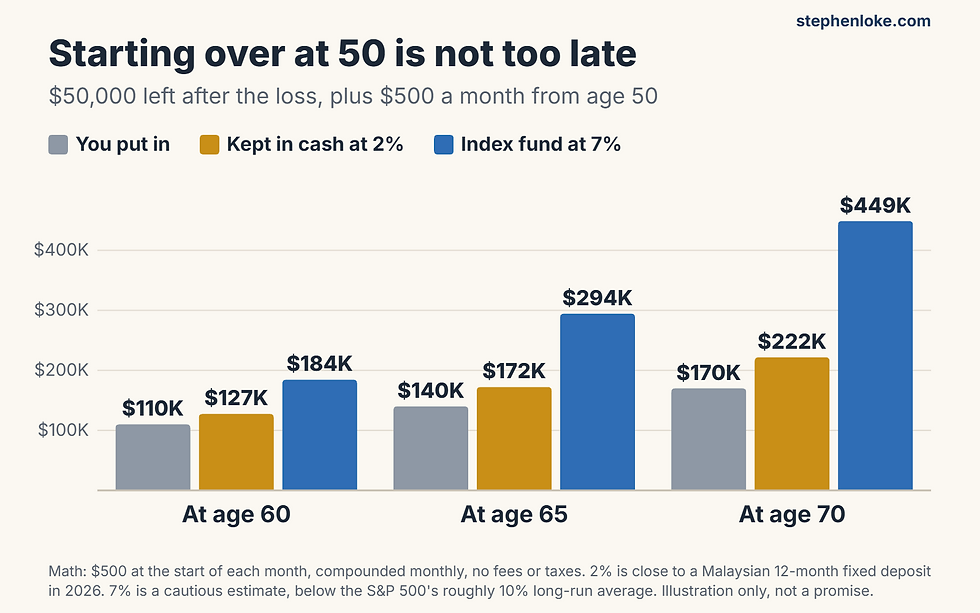
At age 60, the cash saver has about $127,000 and the index investor about $184,000. At 65, it is about $172,000 against $294,000. At 70, about $222,000 against $449,000. The index fund roughly doubles the result, from exactly the same savings habit.
Why use 2% for cash? Because that is roughly what "safe" pays today in many places. In Malaysia, for example, the big banks' 12-month fixed deposit rates were about 1.90% to 1.95% in mid-2026, according to the Association of Banks in Malaysia, while inflation ran at 1.4% in 2025. After inflation, "safe" money barely grows at all.
And remember: you are not investing until 65. You are investing until the end of your life. A 60-year-old today may need their money to last 25 or 30 years. That is a long-term investor by any definition.
If you are 50 or older and worried, read You Lost Money in the Stock Market at 50. Is It Too Late to Retire Comfortably? for a realistic plan.
What this means for you You can't change what you lost. You can only change what you do with the years you have left. At 7% a year, money roughly doubles every 10 years. Every year you wait is a doubling you may never get back. |
The Burned Investor's Scam Shield: 7 Red Flags
Here is something nobody warns you about. Once you have lost money, you become a target. Scammers buy lists of past victims and offer to "recover" your losses, for a fee. Others spot your interest in investing and slide into your messages with a "proven system."
Malaysian police have described victims being lured in with fake profits and then hit with hidden "fees" before they could withdraw. Learn these seven red flags by heart.
A guaranteed or fixed return, especially monthly. Real investments go up and down.
Pressure to act now, before a "deadline" or before "the slots run out."
Payment to withdraw your own money, whether called a tax, a fee or an "unlocking charge."
Money sent to a personal account, a crypto wallet, or anywhere other than a licensed institution.
Celebrity endorsements on social media. Fake videos of famous business people are now easy to make.
A stranger who becomes a friend, then a mentor, then an investment adviser, all through a messaging app.
An offer to recover your past losses. This is one of the most common second scams.
Before you invest a single cent with anyone, check the regulator. In Malaysia, search the Securities Commission's Investor Alert List and Bank Negara Malaysia's Financial Consumer Alert List. In the U.S., use FINRA's BrokerCheck and the SEC's Investor.gov. If the firm isn't licensed, the answer is no.
Frequently Asked Questions
Are index funds safe for someone who has lost money before?
Index funds are not risk-free. A broad index fund can fall 30% to 50% in a severe crash. But they remove the biggest risks that burn ordinary investors: one company collapsing, high fees, stock-picking mistakes and fraud. Held for 10 to 20 years, the S&P 500 has made money in 94% to 100% of historical periods since 1928.
Can an S&P 500 index fund go to zero?
For an S&P 500 index fund to go to zero, all of the roughly 500 largest U.S. companies would have to become worthless at the same time. Individual companies like Enron and Lehman Brothers did go to zero, but the index simply removed them and replaced them. In that scenario, almost every other investment would be worthless too.
What if the market crashes right after I start investing again?
It may happen, and it is survivable. If you invest monthly, a crash early on lets you buy more shares at lower prices. The key is to never be forced to sell, which is why you keep an emergency cushion and only invest money you won't need for at least five years.
Should I invest a lump sum or spread it out?
Vanguard's 2023 research found that investing a lump sum right away beat spreading it over three months about 68% of the time. But if a drop right after investing would make you quit, spreading your money evenly over 6 to 12 months is a sensible compromise that protects your peace of mind.
How much money do I need to start investing in index funds?
Very little. Many brokers let you buy a single ETF share or even a fraction of one, and many unit trust platforms accept small monthly amounts. Consistency matters far more than the starting amount.
Is it too late to start investing at 50 or 60?
No. Many people in their 50s and 60s will need their money to last 25 to 30 years. Starting at 50 with $50,000 and adding $500 a month could grow to about $294,000 by 65 at 7% a year, compared with about $172,000 in cash at 2%.
What is the difference between an index fund and a unit trust?
A unit trust is the Malaysian term for a mutual fund. Some unit trusts are index funds, but many are actively managed and charge upfront sales charges of up to 5.5% plus around 2% a year. An index ETF that tracks the S&P 500 can cost as little as 0.03% to 0.07% a year.
How do I avoid being scammed again?
Only invest through licensed institutions, never send money to personal accounts, and walk away from guaranteed returns, pressure tactics and requests to pay fees before a withdrawal. Check every firm on the regulator's website before you invest, such as the Securities Commission Malaysia's Investor Alert List or FINRA's BrokerCheck in the U.S.
The Bottom Line: It's Safe to Sit on the Cold Stove
Remember Twain's cat. She was right to fear the hot stove. Her mistake was believing every stove would always be hot.
Your hot stove was real. Maybe it was one company, one tip, one adviser, one crypto coin or one person who lied to you. But a broad, low-cost index fund is a different kind of stove. It doesn't depend on one company. It doesn't need you to outsmart professionals. It can't be quietly emptied by a fraudster. And it doesn't bleed you dry with fees.
It will still go up and down, sometimes violently. That is the price of admission to the greatest wealth-building machine ordinary people have ever had. But with time, a safety cushion, automatic investing and a signed set of Burn Rules, history says the odds swing heavily in your favor.
Jack Bogle was fired, humiliated and burned. Instead of walking away, he built the cold stove that millions of families now use to retire with dignity. You don't have to build anything. You just have to sit down on it, and stay there.
FREE REPORT: Why You Lost Money in the Stock Market (And Why It Wasn't Your Fault) Before you invest another dollar, find out exactly what burned you, so it never happens again. My free report reveals the 7 Wall Street traps that quietly drain ordinary investors, the "small" fee that can swallow a third of your retirement, and the one boring strategy the industry hopes you never discover. Written in plain English for investors over 40 who have lost money and want a calm, proven way to rebuild. 100% free. Instant download. No credit card. |
Important: This article is for education only and is not personal financial, investment or tax advice. Past performance does not guarantee future results. Projections and historical figures are estimates based on calendar-year index data and assume no taxes. Index funds can and do lose value. Please consider your own situation and speak with a licensed adviser before investing.
Sources
Mark Twain, Following the Equator (1897), Chapter XI, Project Gutenberg
InvestmentNews: 401(k) holders who bailed on stocks in 2008 made out worse, Fidelity (August 2011)
CBS MoneyWatch: 401(k) investors who stayed the course in 2008-09 were big winners
PlanAdviser: Fidelity analysis of 401(k) investors who kept equities (February 2016)
Aswath Damodaran, NYU Stern: Historical returns on stocks, bonds and bills, 1928 to 2025
CNBC: Jack Bogle's biggest investing mistake cost $1 billion and his job (December 2018)
Justin Fox, Bloomberg Opinion: John Bogle couldn't succeed until he got fired (2019)
Bogle Center: Bogle on Paul Samuelson and the birth of the index fund (2017)
Macmillan Learning: Paul Samuelson and the birth of the index fund
Kahn and Milne, Benjamin Graham: The Father of Financial Analysis (1977, PDF)
Financial Analysts Journal: A Conversation with Benjamin Graham (1976)
The Register: Nvidia joins S&P 500, replacing Enron (November 2001)
U.S. Senate Commerce Committee hearing, An Overview of the Enron Collapse, 18 December 2001
CNN Money: Enron 401(k) plan and Enron stock (November 2001)
Wikipedia: Enron (Fortune "Most Innovative Company" recognition)
Richard Fuld, Lehman Brothers testimony to the House Oversight Committee, 6 October 2008
J.P. Morgan Private Bank, Michael Cembalest, "The Agony & the Ecstasy" (2021 update, PDF)
Bessembinder, "Do Stocks Outperform Treasury Bills?", Journal of Financial Economics (2018)
Arizona State University: Do stocks outperform Treasury bills? research summary
Barber and Odean, "Trading Is Hazardous to Your Wealth", Journal of Finance (2000, PDF)
S&P Dow Jones Indices: SPIVA U.S. Scorecard Mid-Year 2026 (PDF)
Warren Buffett: 2017 Letter to Berkshire Hathaway Shareholders (PDF)
U.S. Department of Justice: Bernard Madoff arrest press release (December 2008, PDF)
U.S. Department of Justice: Madoff Victim Fund distributions
SEC litigation release 20959: Friehling & Horowitz (March 2009)
SEC Chair Mary Schapiro: speech on the custody rule (December 2009)
Reuters via Investing.com: Factbox, the numbers behind the Madoff fraud
U.S. Department of Justice: Samuel Bankman-Fried sentenced to 25 years (March 2024)
SEC: Custody of investment company assets, Rule 17f proposal
Securities Commission Malaysia: Guidelines on trustees for unit trust schemes
FBI Internet Crime Complaint Center: 2025 Internet Crime Report (PDF)
The Vibes: Over 9,000 Malaysians lose RM1.37 billion to investment scams (January 2026)
Malay Mail: Investment fraud losses hit RM1.47b, police say (April 2026)
FIMM: Research on Unit Trust Schemes' Fees and Charges (2021, PDF)
Investor.gov (SEC): Updated investor bulletin on how fees and expenses affect your portfolio
Yardeni Research: S&P 500 bear markets and corrections (PDF)
Nippon.com: Nikkei index sets first record high since 1989 (February 2024)
Business Insider: Millennial millionaire breaks down his simple index fund strategy (2024)
Vanguard: Cost averaging, invest now or temporarily hold your cash? (2023, PDF)
Association of Banks in Malaysia: Interest rates as at 31 May 2026 (PDF)
Department of Statistics Malaysia: Consumer Price Index annual analysis 2025
Vanguard: S&P 500 UCITS ETF (USD) Accumulating factsheet (PDF)


Comments