Stock Picking vs. the S&P 500: What 20 Years of Results Say About Who Actually Wins


For 15 years in a row, one man beat the stock market.
Every single year from 1991 to 2005, Bill Miller's Legg Mason Value Trust finished ahead of the S&P 500. No other mutual fund manager of his era had a streak like it. He earned a reputation as the greatest fund manager of his time, and investors poured billions of dollars into his fund to ride his coattails. (Institutional Investor)
Then the streak broke. His fund trailed the market in 2006, again in 2007, and in 2008 it lost about 55% of its value, finishing near the bottom of its peer group. (The Baltimore Sun) By the end of that year, Reuters reported the fund was behind the S&P 500 over the past one, three, five and ten years. (Reuters via El Economista) Fifteen years of genius, and an investor who arrived late had nothing to show for it.
I tell you this story not to embarrass a brilliant investor. Miller was, and is, genuinely talented. I tell it because it holds the single most expensive lesson in investing:
Picking winners is hard. Picking them consistently, for decades, is close to impossible. Even for the best in the world.
So who actually wins over the long run: the professional stock pickers, the do-it-yourself investors with their research and hunches, or a plain, boring S&P 500 index fund?
We no longer have to guess. For more than 20 years, independent researchers have kept score, fund by fund, year by year, including the funds that quietly died along the way. This article walks you through that scoreboard in plain English. You will see the numbers, the real stories behind them, why the pros lose, when stock picking can still make sense, and a simple plan you can use starting this month.
Pour a coffee. This could be the most valuable half hour you spend on your money this year.
Key takeaways in 30 seconds 93% of pros lost. Over the 20 years to the end of 2025, 92.9% of U.S. large-cap fund managers trailed the S&P 500. Most funds did not even survive. Of 760 large-cap funds open in 2006, only about 263 still existed 20 years later. Winners rarely repeat. Top-performing funds almost never stay on top for long. A few stocks do all the work. About 4% of U.S. stocks created all of the stock market's net wealth since 1926. The boring path wins. A low-cost index fund, bought regularly and held for decades, beat the vast majority of experts. |
Inside this article:
The 20-Year Scoreboard: How Many Pros Beat the S&P 500?
Since 2002, S&P Dow Jones Indices has published a report called the SPIVA Scorecard. SPIVA stands for S&P Indices Versus Active. Think of it as the official scorekeeper in the long fight between stock pickers and index funds.
What makes SPIVA so trustworthy is that it does not let anyone hide their mistakes. It counts every fund that was available at the start of a period, including funds that were later closed or merged away because they performed badly. Most fund advertising only shows you the survivors. SPIVA shows you the whole graveyard.
Here is what the latest full-year scorecard found for the 20 years ending December 31, 2025. (S&P Dow Jones Indices, SPIVA U.S. Year-End 2025)
92.9% of large-cap U.S. stock funds trailed the S&P 500.
95.0% of all U.S. stock funds trailed their benchmark.
89.7% of mid-cap funds and 90.3% of small-cap funds trailed theirs.
Read that first number again. Out of every 100 professional fund managers running large-company U.S. stock funds, only about 7 matched or beat a simple index over 20 years. These are people with research teams, analysts, company access and the best data money can buy.

And it does not get better when you shorten the window much. Over 10 years, 85.6% of large-cap funds trailed the index. Over 15 years, 89.9%. The longer the race, the more the professionals fall behind.
What this means for you If you pick a professionally managed U.S. large-cap fund today and hold it for 20 years, history says you have roughly a 1 in 14 chance of beating a simple S&P 500 index fund. Those are lottery-style odds dressed up in a suit and tie. |
Not a Fluke: The Pros Lose Almost Every Single Year
Maybe you are thinking, "Fine, but surely there were good stretches for stock pickers."
There were a few. But look at the record year by year. In 22 of the last 25 calendar years, most large-cap fund managers trailed the S&P 500. The last time a majority beat it was 2009. Since then, they have lost the race 16 years in a row. (TKer by Sam Ro, citing S&P Dow Jones Indices)
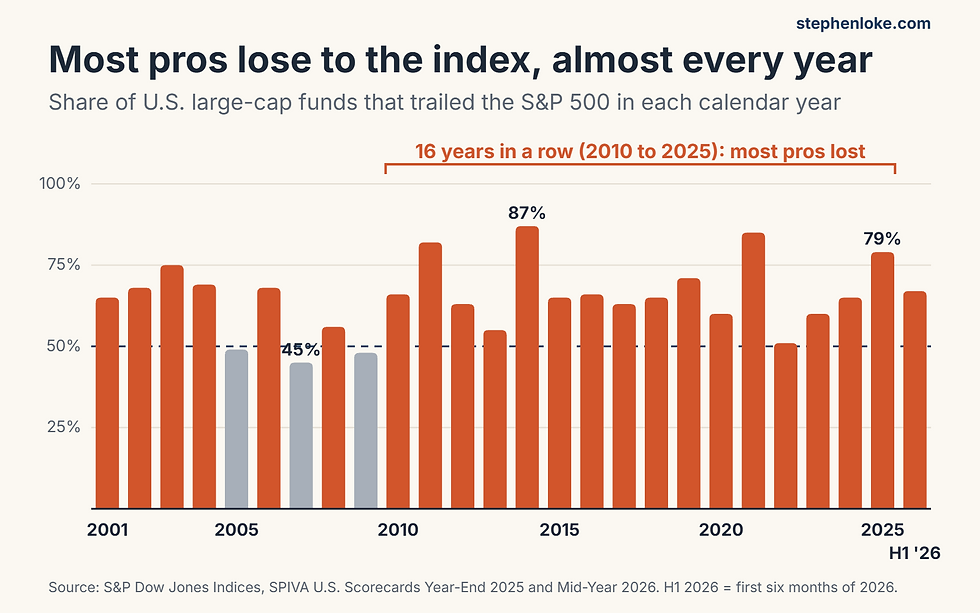
2025 was especially rough. Even though the market swung wildly in the spring, dipping toward bear market territory before roaring back to finish up about 18%, 79% of large-cap managers still trailed the S&P 500. It was the fourth-worst year for them in the 25-year history of the scorecard.
Here is the part that should really get your attention. Wall Street often says stock pickers shine when the market is choppy and individual stocks move in very different directions. The first half of 2026 was exactly that kind of market. The spread between winning and losing stocks was the highest since 2008. War in the Middle East, stagflation worries and a rotation away from the biggest tech names should have been a feast for skilled pickers.
The result? 67% of large-cap managers still trailed the S&P 500 in the first six months of 2026. (S&P Dow Jones Indices, SPIVA U.S. Mid-Year 2026)
The excuse changes every year. The scoreboard does not.
What the Gap Costs You in Real Dollars
Percentages can feel abstract, so let me turn them into money.
Over the 20 years to the end of 2025, the S&P 500 returned 11.00% a year with dividends reinvested. The average large-cap fund, weighted by how much money investors actually had in each one, returned 9.62% a year after fees. The simple average fund returned 8.86% a year. (SPIVA U.S. Year-End 2025, Reports 3 and 4)
A gap of 1.4 to 2.1 percentage points a year does not sound like much. Here is what it does to $100,000 over 20 years:

S&P 500: about $806,200
Average fund (by money invested): about $627,800
Average fund (simple average): about $546,200
That is a difference of roughly $178,000 to $260,000 on a $100,000 investment. For many families, that gap is the difference between a comfortable retirement and a nervous one. And remember, those averages include the lucky 7% who beat the index. The typical investor in a losing fund did worse.
A low-cost S&P 500 index fund will trail the index itself by a tiny sliver, its fee, which can be as low as 0.03% a year. That is still a world away from the professional average.
The Fund Graveyard Nobody Advertises
Now for the statistic the fund industry would rather you never see.
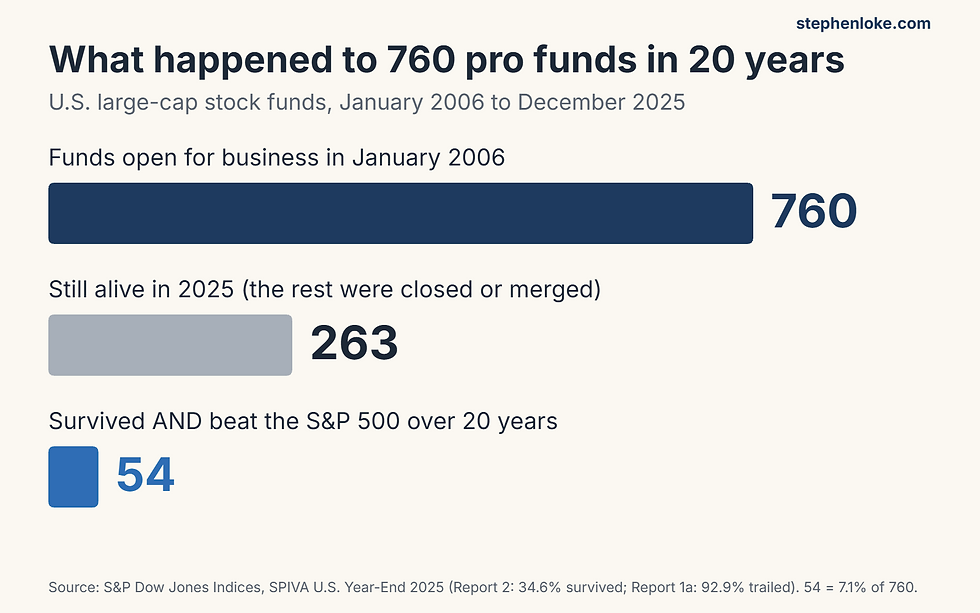
At the start of 2006, there were 760 actively managed U.S. large-cap stock funds. By the end of 2025, only about 35% of them still existed. The rest, roughly 500 funds, had been closed down or merged into other funds. (SPIVA U.S. Year-End 2025, Report 2)
Funds rarely close because they are doing well. They usually disappear after a run of poor results, when investors leave. The fund company then merges the weak fund into a stronger one, and its bad record quietly vanishes from the brochures.
This creates an illusion called survivorship bias. When you look at a list of funds today, you are only looking at the survivors. It is like judging the safety of a dangerous sport by interviewing only the people who walked away from it.
So follow the money from start to finish:
760 funds started the race in 2006.
About 263 were still running in 2025.
About 54 survived and beat the S&P 500.
That is the real number: 54 winners out of 760 starters. And no one could tell you in 2006 which 54 they would be.
"Just Pick Last Year's Best Fund." Here Is Why That Fails
The natural next thought is: "I'll simply choose the managers with the best recent record."
That is exactly what most investors do. Unfortunately, the evidence says top performers rarely stay on top.
S&P Dow Jones Indices tracks this in its Persistence Scorecard. Among U.S. stock funds that ranked in the top quarter of their category in 2021, none stayed in the top quarter every year through 2025, with the exception of small-cap funds. Only 4.5% of large-cap funds that beat the median in 2021 kept beating the median in each of the following four years. If results were pure luck, you would expect about 6.25% to do that. (S&P Dow Jones Indices, U.S. Persistence Scorecard Year-End 2025)
In other words, past winners repeated their success slightly less often than a coin flip would predict.
Morningstar runs its own independent test, called the Active/Passive Barometer. It compares active funds with real index funds you could actually buy, after fees. Over the 10 years through 2025, only 21% of active funds both survived and beat their average index peer. For U.S. large-cap funds, the figure was just 10%. (Morningstar, US Active/Passive Barometer Year-End 2025)
The veteran's rule A five-star rating, a magazine cover or a hot three-year record tells you what already happened. It tells you almost nothing about what will happen next. Never pay for yesterday's performance. |
Why Smart Professionals Lose: The 4 Forces Working Against Them
None of this means fund managers are foolish. Most are intelligent, hard-working and honest. They lose because they are fighting four forces that almost nobody can overcome for decades.
Force 1: The simple arithmetic of investing
In 1991, Nobel Prize-winning economist William Sharpe published a short paper called "The Arithmetic of Active Management." His point was so simple it is almost shocking. (William F. Sharpe, Stanford University)
All investors together own the whole market. So before costs, the average dollar managed by stock pickers must earn the market's return, because together they are the market. After costs, the average actively managed dollar must earn less than the market. It is not an opinion. It is arithmetic.
An index fund simply takes the market's return at very low cost. That means, on average, it must beat the average active dollar. Every year. Forever.
Force 2: Fees that compound against you
Fees have fallen a lot, which is good news. But the gap remains. Morningstar's 2026 fee study found that investors paid an asset-weighted average of 0.58% a year in actively managed U.S. stock funds in 2025, compared with roughly 0.10% for passive funds. Many popular S&P 500 index funds charge far less than that. (Funds Society and Money Talks News, summarizing Morningstar's 2026 US Fund Fee Study)
A half a percent sounds trivial. Watch what it does over 20 years:
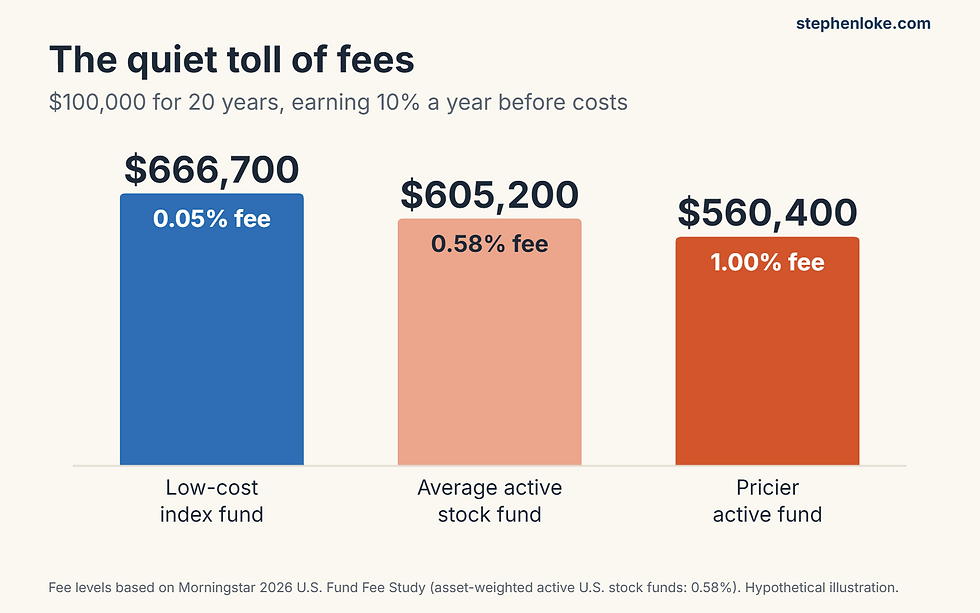
The difference between a 0.05% fee and a 1.00% fee on $100,000 over 20 years is more than $100,000. You pay that fee whether your manager wins or loses. And the highest fees are often charged by funds sold through salespeople, which also pay commissions out of your money.
Force 3: A tiny number of stocks do all the work
This is the most important idea in this whole article, so please slow down here.
Professor Hendrik Bessembinder of Arizona State University studied the lifetime returns of about 25,300 U.S. stocks from 1926 to 2016. He found that 58% of them did worse over their lifetimes than one-month U.S. Treasury bills, which are basically cash. Just 4% of companies, about 1,092 of them, accounted for all of the net wealth the U.S. stock market created over those 90 years. The other 96% together did about as well as Treasury bills. (Arizona State University, W. P. Carey School of Business)
When he and his colleagues studied more than 64,000 stocks from around the world between 1990 and 2020, the picture was even more extreme. Just 2.4% of companies created all of the $75.7 trillion in net global stock market wealth. (CFA Institute, Financial Analysts Journal)

Think about what that means for a stock picker. If you own the whole market through an index fund, you are guaranteed to own the rare superstars, whoever they turn out to be. If you pick 20 or 30 stocks, there is a very real chance you miss most of the handful that matter. Bessembinder himself said his results help explain why poorly diversified active strategies so often underperform.
It is not only a 1926 story. In 2025, just 30% of the stocks in the S&P 500 beat the S&P 500 itself. (SPIVA U.S. Year-End 2025) Seven out of ten stocks you could have picked did worse than simply owning the index.
J.P. Morgan found something similar when it studied every company that was ever part of the Russell 3000 index since 1980. Roughly 40% of those stocks suffered a permanent decline of 70% or more from their peak, and about two-thirds of all stocks underperformed the index over their lifetimes. (J.P. Morgan, The Agony and the Ecstasy)
Force 4: Professionals are competing against other professionals
Decades ago, most shares were owned by individual investors. Today, the market is dominated by large institutions, hedge funds and lightning-fast computer programs. When a fund manager buys a stock, the seller on the other side is very often another highly trained professional with the same data.
Charles Ellis, a respected investment consultant, famously called active investing a "loser's game." His point was that when everyone is skilled, the winner is usually the one who makes the fewest costly mistakes, not the one who makes the most brilliant moves.
What About Doing It Yourself? Two Stories Worth Remembering
If professionals with every advantage struggle, what about the rest of us picking stocks from the kitchen table? Two famous stories help answer that.
The grandmothers who "beat Wall Street"
In the 1990s, a group of women from a small Illinois town called Beardstown became celebrities. Their investment club claimed it had earned 23.4% a year from 1984 to 1993, roughly double the market. Their homespun investing guide became a best seller, followed by more books, TV appearances and speaking tours.
Then in 1998 a magazine editor, Shane Tritsch of Chicago Magazine, questioned the numbers. The club agreed to an audit by the accounting firm Price Waterhouse. The real return from 1984 to 1993 turned out to be 9.1% a year. Members' own monthly savings had accidentally been counted as investment gains. (CNN Money, 1998) Over the same period, the broad stock market returned about 15% a year with dividends reinvested. (Deseret News, 1998)
The ladies were not crooks. They were sincere, hard-working amateurs who did their homework. That is the point. Hard work and good intentions did not beat a simple index. And without a clear scoreboard, they did not even know they were losing.
The pros versus the darts

In 1988, The Wall Street Journal started a now-famous contest inspired by Princeton professor Burton Malkiel's book, A Random Walk Down Wall Street. Malkiel had suggested that a blindfolded monkey throwing darts at the stock pages could pick a portfolio as well as the experts. The Journal decided to test it, with staff members throwing the darts.
By the 100th contest in 1998, the professionals had beaten the darts 61 times. But against the Dow Jones Industrial Average, the pros won only 51 contests and lost 49. Barely better than a coin toss. (Investor Home, The Wall Street Journal Dartboard Contest)
And there was a catch. The contest measured price changes only, not dividends, and the pros' picks got a short-term boost simply because they were published in one of the world's most-read newspapers. Academic studies of the column found that readers who bought the experts' picks after publication tended to do worse.
A 10-second test before you buy any stock Ask yourself: "What do I know about this company that thousands of full-time professionals do not already know?" If the honest answer is "nothing," the price already reflects your idea. |
If you have been burned by your own stock picks, you are in very good company. My article Why Smart People Lose Money in the Stock Market explains the mental traps that make it so hard. And if you are not sure whether your picking has drifted into speculation, read 7 Signs You're Gambling in the Stock Market, Not Investing.
The Star-Manager Trap: When Billions Chase Yesterday's Winner
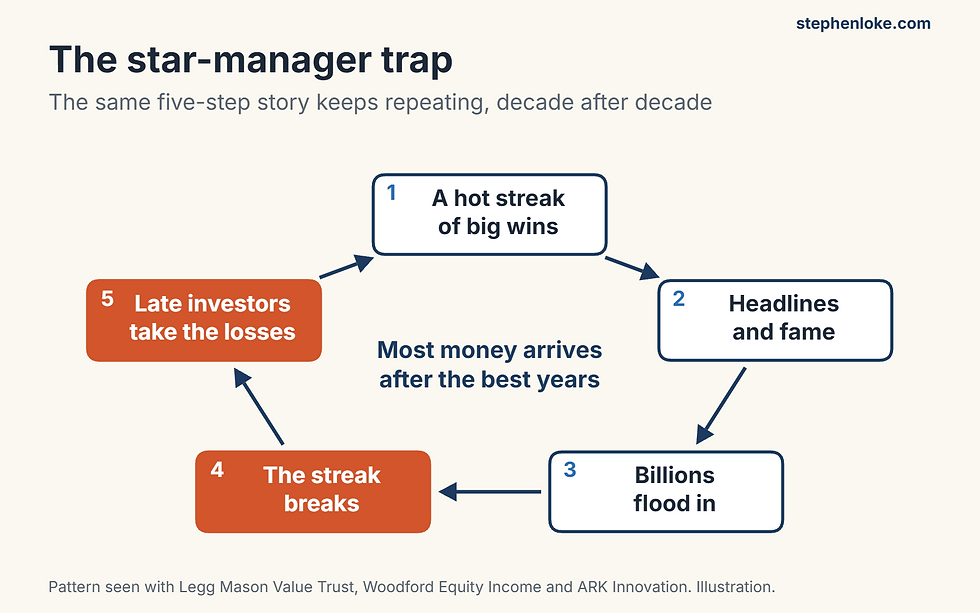
Bill Miller's story is not unique. It follows a pattern I have watched repeat again and again.
Neil Woodford: Britain's star stock picker
For decades, Neil Woodford was the most famous fund manager in the United Kingdom. When he launched his own firm in 2014, ordinary savers and big investment platforms piled in. His flagship Woodford Equity Income Fund grew to more than £10 billion.
Then his picks went wrong, and he moved more money into hard-to-sell small companies. Investors began to leave. By the end of May 2019, the fund had shrunk to about £3.7 billion, and in June it was suspended, trapping savers who could not get their money out. In October 2019 the fund was wound up. (CNBC, 2019)
In 2025, Britain's Financial Conduct Authority moved to fine Woodford nearly £6 million and his former firm £40 million, and to ban him from managing money for ordinary investors. The regulator said he had made "unreasonable and inappropriate investment decisions." (Funds Europe)
Cathie Wood and the ARK Innovation fund
In 2020, Cathie Wood's ARK Innovation ETF gained about 153%, and she became one of the most famous investors on the planet. Investors poured an estimated $14.1 billion into the fund in 2020 and 2021, mostly after the big gains had already happened.
Then came 2022. The fund lost 67% in a single year. Morningstar estimated that, measured in actual dollars won and lost by its shareholders, ARK Innovation destroyed about $5 billion of investor wealth over the 10 years through 2025, ranking it among the biggest wealth destroyers in the entire U.S. fund industry. (Morningstar)
Notice the pattern. Most of the money arrived after the best years were over. The fund's reported returns looked spectacular in the brochure. The typical investor's real experience was painful.
That is the star-manager trap. By the time a manager is famous enough for you to hear about, much of the good luck has usually been used up.
It Is Not Just America. The Pattern Is Global
Many readers of this site live outside the United States, so it is fair to ask: is this an American quirk?
It is not. S&P Dow Jones Indices publishes SPIVA scorecards for markets around the world, and the results rhyme everywhere.
Around the world, the same story Europe: 81.8% of active equity funds lagged their benchmarks in 2025, rising to 97.0% over 10 years. United Kingdom: 97% of U.K. small-cap funds and 89% of large and mid-cap funds underperformed in 2025. Canada: 93.4% of Canadian equity funds trailed their benchmark in 2025. Asia: More than 70% of global equity funds sold in Korea, Thailand and Malaysia underperformed in 2025. Brazil: 90.8% of Brazil equity funds trailed over 10 years. Middle East: More than 80% of active MENA equity funds underperformed over 10 years. |
Sources for the box above: S&P Dow Jones Indices SPIVA scorecards for Europe, Canada, Asia Ex-Japan, Latin America and the Middle East and North Africa (MENA). Full links are in the Sources list at the end.
Different countries, different currencies, different rules. Same result. Over long periods, low-cost indexing beats most stock pickers almost everywhere it has been measured.
The Honest Case for Stock Picking
I promised you the full picture, so here is the other side, fairly stated.
Some managers do win. About 7% of large-cap managers beat the S&P 500 over 20 years. Skill exists. The problem is identifying it in advance, and paying for it reasonably. Interestingly, Bill Miller himself later ran another fund that beat the S&P 500 by nearly 3 percentage points a year over a 10-year stretch, according to Morningstar figures reported by Institutional Investor. (Institutional Investor) Talent is real. It is just unpredictable.
Some corners of the market are friendlier. In 2025, only 41% of U.S. small-cap funds trailed their benchmark. In the first half of 2026, only 38% of emerging markets funds did. (SPIVA U.S. Mid-Year 2026) Short bursts like these happen. Over 15 and 20 years, though, even these categories mostly lost.
Cheap active funds do better than expensive ones. Morningstar found that 31% of active funds in the cheapest fifth of their categories beat their average index peer over 10 years, well above the overall average. (Morningstar)
The S&P 500 is not risk-free. It fell about 37% in 2008, and today it is heavily concentrated in a handful of giant technology companies. At the end of 2025, the technology sector made up 34.4% of the index. An index fund does not protect you from crashes. It protects you from being wrong about which stocks to own.
So stock picking is not illegal, immoral or always foolish. It is simply a game where the odds are stacked against the player over long periods. If you play it, play it with money you can afford to lose and keep score honestly.
How "Bogle's Folly" Became the World's Default Investment
In 1975, a stubborn man named John Bogle had an idea Wall Street hated. Why not create a mutual fund that simply bought every stock in the S&P 500 and charged almost nothing?
He launched the First Index Investment Trust on August 31, 1976. He hoped to raise $50 million to $150 million. He raised just over $11 million, which he later called an "abject failure." Critics mocked it as "Bogle's Folly." (Vanguard)
That little fund is known today as the Vanguard 500 Index Fund. And by the end of 2023, U.S. index funds and ETFs held about $13.3 trillion, overtaking actively managed funds for the first time in history. (Financial Times via Hargreaves Lansdown) Investors finally voted with their wallets.
Bogle summed up his whole philosophy in one line that I have never forgotten: "Don't look for the needle in the haystack. Just buy the haystack!"
Warren Buffett, arguably the greatest stock picker who ever lived, agrees. In his 2013 letter to shareholders, he said the money he leaves for his wife should go 90% into a very low-cost S&P 500 index fund and 10% into short-term government bonds. (Berkshire Hathaway 2013 letter) He also famously won a 10-year, $1 million bet against a group of hedge funds using nothing but an S&P 500 index fund. I told that story in detail in Why Most Day Traders Lose Money, and the Boring Alternative That Quietly Wins.
When the world's greatest stock picker tells his own family to buy the index, the rest of us should listen.
Stock Picking vs an S&P 500 Index Fund: Side by Side
Picking stocks or active funds | Low-cost S&P 500 index fund | |
|---|---|---|
Odds of beating the index over 20 years | About 7 in 100 for professionals | Matches the index, minus a tiny fee |
Typical yearly cost | 0.58% average for active stock funds, more for many | Often 0.03% to 0.10% |
Time needed | Hours of research, every week | About an hour a year |
Chance of missing the big winners | High, since 4% of stocks create all the gains | None, you own them all |
Risk of a single bad bet | Can be severe | Spread across 500 companies |
Main danger | Picking wrong, paying too much, losing patience | Panic selling in a crash |
How to Invest the Winning Way: 7 Simple Steps
You do not need to beat the market to build serious wealth. You only need to capture the market's return, keep your costs low and stay invested. Here is a simple plan.
1. Choose one low-cost, broadly diversified index fund. An S&P 500 fund, a total U.S. market fund or a global all-world fund are common choices. Look at the yearly fee, called the expense ratio. Ideally it is around 0.1% or lower.
2. If you live outside the U.S., ask about tax and domicile. Rules on dividend withholding tax and estate tax differ by country, and the same index can be offered through funds based in different places. A licensed adviser or tax professional in your country can tell you which version keeps the most money in your pocket.
3. Automate a monthly investment. Set up an automatic transfer on payday. Buying a fixed amount every month, in good markets and bad, is called dollar-cost averaging. It removes the temptation to guess.
4. Keep a cash cushion. Hold three to six months of living expenses in a safe savings account, so an emergency never forces you to sell at the worst moment.
5. If you love picking stocks, use the 90/10 rule. Keep at least 90% in your index core. Put no more than 10% into your own picks, using only money you can afford to lose.

6. Keep an honest scoreboard. Once a year, compare the return on your stock picks, after all costs, with what the same money would have earned in your index fund. The Beardstown Ladies teach us that without an honest scoreboard, it is easy to believe you are winning when you are not. If the index wins three years running, shrink your stock-picking pot.
7. Ignore star managers and hot tips. When a fund or stock is on the cover of every magazine, the best returns have usually already happened. Rebalance once a year and otherwise leave your plan alone.
If you are rebuilding after losses, these guides will help you take the next step calmly: Down 50%? A 12-Month Plan to Rebuild Your Portfolio and You Lost Money in the Stock Market at 50. Is It Too Late to Retire Comfortably?
Quick math: why boring gets big Invest $500 a month for 25 years. At 7% a year you would have roughly $405,000. At 10% a year, roughly $663,000. You would have put in only $150,000. You did not have to pick a single winning stock. |
The Choice in Front of You
Picture two investors twenty years from now.
The first spent thousands of hours reading reports, chasing tips and switching funds every time a new star appeared. Some years were thrilling. A few were disastrous. Statistically, that investor ended up with less money, more stress and a lot less free time.
The second investor made one decision and stuck with it: own the whole haystack, pay almost nothing in fees and stay the course. Every month the money went in automatically. In the crashes, they did nothing. Twenty years later, they beat roughly 93 out of 100 professional fund managers, without knowing the name of a single one.
Twenty years of evidence, from the U.S. to Europe to Asia, points in the same direction. The winner was not the smartest person in the room. It was the most patient one, with the lowest costs.
You can become that investor starting today.
FREE REPORT: Why You Lost Money in the Stock Market (And Why It Wasn't Your Fault) You have just seen why 93 out of 100 professional stock pickers lose to a simple index over 20 years. My free 38-page report goes one step further. It reveals the 7 Wall Street traps that quietly drain ordinary investors, the "small" yearly fee that can swallow a fortune, what Warren Buffett told his own family to do with their inheritance, and the one boring strategy the industry hopes you never discover. Written in plain English for investors over 40 who have lost money and want a calm, proven way to rebuild wealth for retirement. 100% free. Instant download. No credit card. |
Frequently Asked Questions
Do most fund managers beat the S&P 500?
No. According to S&P Dow Jones Indices' SPIVA U.S. Scorecard, 92.9% of actively managed U.S. large-cap stock funds trailed the S&P 500 over the 20 years ending in 2025. Over 10 years the figure was 85.6%, and in 2025 alone it was 79%.
Is stock picking better than investing in an S&P 500 index fund?
For most people, history says no. Over long periods, the large majority of professional stock pickers and most individual investors earn less than a low-cost index fund after fees. A small minority do win, but it is very hard to identify them in advance.
Why do most active fund managers underperform?
Four main reasons: the arithmetic of active management, which says the average active dollar must trail the market after costs; higher fees; the fact that a tiny share of stocks produces most of the market's gains and is easy to miss; and fierce competition from other professionals.
What percentage of stocks beat the market?
Fewer than most people think. Research by Professor Hendrik Bessembinder found that only about 4% of U.S. stocks accounted for all of the stock market's net wealth creation from 1926 to 2016, and 58% did worse than one-month Treasury bills over their lifetimes. In 2025, only 30% of S&P 500 stocks beat the S&P 500 itself.
What is the SPIVA Scorecard?
SPIVA stands for S&P Indices Versus Active. Published by S&P Dow Jones Indices since 2002, it compares actively managed funds with their benchmark indexes and corrects for survivorship bias by counting funds that were closed or merged during the period.
Can I still pick stocks if I invest in index funds?
Yes. Many investors use a "core and satellite" approach: at least 90% in a low-cost index fund, and a small portion, such as 10% or less, for individual stocks they enjoy researching. Compare your picks against the index every year and keep the stock-picking portion to money you can afford to lose.
Is the S&P 500 index fund risk-free?
No. The S&P 500 fell about 37% in 2008 and can fall sharply again. It is also concentrated in large technology companies. An index fund removes the risk of picking the wrong stocks or managers, but not the risk of market downturns, which is why a long time horizon and a cash cushion matter.
Is index investing a good idea if I am over 50?
Many people in their 50s and 60s still have 20 to 30 or more years of investing ahead, counting retirement. A low-cost, diversified index fund combined with a sensible bond and cash cushion can still do a lot of work. A licensed adviser can help set the right mix for your age, goals and comfort with risk.
Sources
S&P Dow Jones Indices: SPIVA U.S. Scorecard Year-End 2025 (PDF)
S&P Dow Jones Indices: SPIVA U.S. Scorecard Mid-Year 2026 (PDF)
S&P Dow Jones Indices: U.S. Persistence Scorecard Year-End 2025
S&P Dow Jones Indices: SPIVA Latin America Scorecard Year-End 2025
TKer by Sam Ro: SPIVA 2025, active managers vs. the benchmark
Morningstar: Investor success hinges on lower costs and greater transparency
Money Talks News: Why this record-low number is great news for your retirement
Arizona State University: Do stocks outperform Treasury bills?
CFA Institute: Long-Term Shareholder Returns, Evidence from 64,000 Global Stocks
Institutional Investor: Bill Miller in the Wilderness and Loving It
Reuters (via El Economista): Poor results signal trouble for Legg's Miller
CNBC: Star UK fund manager Woodford forced to close flagship fund
Morningstar: These 15 Funds Cost Investors Billions Over the Past Decade
Hargreaves Lansdown (Financial Times): Passive eclipses active in US fund market
Disclaimer: This article is for general education only and is not personalized financial, tax or legal advice. Investing involves risk, including the loss of principal. Past performance does not guarantee future results. Consider speaking with a licensed professional about your own situation.




Comments