How to Invest in the S&P 500 If You Live Outside the United States


Picture two friends in Kuala Lumpur who decide, on the same morning, to buy the same thing.
Each puts US$50,000 into the S&P 500, the 500 giant American companies that make your iPhone, answer your Google searches, sell you Coca-Cola and process the payment when you tap your Visa card. Same index. Same day. Same price.
Ten years later, both investments have roughly tripled. Both friends feel clever. Then life does what life always does, and both of them pass away.
One family inherits almost every cent. The other family discovers, months later, that a government they never voted for, the United States, wants a large slice of the money. The account is frozen until the paperwork is done. They end up paying a lawyer in a country they have never visited.
I didn't invent that math to scare you. In March 2026, The Edge Malaysia walked through almost exactly this situation with tax specialists from EY. US$50,000 put into an S&P 500 ETF in 2015 would have grown to about US$163,800 ten years later. After the US estate tax, the heirs could be left with roughly US$98,300. The yearly return the family actually received fell from 12.6% to about 7%.
The difference between those two families was not intelligence. It was not luck. It was one small, boring decision that almost nobody explains to people outside America: which door they used to walk into the S&P 500.
If you live in Malaysia, Singapore, the UK, Australia, Canada, India, Japan, Europe or anywhere else outside the United States, this guide is that explanation. By the end, you will know which type of S&P 500 fund suits where you live, how to avoid the two taxes that quietly drain foreign investors, and the exact 7-step plan to start this month, even with a few hundred dollars.
Key takeaways in 60 seconds ✔ Almost anyone in the world can own the S&P 500, but how you own it matters as much as whether you own it. ✔ US-listed ETFs such as VOO are the cheapest on paper. For many non-Americans they also carry a 30% tax on dividends and a US estate tax of up to 40% on holdings above US$60,000. ✔ Ireland-domiciled "UCITS" ETFs such as CSPX, VUAA and SPYL hold the same 500 companies, cut the dividend tax to 15% inside the fund, and are not US assets for estate tax purposes. ✔ Australians, Canadians and Japanese have good funds at home. Malaysians and Singaporeans usually do best with Irish-domiciled funds. ✔ Keep total yearly costs under 0.2%, invest the same amount every month, leave a map for your family, and let time do the heavy lifting. |
What's inside this guide
Why the Whole World Wants a Piece of the S&P 500
Let's start with what you are actually buying.
The S&P 500 is a list of about 500 leading companies listed in the United States, kept by S&P Dow Jones Indices. Together they cover roughly 80% of the value of the entire US stock market. When you buy an S&P 500 index fund, you don't pick winners. You own a thin slice of all of them, automatically. When a company shrinks, it drops out. When a new giant rises, it gets added. The index cleans its own house, and you never have to.
The world has noticed. S&P Dow Jones Indices' annual survey found that about US$23 trillion was indexed or benchmarked to the S&P 500 at the end of 2025, with roughly US$16 trillion sitting in funds that simply track it. In June 2026, Vanguard's S&P 500 ETF (VOO) became the first exchange-traded fund in history to hold US$1 trillion.
Why such devotion? Three reasons.
Reason 1: It is most of the world's stock market. By MSCI's count, American companies made up 62.7% of the entire global stock market at the end of June 2026. Japan was 5.6%. The UK was 3.1%. Malaysia was 0.14%. Singapore was 0.39%. If you invest only at home, you are betting your retirement on a tiny corner of the world economy.

Reason 2: It is not just America. The iPhone in your pocket, the Windows laptop at your office, the Netflix show you watched last night and the McDonald's down the road all send profits back to S&P 500 companies. Goldman Sachs estimates that 28% of S&P 500 revenue in 2024 came from outside the US. Older studies by S&P Dow Jones Indices put the figure closer to 43%. Either way, when you own the S&P 500 you own a share of global spending, including your own.
Reason 3: The long-run record. Using the annual return data compiled by Professor Aswath Damodaran at NYU Stern, US$10,000 invested at the start of 1976 grew to about US$2.79 million by the end of 2025 with dividends reinvested. That is about 11.9% a year, before taxes and fees.

Look at that chart again. It went through Black Monday in 1987, the dot-com bust, the 2008 crisis when the index fell 36.6% in a single year, a global pandemic, and the 18% drop of 2022. Since 1928, the index has risen in 72 of 98 calendar years. It made money in 94% of all 10-year periods, and in every single 20-year period on record.
Why start the chart in 1976? Because that is the year a stubborn man named Jack Bogle launched the first index fund for ordinary people. On 31 August 1976, his fund hoped to raise up to US$150 million. It raised US$11.3 million, enough to buy only 280 of the 500 stocks. Critics called it "Bogle's Folly." Fifty years later, Morningstar reports that the same fund holds about US$1.67 trillion.
Even Warren Buffett, the greatest stock picker of our time, chose this path for his own family. In his 2013 letter to shareholders, he told the trustee for his wife's inheritance to put 10% in short-term government bonds and 90% in "a very low-cost S&P 500 index fund." Then he proved his point. In a famous 10-year bet from 2008 to 2017, an S&P 500 index fund returned 8.5% a year, while the five hedge-fund portfolios picked by his opponent returned between 0.3% and 6.5%. Buffett's winnings, US$2,222,279, went to Girls Inc. of Omaha.
Meanwhile, the professionals keep losing. S&P Dow Jones Indices' SPIVA scorecard shows that 92.9% of US large-cap funds trailed the S&P 500 over the 20 years to the end of 2025. And no, your local fund managers are not the exception.

I walked through those 20-year numbers in detail in Stock Picking vs. the S&P 500: What 20 Years of Results Say About Who Actually Wins. The short version: the index wins, almost everywhere, almost all the time.
Veteran's note The S&P 500 is not magic, and it is not safe in the short run. It can fall 30% to 50% in a bad crash, and it will again. What makes it powerful is that it survives its crashes and keeps compounding. Your job is not to predict the next crash. Your job is to stay in the room. |
The World Is Already Doing This: Stories From Tokyo, Seoul, Mumbai and London
While many people in Asia still argue about whether to invest abroad, millions of ordinary savers have already made their move.
Tokyo. For decades, Japanese families kept their savings in bank deposits earning almost nothing. In January 2024, Japan launched the new NISA, which lets each adult invest up to ¥3.6 million a year, and ¥18 million over a lifetime, free of tax. Where did the money go? Largely abroad. Mitsubishi UFJ's eMAXIS Slim US Equity (S&P 500) fund became Japan's largest public equity fund in October 2024, breaking a record that had stood for 16 years. On 7 January 2026 it passed ¥10 trillion, the first Japanese fund of its kind to do so. Bloomberg reported that Japanese households bought a record ¥9.4 trillion of foreign stocks through investment funds in 2024, even while they were selling Japanese shares.
Seoul. Koreans even have a nickname for their overseas stock buyers: the "Western ants." According to Korea Securities Depository data, Korean investors held US$44.2 billion of US stocks at the end of 2022. By the end of 2025 it was US$163.6 billion, and on 2 June 2026 it hit a record US$206.3 billion. Mirae Asset's Korea-listed TIGER US S&P500 ETF passed ₩20 trillion in July 2026, the first Korean-listed overseas equity ETF to reach that size. The Korea Times profiled a 32-year-old Seoul office worker who puts ₩1 million every month into S&P 500 ETFs through his pension accounts. He sees it as building his own pension, one month at a time.
Mumbai. India shows the other side of the coin. In January 2022, the market regulator SEBI told mutual funds to stop taking new money into overseas schemes, because the whole industry was about to hit a US$7 billion cap on foreign investment. Motilal Oswal's popular S&P 500 Index Fund had to stop lump-sum purchases. By July 2026 the cap still had not changed, and Value Research counted 54 of 66 international funds closed to new money. Same index, but the door was locked by local rules.
London. On 1 January 2018, a European rule called PRIIPs required every investment product sold to ordinary investors to come with a standard "key information document." American fund companies didn't produce one. Within days, the UK broker Hargreaves Lansdown suspended nearly 1,200 products, about 900 of them ETFs, mostly US-listed. Overnight, ordinary Europeans could no longer buy VOO or SPY. They switched to Irish-domiciled versions. Today the iShares Core S&P 500 UCITS ETF is Europe's largest ETF, with US$161.5 billion in assets.
Kuala Lumpur. Malaysians are on the move too. Moomoo launched here in February 2024 and passed one million Malaysian users in a little over a year, with about half of its users trading international markets, mainly the US and China. When Rakuten Trade opened US trading in 2022, Vanguard's S&P 500 ETF was one of the first-day favourites.
What this means for you The S&P 500 has quietly become the world's retirement plan. But every country has different rules, and those rules can change overnight. The fund you choose must fit where you live, not just what you want to own. |
The 4 Doors to the S&P 500 (and Who Each One Fits)
Every S&P 500 fund on earth owns roughly the same 500 companies. What differs is the "wrapper": where the fund is legally based, where it trades, and how it is taxed. Those three things decide how much of the return actually reaches your family.

Door 1: US-listed ETFs (VOO, IVV, SPY, SPYM)
These are the giants. VOO and IVV charge 0.03% a year. SPYM, which was called SPLG until October 2025, charges just 0.02%. SPY, the oldest, charges about 0.09%. They are huge, cheap and easy to trade through most international brokers.
For an American, they are close to perfect. For a non-American, two hidden problems come with them: a tax on every dividend, and the US estate tax if you die holding more than US$60,000 of US assets. If you live in the EU, you usually can't buy them anyway, because of the PRIIPs rule above.
Door 2: Ireland-domiciled UCITS ETFs (CSPX, VUAA, SPYL, SPXS)
These funds own the same S&P 500 companies but are legally based in Ireland and trade mainly on the London Stock Exchange and other European exchanges. The big names:
iShares Core S&P 500 UCITS ETF (CSPX): 0.07% a year, about US$161.5 billion in assets, Europe's largest ETF.
Vanguard S&P 500 UCITS ETF (VUAA, or VUSA for the version that pays out dividends): 0.07% a year.
SPDR S&P 500 UCITS ETF (SPYL, or SPY5 for the version that pays out dividends): 0.03% a year.
Invesco S&P 500 UCITS ETF (SPXS): 0.05% a year, a "synthetic" fund I'll explain in a moment.
Why Ireland? Because of a tax treaty between Ireland and the US, these funds pay 15% tax on US dividends instead of 30%. Ireland doesn't tax non-resident investors on their fund holdings. And because shares of an Irish fund are not US property, the US estate tax does not reach them. For most investors in countries without a US tax treaty, including Malaysia and Singapore, this is usually the strongest door.
Door 3: An S&P 500 fund listed in your own country
Some countries have excellent home-grown options. Australians can buy the iShares S&P 500 ETF on the ASX (ticker IVV), which has been Australian-domiciled since 2018 and charges 0.04%. Canadians have TSX-listed funds such as VFV, XUS and ZSP at around 0.09%. Japanese investors have eMAXIS Slim in their NISA. Koreans have the TIGER fund. Singapore's SGX lists the SPDR S&P 500 ETF (S27), though that one is the US-domiciled SPY, so the US taxes still apply. A new Irish-domiciled Xtrackers S&P 500 fund is scheduled to start trading on SGX on 13 October 2026.
Malaysia is the gap. As of 2026 there is no S&P 500 ETF on Bursa Malaysia. The closest is a Shariah-compliant fund that tracks 50 large US companies, which is a different index with higher fees.
Door 4: Unit trusts, feeder funds and robo-advisers
These are the convenient, hand-holding options. A unit trust or feeder fund invests in an S&P 500 fund for you. A robo-adviser builds and rebalances a portfolio of ETFs. They are easy, and some are reasonably priced. But many charge an upfront sales charge plus 0.5% to 2% a year, on top of the costs of the funds underneath. Read the fee table, and ask which fund you actually own underneath, because that decides your tax treatment. I explain why "small" fees do so much damage in The 3 Silent Portfolio Killers Wiping Out Retail Investors.
Trap No. 1: The Dividend Tax That Leaks Out Every Year
Every year, S&P 500 companies pay out dividends. In 2025 the dividend yield was about 1.34%. The US taxes those dividends before they leave the country.
Here is the rule. The US charges non-Americans a default 30% tax on US dividends. If your country has an income tax treaty with the US, the rate drops, as long as you file a simple form called the W-8BEN with your broker. Under the IRS treaty tables, the rate on ordinary dividends is 15% for residents of the UK, Australia, Canada and Ireland, 10% for Japan and 25% for India.
Malaysia and Singapore have no income tax treaty with the US. So a Malaysian or Singaporean who buys VOO directly pays the full 30% on every dividend, forever.
An Irish-domiciled fund pays only 15%, because the Irish fund itself gets the treaty rate. Here is what that difference does over 30 years:

That's US$69,800 more, from a decision you make once, in five minutes, at the start.
Notice something surprising. The Irish fund charges a higher fee (0.07% versus 0.03%) and still wins by a mile. The tax leak is ten times bigger than the fee difference. This is why comparing fees alone can lead you to the wrong fund.
There is an even sharper tool. "Synthetic" S&P 500 funds, such as Invesco's SPXS, don't hold the shares directly. They receive the index return through a contract with large banks, backed by collateral. Under current US rules, those contract payments on a qualifying index like the S&P 500 are not subject to US dividend withholding at all. The trade-offs: the structure is more complex, it depends on the banks honouring the contract, and the US rules are tested every year and could change.
Smart move If you do buy US-listed funds, make sure your W-8BEN is on file. Most brokers do it online in minutes. It stays valid until the last day of the third calendar year after you sign it, so put a reminder in your calendar to renew it. Without it, you can be taxed at 30% even if your country has a treaty. |
One piece of good news: if you are not a US citizen and don't live in America (generally, not present for 183 days or more in a year), you normally pay no US tax when you sell your S&P 500 shares for a profit. The US taxes your dividends, not your gains.
Trap No. 2: The US Estate Tax Nobody Warns You About
This is the one that keeps me up at night on behalf of my readers.
According to the IRS, if a person who is neither a US citizen nor a US resident dies owning more than US$60,000 of "US-situated" assets, the estate must file a US estate tax return, Form 706-NA, within nine months. Shares of US companies count, even if the account sits in Kuala Lumpur and the certificates have never touched American soil. That includes US-listed ETFs like VOO, SPY and IVV.
Americans get an estate tax exemption in the millions. Non-Americans get a credit of just US$13,000, which works out to the tax on about US$60,000. Above that, rates climb quickly, up to 40%.
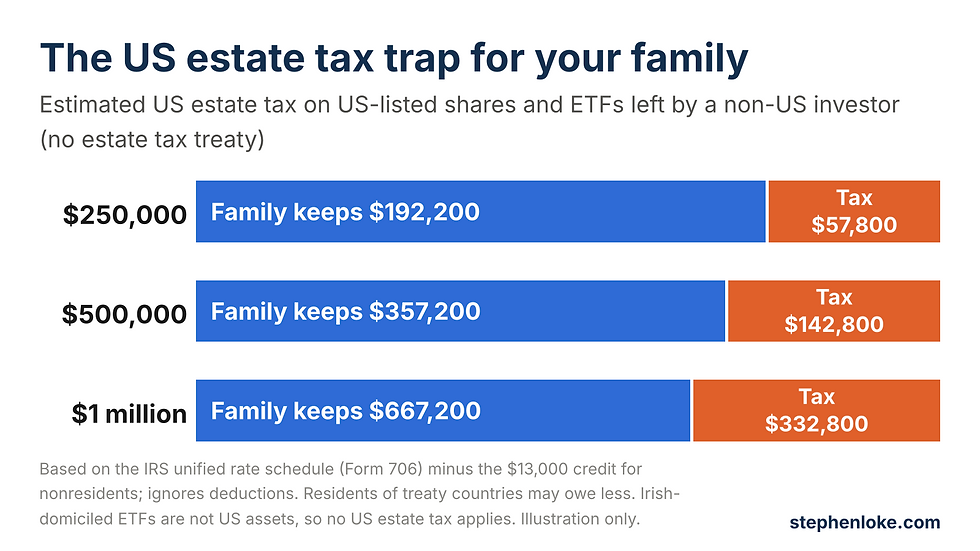
On a US$500,000 holding, the estimated tax is about US$142,800. On US$1 million, it is about US$332,800, a third of everything you built.
And the money doesn't just get taxed. It gets stuck. Under US regulations, a US company or transfer agent should not transfer shares registered to a deceased non-resident without a transfer certificate from the IRS, unless the US estate is small enough to fall under the US$60,000 line. Your grieving family may need a US lawyer, a US tax filing and months of waiting before they can touch a single share.

Now the good part. The IRS's own instructions say that shares of corporations organised outside the US count as property located outside the US. Shares of an Irish-domiciled ETF are therefore not US assets for this tax. Ireland also has its own exemption: under Section 75 of its Capital Acquisitions Tax Act, units of Irish funds are exempt from Irish inheritance tax when neither the person who died nor the heir is domiciled or ordinarily resident in Ireland.
Some countries, including the UK, Japan, Australia and Canada, have estate tax treaties or treaty provisions with the US that can reduce or remove this problem. Malaysia and Singapore do not.
Reality check Buying a US-listed ETF through a Malaysian or Singaporean broker, a trading app or a robo-adviser does not change where the fund is based. VOO is still a US asset. If your goal is to pass money to your children, the wrapper matters more than the brand of the app. |
I also suggest you don't keep your investments a secret from your spouse or children. If it feels awkward, my guide on how to tell your spouse you lost money in the stock market has a script for honest money conversations that works just as well for good news.
Trap No. 3: Currency Swings, Friend, Foe, or Both?
When you buy the S&P 500 from outside America, you own US-dollar assets. Your results are measured in your home currency. That adds a second ride on top of the stock market.
The ringgit was pegged at 3.80 to the dollar until July 2005. It was about 4.47 at the end of 2024, then rose more than 9% in 2025 to finish near 4.06. The Singapore dollar has strengthened against the US dollar for most of the past two decades. The yen has weakened. So how much did currency matter over 20 years?

Currency changed the score. It did not change the story. In every one of these currencies, patient S&P 500 investors multiplied their money six to ten times over 20 years, because the growth of the underlying companies overwhelmed the currency swings.
Three practical rules:
Don't try to time the exchange rate. Nobody does it reliably, including central banks.
Invest a fixed amount every month. You automatically buy at a mix of good and bad exchange rates. I compare this approach with investing all at once in Lump Sum or Monthly? How to Put Money Back Into the Market After a Big Loss.
Watch the conversion cost. Some brokers charge a wide spread when they change your ringgit or dollars into US dollars. Ask before you open the account.
Trap No. 4: Fees That Look Small and Eat Big
A 1.8% yearly fee sounds tiny. It isn't.
Take US$100,000 invested for 30 years at 10% a year before costs. In a fund charging 0.07% a year, it grows to about US$1.71 million. In a fund that takes a 5% sales charge upfront and 1.8% a year, a fee structure still common across Asia, it grows to about US$1.01 million. That is roughly US$700,000 lost to fees, for owning the same 500 companies.
The index doesn't care who sells it to you. Your goal is a total yearly cost under 0.2%, including fund fees, platform fees and currency conversion.
Which Door Fits Where You Live? A Quick Country Guide
This table is a starting point for your own research, not personal tax advice. Rules change, so confirm the details for your situation.
Where you live | US tax on dividends if you buy US-listed ETFs directly | A sensible door to research first |
|---|---|---|
Malaysia | 30% (no US treaty) | Irish UCITS ETF (CSPX, VUAA, SPYL) through a Securities Commission-licensed broker with London access |
Singapore | 30% (no US treaty) | Irish UCITS ETF on the London Stock Exchange, or an Irish-domiciled fund listed on SGX |
United Kingdom | 15% | Irish UCITS ETF with UK reporting fund status, inside an ISA (up to £20,000 a year) |
Australia | 15% | ASX-listed iShares S&P 500 ETF (IVV), Australian-domiciled |
Canada | 15% | TSX-listed S&P 500 ETF such as VFV, XUS or ZSP |
Japan | 10% | eMAXIS Slim US Equity (S&P 500) or similar inside a NISA (¥3.6 million a year) |
India | 25% | Domestic S&P 500 funds when open, or overseas ETFs under the US$250,000 a year LRS limit |
European Union | Usually can't buy (PRIIPs) | Irish UCITS ETF |
Not sure which door applies to you? Walk through this 60-second check:
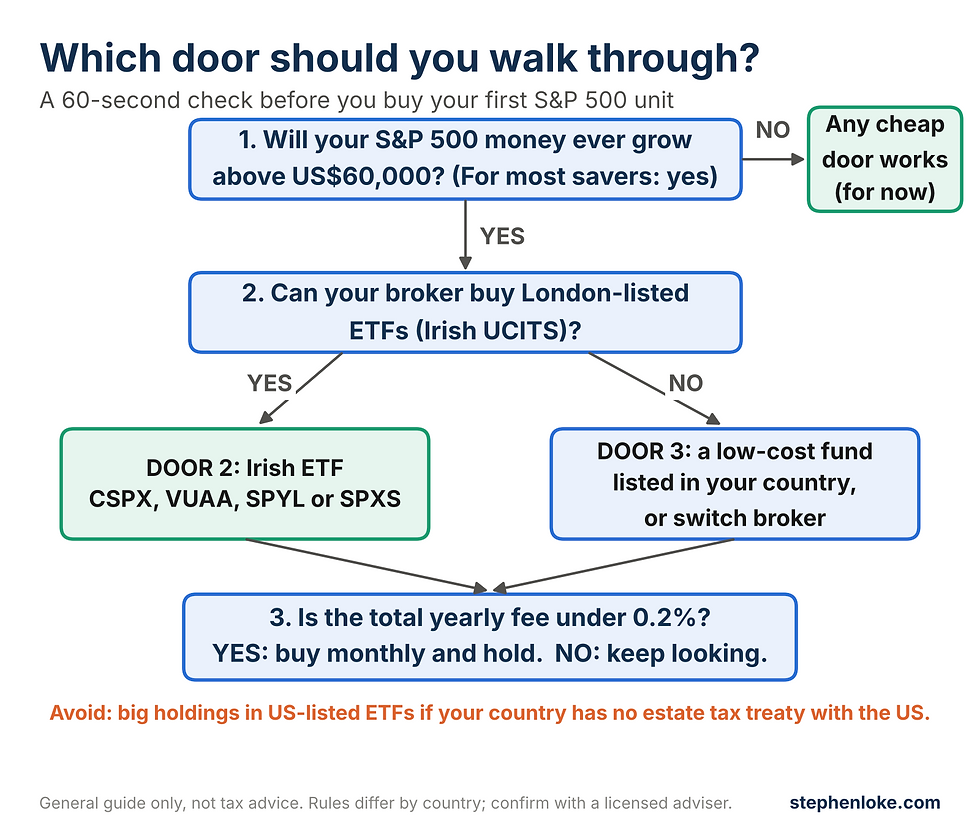
A few local notes worth knowing:
Malaysia: Malaysian resident individuals don't pay tax on capital gains from shares, and foreign-sourced income they receive is currently exempt until 31 December 2036, subject to conditions. Confirm your situation with LHDN or a tax adviser.
Singapore: there is no capital gains tax, and foreign-sourced income received by individuals is generally tax-exempt. The 30% US dividend tax is the cost that remains, which is why the fund's home matters.
United Kingdom: choose funds with UK "reporting fund" status. If a fund doesn't have it, HMRC can tax your gains as income instead of capital gains.
Your 7-Step Plan to Own the S&P 500 From Anywhere
Here is the whole process on one page. Print it.
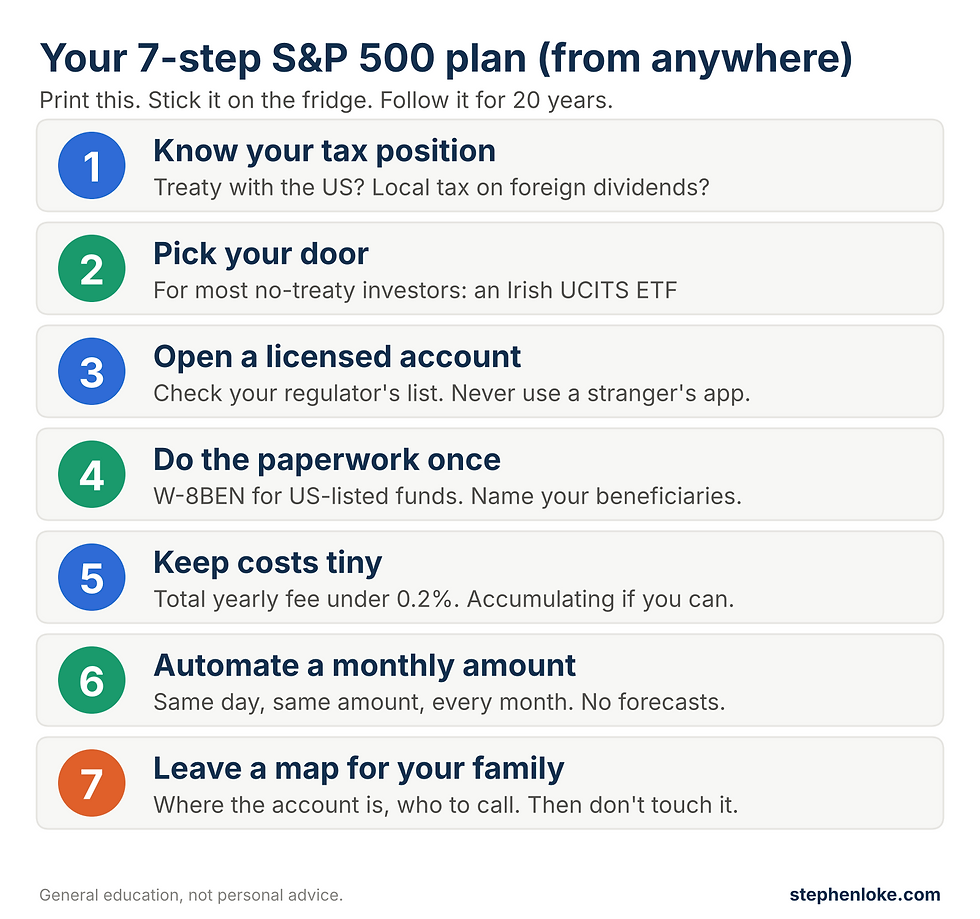
Step 1: Know your tax position
Find out two things: does your country have an income tax treaty with the US, and how does your country tax foreign dividends and gains? Ten minutes on your tax authority's website, or one conversation with an adviser, can be worth tens of thousands of dollars.
Step 2: Pick your door
Use the country guide and the flowchart above. For most investors in Malaysia, Singapore and other no-treaty countries, an Irish-domiciled UCITS ETF is the natural first choice. If your home market has a cheap local S&P 500 fund, as in Australia, Canada or Japan, that may be simpler still.
Step 3: Open a licensed account
Use a broker that is licensed by your own country's regulator. In Malaysia, check the Securities Commission's list of licensed firms. Never send money to an "account manager" you met on Facebook, Instagram, WhatsApp or Telegram. Malaysian police recorded RM1.47 billion lost to investment fraud in 9,603 cases in 2025, with fake stock investments the most common type. I explain the warning signs in 7 Signs You're Gambling in the Stock Market, Not Investing.
Step 4: Do the paperwork once
If you buy any US-listed fund, complete the W-8BEN. Fill in your beneficiary or nominee details wherever your broker allows it. Make a simple will that mentions your investment accounts.
Step 5: Keep costs tiny
Aim for a total yearly cost under 0.2%. If you are building wealth and don't need income, consider an "accumulating" share class, such as CSPX, VUAA or SPYL. These reinvest dividends inside the fund automatically, so you never have to decide what to do with small payouts.
Step 6: Automate a monthly amount
Pick an amount you can keep investing in good times and bad, then set it to happen on the same day each month. See what steady monthly investing can grow into in What $500 a Month in an S&P 500 Index Fund Becomes After 10, 20 and 30 Years.
Step 7: Leave a map for your family, then don't touch it
Write down where your accounts are, which broker holds them and who to call. Tell the person who will need to know. Then leave the money alone through every scary headline. When the market falls, read The Market Just Dropped 20%. Here's What Calm Investors Do Next before you do anything else.
6 Costly Mistakes Non-US Investors Make
Building a large position in US-listed ETFs without knowing about the estate tax. It is the most expensive mistake on this list, and your family pays for it, not you.
Forgetting the W-8BEN. If your country has a treaty, you may pay twice the dividend tax you need to.
Paying 1.5% or more a year for an S&P 500 "feeder" fund when an Irish ETF costs 0.03% to 0.07%.
Trying to time the exchange rate. Waiting for "a better ringgit" has cost many people years of compounding.
Chasing hot stocks instead of the index. If that sounds familiar, read Why Smart People Lose Money in the Stock Market.
Selling in a panic. Every crash in the 50-year chart above felt permanent at the time. None of them were.
Frequently Asked Questions
Can I invest in the S&P 500 from Malaysia?
Yes. Malaysians can buy S&P 500 ETFs through brokers licensed by the Securities Commission that offer US or London market access. There is no S&P 500 ETF listed on Bursa Malaysia as of 2026, so most Malaysians use either a US-listed ETF such as VOO or an Ireland-domiciled UCITS ETF such as CSPX, VUAA or SPYL. Because Malaysia has no tax treaty with the US, many long-term investors prefer the Irish versions.
Is VOO or CSPX better for non-US investors?
Both track the S&P 500. VOO charges 0.03% a year but is a US fund, so investors from countries without a US treaty pay 30% tax on its dividends and may face US estate tax above US$60,000. CSPX charges 0.07% but pays only 15% on US dividends inside the fund, reinvests dividends automatically and is not a US asset for estate tax. For many non-US investors, especially in Malaysia and Singapore, CSPX is the better long-term fit.
Do non-US investors pay US capital gains tax on S&P 500 ETFs?
Generally, no. A non-US citizen who does not live in the US and is not present there for 183 days or more in the year does not pay US tax on gains from selling US shares or ETFs. The US taxes dividends, not capital gains, for most overseas investors. Your own country may still tax gains, so check local rules.
What is the US estate tax limit for non-US investors?
For people who are neither US citizens nor US residents, a US estate tax return is required if US-situated assets exceed US$60,000 at death. US stocks and US-listed ETFs count. The tax rate rises to a top rate of 40%. Some countries have estate tax treaties with the US that reduce this. Ireland-domiciled ETFs are not US assets for this purpose.
What is the W-8BEN form and do I need it?
The W-8BEN is a US tax form that tells your broker you are not a US person and claims any treaty-reduced tax rate on US income such as dividends. If you hold US-listed funds or shares, you need one on file. It is normally valid until the end of the third calendar year after you sign it.
Should I choose an accumulating or distributing S&P 500 ETF?
Accumulating funds reinvest dividends automatically, which suits people building wealth for the long term and keeps things simple. Distributing funds pay dividends out in cash, which can suit retirees who want income. The tax treatment of each type depends on your country, so check before choosing.
How much money do I need to start investing in the S&P 500?
Very little. Many brokers now let you buy fractional shares or invest small regular amounts, sometimes from around RM100 or US$50 a month. The amount matters less than the habit. A small sum invested every month for 20 years usually beats a large sum invested once and then abandoned.
The Bottom Line: One Boring Decision, Made Well
In 1976, the experts laughed at Jack Bogle's little index fund. It raised a fraction of what he hoped and couldn't even afford all 500 stocks. Today that idea manages trillions of dollars and is the backbone of retirement plans from Tokyo to Toronto.
You don't need to live in America to share in what American companies build. You don't need to pick stocks, read charts or watch the news. You need to make one good decision about which door to walk through, set up a monthly habit, and give it time.
Go back to the two friends at the start. They owned the same companies and earned the same returns. One family kept almost everything. The other lost a large slice of it and spent months waiting. The only difference was the wrapper.
Choose yours with care. Then stay in the room.
FREE REPORT: Why You Lost Money in the Stock Market (And Why It Wasn't Your Fault) Before you invest another dollar, ringgit or pound, find out exactly which traps drain ordinary investors, so they never catch you again. My free report reveals the 7 Wall Street traps that quietly drain ordinary investors, the "small" fee that can swallow a third of your retirement, and the one boring strategy the industry hopes you never discover. Written in plain English for investors over 40, wherever you live. 100% free. Instant download. No credit card. |
Important: This article is for education only and is not personal financial, investment, legal or tax advice. Tax rules differ by country and change over time. Past performance does not guarantee future results. Figures in the charts are illustrations based on historical data and stated assumptions, before local taxes and currency effects unless noted. Please consider your own situation and speak with a licensed adviser before investing.
Sources
The Edge Malaysia: Navigating taxation in global investing (March 2026)
MSCI: A Complete Geographic Breakdown of the MSCI ACWI IMI (data as of 30 June 2026)
Investing.com: Goldman analyzes foreign sales exposure of U.S. firms (July 2025)
Aswath Damodaran, NYU Stern: Historical Returns on Stocks, Bonds and Bills, 1928-2025
Aswath Damodaran: Data Update 2 for 2026, Equities Get Tested and Pass Again (January 2026)
Morningstar: The index fund turns 50, how Jack Bogle changed investing forever (August 2026)
S&P Dow Jones Indices: SPIVA Australia Scorecard Year-End 2025
Mitsubishi UFJ Asset Management: eMAXIS Slim US Equity (S&P 500) passes ¥10 trillion (January 2026)
The Korea Herald: Korean investors pile into US stocks despite weaker won (January 2026)
DigitalToday: Korean retail investors' U.S. stock holdings top $200 billion again (October 2026)
Asia Economy: Mirae Asset TIGER US S&P500 ETF surpasses 20 trillion won (July 2026)
The Korea Times: More young Koreans look to stocks, bonds as retirement nest egg (September 2026)
Value Research: Motilal Oswal restricts investments in its international funds (January 2022)
Outlook Money: Why Indian investors face a shrinking international fund menu (July 2026)
International Adviser: Expats hit as funds suspended over missing PRIIPs documents (January 2018)
justETF: US-domiciled ETFs, why they are no longer available from many online brokers (March 2018)
Fintech News Malaysia: Moomoo Malaysia passes one million users (July 2025)
The Edge Malaysia: Rakuten Trade, US stock trading attracts investors' interest (2022)
Invesco: Synthetic ETF infographic, US withholding tax on swaps
StashAway Malaysia: Guide to ETFs in Malaysia (February 2026)
The Smart Investor: Xtrackers brings S&P 500 and other ETFs to SGX (October 2026)
IRS: Some nonresidents with U.S. assets must file estate tax returns
IRS: Transfer certificate filing requirements for estates of nonresidents
Irish Statute Book: Capital Acquisitions Tax Consolidation Act 2003, Section 75
Ministry of Finance Malaysia: Economic Report 2005/2006, ringgit peg
Malaysiakini/Bernama: Ringgit closes 2024 at 4.47 (December 2024)
Free Malaysia Today: Ringgit ends 2025 on a high note (December 2025)
PwC Tax Summaries: Malaysia, individual income determination
PwC Tax Summaries: Singapore, individual income determination
Reserve Bank of India: Liberalised Remittance Scheme master direction
Malay Mail/Bernama: Investment fraud losses hit RM1.47 billion (April 2026)


Comments