Warren Buffett's Advice for 99% of Investors Fits in One Sentence. Almost Nobody Follows It


On September 18, 2026, a 96-year-old man in Omaha quietly handed over the last of his titles.
Warren Buffett became Chairman Emeritus of Berkshire Hathaway. His son Howard became Chairman. Greg Abel had already been running the company as CEO since January 1. In his farewell letter, Buffett summed up the moment in four words: "Father Time always wins."
Within hours, the tributes poured in. Commentators replayed his greatest hits: Coca-Cola, American Express, Apple, the bargains he scooped up in 2008. Every list was about stocks he picked.
But here is the strange part. For ordinary people, Buffett's most valuable advice was never a stock. It was a single sentence. He repeated it, in one form or another, for more than 30 years. He put it in writing. He wrote it into his will. He even made a million-dollar bet on it, and won.
And yet almost nobody follows it.
Not the professionals who manage trillions of dollars. Not the wealthy families paying for "superior" advice. Not the millions of everyday investors who own index funds and still manage to earn less than the funds they own.
This article is about that sentence. Where it came from, the hard evidence behind it, the five forces that pull smart people away from it, and a simple plan to make it work for you. Read it slowly. The ideas here have quietly built more retirements than any hot tip ever has.
In this article, you will discover:
The exact instruction Buffett left for his wife's inheritance, and why it is not Berkshire stock
The $1 million bet that embarrassed some of the smartest money managers on Wall Street
Why 93 out of 100 professional fund managers lost to a "dumb" index over 20 years
How a fee that sounds tiny can quietly take one-third of your retirement
The five psychological traps that make people ignore the best advice they will ever get
A five-step plan you can set up in about an hour, and then mostly leave alone
Jump to a section:
The One Sentence (and Where Buffett Actually Said It)
In his 2013 letter to Berkshire shareholders, Buffett did something unusual. He described the instructions in his own will.
His Berkshire shares, he explained, are going to charity. So the money set aside for his wife will be paid in cash to a trustee. And his advice to that trustee was almost comically simple: put 10% in short-term government bonds and "90% in a very low-cost S&P 500 index fund." He even named Vanguard's fund as his suggestion.
Think about that. The most famous stock picker alive did not tell his trustee to buy Coca-Cola, or Apple, or Berkshire. He did not ask for a star fund manager. He asked for the cheapest possible way to own the 500 largest companies in America, and to leave it there.
He went further. He predicted that this plain approach would beat the results of most investors who hire high-fee managers, including pension funds, institutions and wealthy individuals.
This was not a one-time remark. In his 1993 letter, Buffett wrote that by investing regularly in an index fund, "the know-nothing investor can actually out-perform most investment professionals." In his 2014 letter, he praised the investor who buys a low-cost index fund and simply sits tight for decades. In his 2016 letter, he told both large and small investors to stick with low-cost index funds.
Put all of those letters side by side, and his advice for the vast majority of us boils down to one sentence:
Buy a very low-cost S&P 500 index fund, keep buying it, and leave it alone for decades.

That sentence has four working parts, and each one matters. Low cost, because every dollar of fees is a dollar that never compounds for you. The S&P 500, because it gives you a slice of 500 large companies in one purchase. Keep buying, because regular investing turns market drops into sales. And leave it alone, because, as you are about to see, most of the damage people do to their money happens when they touch it.

The Veteran's Note Buffett is not saying the stock market is safe, or that it only goes up. The S&P 500 fell 37% in 2008 alone. What he is saying is more subtle and more useful: you cannot reliably beat the average, so own the average as cheaply as possible, and let time do the heavy lifting. The 10% in short-term government bonds is the shock absorber. It gives a trustee, or you, cash to live on when stocks are down, so nobody is forced to sell at the worst moment. |
Why "99%"? Who This Advice Is For
Buffett has always drawn a clear line between two kinds of investors.
On one side are professionals: people with the time, training, temperament and resources to study businesses full-time. On the other side are non-professionals: people with jobs, families, farms, businesses and lives. In his 2013 letter, he said plainly that the non-professional's goal should not be to pick winners. It should be to own a cross-section of businesses that, in aggregate, are bound to do well.
That second group is almost everyone. If you are reading this after a long day at work, you are in it. So am I, most days. So are most doctors, engineers, lawyers and business owners, no matter how intelligent they are.
Here is the twist that should make all of us humble. As you will see in a moment, most of the professionals do not beat the index either. So when we say this advice fits 99% of investors, we are being generous to the remaining 1%.
The $1 Million Bet That Proved It
Back in 2007, Buffett did something no Wall Street critic had dared to do. He put his money where his mouth was.
He publicly offered a 10-year bet. On his side: a plain, low-cost Vanguard S&P 500 index fund, bought and never touched. On the other side: any professional who believed they could pick a group of hedge funds that would do better.
At first, nobody stepped forward. Then Ted Seides, co-manager of a New York firm called Protégé Partners, accepted. On December 19, 2007, the wager was set.
Each side paid $318,250 for zero-coupon U.S. Treasury bonds that would be worth $500,000 at the end of 2017. The combined $1 million would go to the winner's chosen charity. Buffett's was Girls Inc. of Omaha.
Protégé did not pick one fund. It picked five "funds-of-funds," and those five owned stakes in more than 200 hedge funds. By Buffett's own description, this was a team of exceptionally smart, confident and motivated people. They could fire managers and hire new stars whenever they liked. And they were paid handsomely. Fixed fees averaged about 2.5% of assets per year, plus a share of the profits.
The hedge funds got off to a flying start. In 2008, as Lehman Brothers collapsed, the index fund lost 37%. Every one of the five funds-of-funds lost less.
Then the tables turned. From 2009 onward, the group as a whole fell behind the index fund every single year.

When the decade ended, the scoreboard was brutal. The index fund was up 125.8%, or 8.5% a year. The best of the five funds-of-funds was up 87.7%. The worst managed just 2.8% over nine years before it was liquidated.

There was one more twist. In 2012, bond yields had fallen so low that the Treasury bonds backing the bet were paying less than 1% a year. Buffett and Protégé agreed to sell them and buy 11,200 Berkshire B shares instead. The result: Girls Inc. of Omaha received $2,222,279 in early 2018, more than double the original $1 million.
To his credit, Seides was gracious in defeat. In 2017, before the bet even ended, he conceded in a Bloomberg column. He agreed that hedge fund fees are too high, though he argued that comparing hedge funds to a pure stock index was like comparing apples and oranges, since hedge funds aim to protect money in falling markets.
That is a fair point for a pension fund trying to smooth its returns. But for a person trying to grow wealth for retirement over 10, 20 or 30 years, the result speaks for itself. Buffett summed up the lesson in seven words that every investor should memorize: "Performance comes, performance goes. Fees never falter."
Remember This More than 200 brilliant, highly motivated professionals made tens of thousands of buy and sell decisions over ten years. Buffett made one decision and then did nothing. Nothing won. His own conclusion was to stick with big, easy decisions and avoid constant activity. That is the whole game for most investors. |
If you want to go deeper on how individual stock picking stacks up over two decades, read Stock Picking vs. the S&P 500: What 20 Years of Results Say About Who Actually Wins.
The Professionals' Report Card: 20 Years of Evidence
You might say one bet is one bet. Maybe Protégé was simply unlucky.
So let us look at the biggest scorecard in the industry. Since 2002, S&P Dow Jones Indices has published its SPIVA reports, which compare actively managed funds against their benchmarks, after fees. Its latest U.S. report, published in March 2026, covers results to December 31, 2025.

The numbers are hard to argue with. In 2025 alone, 79% of active large-cap U.S. stock funds underperformed the S&P 500. That was the fourth-worst year for active managers in the 25-year history of the reports. Stretch the time frame and it gets worse: about 86% lagged over 10 years, 90% over 15 years and 93% over 20 years.
Read that last number again. Over 20 years, roughly 93 out of every 100 professionally managed large-cap funds failed to beat a list of 500 companies that changes only a few times a year.
And it is worse than it looks. SPIVA also tracks how many funds even survive. Of the large-cap funds that existed 20 years ago, only about 35% were still around at the end of 2025. The rest were merged into other funds or quietly closed, usually after poor results. Those funds do not show up in glossy brochures. Their investors simply woke up one day to find their money moved somewhere else.
What about picking last year's winners? SPIVA's Persistence Scorecard shows that today's top performers rarely stay on top. Among small-cap funds, for example, only 2% of top-quarter performers stayed in the top quarter over five years. Choosing a fund because it did well recently is a little like choosing a horse because it won the last race. It feels sensible. It rarely works.
The Silent Thief: What Fees Do to Your Money Over 30 Years
Why do so many smart professionals lose to an index? Part of the answer is simple arithmetic.
Before costs, all investors together own the whole market, so together they earn the market's return. After costs, the average investor must earn less. Every dollar paid in fees, trading costs and taxes comes out of the investor's pocket. The index fund simply pays the least.
How big is the gap? According to the Investment Company Institute, the average stock index mutual fund charged 0.05% a year in 2025, while the average actively managed U.S. stock fund charged 0.64%. Many large S&P 500 index funds charge even less. Vanguard's S&P 500 ETF charges 0.03%, or $3 a year on every $10,000 invested.
A gap of half a percent sounds like nothing. Over decades, it is everything. Look at what happens to $100,000 over 30 years when the market earns the same 8% a year before costs, and the only difference is the fee.

Annual cost | Typical example | $100,000 after 30 years |
|---|---|---|
0.05% | Low-cost index fund | $992,383 |
0.64% | Average active stock fund | $841,928 |
1.64% | Active fund plus a 1% adviser fee | $635,843 |
2.50% | Hedge fund-style fixed fees | $498,395 |
Same market. Same 30 years. The investor paying 1.64% a year ends up with about $356,540 less than the index investor. That is the price of a house in many places, handed over a little at a time, in fees that never appear as a bill.
Buffett put real numbers on this in his 2016 letter. He estimated that wealthy individuals, pension funds and college endowments had wasted more than $100 billion over the previous decade searching for superior investment advice. In the same letter, he paid tribute to the man who made cheap investing possible for everyone: if a statue is ever built to honor the person who has done the most for American investors, "the hands-down choice should be Jack Bogle."
There is an old Wall Street story that captures this perfectly. In his 1940 book Where Are the Customers' Yachts?, Fred Schwed told of a visitor to New York who was shown the beautiful yachts belonging to the bankers and brokers in the harbor. The visitor looked around and asked a simple question: where were the customers' yachts? Eighty-six years later, the question still stands.
Your Move Ask whoever manages your money one plain question: "How much did I pay last year in total, in dollars, for fund fees, adviser fees and trading costs?" Not a percentage. Dollars. If the answer takes more than a minute to find, or makes you wince, you have just found the first leak in your retirement plan. |
So Why Does Almost Nobody Follow It?
Now for the uncomfortable question.
If the evidence is this strong, and the advice is this simple, why is it so rarely followed? You might object that index funds are booming. And you would be right. According to Morningstar, passive funds overtook active funds in total U.S. fund assets at the end of 2023, and held more than 55% of assets by the end of 2025.
But owning an index fund and following Buffett's sentence are two very different things. Nearly four in ten American adults, 38% according to Gallup in 2025, own no stocks at all. Millions more own index funds but trade in and out of them at the worst possible times. And millions of others treat the market like a casino.
In over half a century of market history, the same five forces keep pulling people away from the one sentence that would serve them best.

Force 1: It Is Too Boring to Feel Smart
Human beings are wired to believe that difficult problems need complicated solutions. If you are trying to secure your retirement, it feels wrong that the answer could fit on an index card.
The financial media makes this worse. A television channel cannot fill 24 hours a day by saying "nothing has changed, keep holding." Excitement sells advertising. Patience does not.
The economist Paul Samuelson is often credited with saying that investing should be like watching paint dry or grass grow, and that people who want excitement should take a small sum to Las Vegas instead. He was right. If your portfolio is thrilling, it is probably costing you.
Even Benjamin Graham, the father of value investing and Buffett's own teacher, came around late in life. In a 1976 interview, shortly before he died, Graham said he was no longer an advocate of elaborate stock analysis for finding bargains. He said he now largely sided with the academics who argued that the market is very hard to beat.
Force 2: Everyone Thinks They Are Above Average
Ask a room full of drivers whether they are better than average, and most will raise their hands. Investing is no different.
In a landmark study published in the Journal of Finance in 2000, professors Brad Barber and Terrance Odean examined the accounts of 66,465 households at a large discount broker from 1991 to 1996. The average household turned over about 75% of its stock portfolio every year. The most active 20% of traders earned a net return of 11.4% a year. The market earned 17.9%.
The people who worked hardest, read the most and traded the most did the worst. Their confidence was not an asset. It was a cost.
If you have ever felt that pull, you are in very good company. I have written about it at length in Why Smart People Lose Money in the Stock Market: 8 Mental Traps and How to Escape Them, and the results for frequent traders are even more sobering in Why Most Day Traders Lose Money, and the Boring Alternative That Quietly Wins.
Force 3: Wall Street's Sales Machine Does Not Profit From It
A low-cost index fund is a wonderful product for the buyer and a terrible product for the seller. There are no big commissions, no exciting stories to sell and very little to talk about at the annual review.
The industry's reaction to the very first index fund tells you everything. In 1976, Jack Bogle, who had been fired from his previous firm two years earlier, launched the First Index Investment Trust at his new company, Vanguard. He hoped to raise $150 million. He raised $11.3 million. Critics mocked it as "Bogle's Folly." Some called indexing un-American, a sure path to mediocrity. The bankers who sold the offering reportedly wanted to give the money back.
That fund became the Vanguard 500 Index Fund. This year marks its 50th anniversary, and indexing has changed the financial world. But notice how long it took, and how hard the industry fought it. Your adviser, your bank and your favorite financial website may all have good intentions. They also have bills to pay. Simple, cheap advice rarely pays them.
Force 4: Fear Makes People Sell at the Bottom
This is the most expensive force of all, and it catches even people who own index funds.
Every year, Morningstar compares the returns of funds with the returns their investors actually earn, after the timing of their buying and selling. Its 2026 study covered the ten years to December 31, 2025. Funds earned 9.9% a year. The average investor in those funds earned 8.7%. That gap of 1.2 percentage points a year came purely from bad timing: buying after prices rose, selling after they fell.

Here is the part that surprises people. Index fund investors had a gap too, of 1.1 points a year. Owning the right fund is not enough. Buffett's sentence has a second half, leave it alone, and that half is where most people fail.
DALBAR, which has tracked investor behavior for decades, shows how wildly this swings. In 2024, the average stock fund investor trailed the S&P 500 by 8.48 percentage points. In 2025, the gap shrank to 0.72 points, the smallest since 2012. The market did not change its nature between those two years. Investor behavior did.
Why is panic selling so costly? Because the market's best days tend to arrive right next to its worst days, when fear is at its peak. J.P. Morgan Asset Management studied $10,000 invested in the S&P 500 from January 2006 to December 2025.

Stay invested for those 20 years, and $10,000 grew to $80,619. Miss just the 10 best days, and you ended with $35,866, less than half. Miss the 30 best days and you had $13,826. Six of the 10 best days happened within two weeks of the 10 worst days. The person who sold in a panic was almost always out of the market when the rebound came.
If the market is falling as you read this, please read The Market Just Dropped 20%. Here's What Calm Investors Do Next before you touch anything.
Force 5: The Casino Itch
The final force is the oldest one: the itch to get rich quickly.
Buffett has long described the stock market as a church with a casino attached. At Berkshire's annual meeting in May 2026, he told CNBC that the casino side had never been more tempting. Pointing to one-day options and the explosion of betting-style products, he said, "we've never had people in a more gambling mood than now."
Every cycle has its version. In 1999 it was internet stocks. In 2021 it was meme stocks and crypto coins with cartoon dogs. Today it is same-day options and prediction markets. The faces change. The ending rarely does.
The cruel irony is that the gambler and the index investor are often the same person, just at different moments. Someone holds an index fund for three years, gets bored, sees a friend's screenshot of a big win, and moves "just a little" into something exciting. If you recognize yourself here, take the honest test in 7 Signs You're Gambling in the Stock Market, Not Investing.
Reality Check None of these five forces is a character flaw. They are normal human wiring. Boredom, confidence, trust, fear and hope served our ancestors well. They are terrible financial advisers. The investors who succeed are not braver or smarter. They simply build a system that keeps these forces away from the controls. |
The People Who Did Follow It
Is it really possible to follow Buffett's advice for decades? Yes. Here are three very different people who did.
The pension manager who did "nothing." In 2016, the Wall Street Journal profiled Steve Edmundson, the investment chief of Nevada's Public Employees' Retirement System, then a $35 billion fund. His philosophy, as the paper described it, was to do as little as possible, usually nothing. He held most of the fund in low-cost index funds, did not chase the latest market news, and even brought his lunch from home. His returns compared well with much larger and more expensive state pension systems, including California's, the largest public pension system in the country. A former holder of his job noted that doing nothing is much harder than it looks.
The man the industry laughed at. Jack Bogle lost his job in 1974. Two years later, he launched an idea that Wall Street mocked. He spent the rest of his life telling ordinary people to buy the whole market, keep costs low and stay the course. By the time he died in 2019, the investors who listened to him had saved enormous sums in fees, and Buffett had publicly called him the person who had done the most for American investors.
The billionaire's own family. Buffett could hire any investment manager on earth for his wife's inheritance. He could leave instructions to buy his favorite stocks. Instead, he wrote down the same simple sentence he had been giving everyone else. When the world's most famous investor chooses an index fund for the people he loves most, that tells you something.
Notice what these three have in common. None of them was trying to be clever. Each of them built a simple system and then had the discipline to leave it alone. If you want to see how simple habits built Buffett's own fortune, read Why Warren Buffett Still Lives in the Same House, and Why That Made Him $100 Billion.
What Buffett's Sentence Looks Like in Real Money
Let us make this concrete. Suppose you had read Buffett's 2013 letter when it came out in early 2014 and put $10,000 into an S&P 500 index fund at the start of that year, reinvesting the dividends.
Here is what happened next, year by year.
Year | S&P 500 total return | What it felt like |
|---|---|---|
2014 | +13.7% | A solid year |
2015 | +1.4% | Flat and frustrating |
2016 | +12.0% | Election fears, then a rally |
2017 | +21.8% | Smooth sailing |
2018 | -4.4% | A sharp fall in December |
2019 | +31.5% | A big rebound |
2020 | +18.4% | A pandemic crash, then recovery |
2021 | +28.7% | Euphoria |
2022 | -18.1% | The worst year since 2008 |
2023 | +26.3% | Recovery |
2024 | +25.0% | Records again |
2025 | +17.9% | Tariff scare in April, then 39 record highs |
By the end of 2025, that $10,000 had grown to about $45,900, a return of roughly 13.5% a year before fund fees and taxes. The investor did not need to predict the pandemic, the 2022 inflation shock or the 2025 tariff scare. They only needed to stay put.
Now, a word of honesty that you will not hear from people selling courses. Those 12 years were unusually good. Over the long run, the S&P 500 has delivered far less: according to the table in Buffett's own 2017 letter, it compounded at 9.9% a year with dividends from 1965 through 2017. Future returns could easily be lower than the last decade. Plan with modest numbers, and treat anything better as a bonus.
The real lesson of the table is not the final number. It is the two negative years in the middle. In each of them, plenty of people sold, convinced that this time was different. They turned a temporary paper loss into a permanent real one. The patient investor simply kept buying at lower prices.
Curious what steady monthly investing looks like over longer periods? Read What $500 a Month in an S&P 500 Index Fund Becomes After 10, 20 and 30 Years.
Your Buffett Plan: 5 Steps You Can Set Up This Week
Knowing the sentence is easy. Following it is the hard part. The secret is to make the right behavior automatic, so you do not have to rely on willpower when markets get scary.
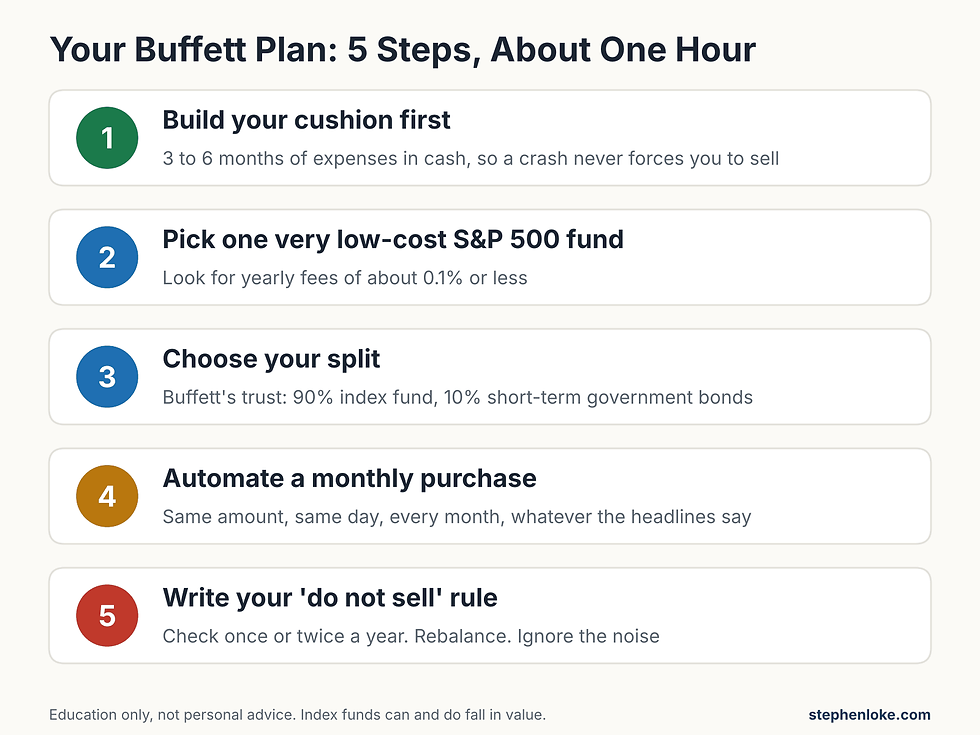
Step 1: Build your cushion first. Before you invest a single dollar in stocks, set aside three to six months of living expenses in cash or a high-quality savings account. This is your version of Buffett's 10% in short-term government bonds. Its job is to make sure a job loss, an illness or a broken roof never forces you to sell stocks during a crash.
Step 2: Pick one very low-cost S&P 500 fund. Look for an annual expense ratio of about 0.1% or less. For investors with access to U.S. funds, the large S&P 500 funds from providers like Vanguard, iShares and SPDR are among the cheapest investments ever created. If you live outside the United States, the right choice depends on where the fund is based, tax treaties and estate rules in your country. I explain the options step by step in How to Invest in the S&P 500 If You Live Outside the United States.
Step 3: Choose your split. Buffett's split for his wife's trust was 90% stocks and 10% short-term bonds. That suits money meant to last a long time. Money you will need within the next five years should not be in stocks at all. Many investors nearing retirement hold more in bonds or cash so they can sleep at night. There is no perfect number. The best split is one you will still be holding after the next 30% drop.
Step 4: Automate a monthly purchase. Set up an automatic investment for the same amount on the same day every month. When prices are high, your money buys fewer shares. When prices fall, it buys more. You stop asking "is now a good time?" because the answer is always "it's the 5th of the month." If you have a lump sum to invest and are nervous about timing, read Lump Sum or Monthly? How to Put Money Back Into the Market After a Big Loss.
Step 5: Write your "do not sell" rule. Take a sheet of paper and write: "I will not sell my index fund because of the news. I will check my account once or twice a year, rebalance back to my chosen split, and otherwise leave it alone." Sign it. Tape it inside a cupboard. It sounds silly. It works, because the decision is made when you are calm, not when the headlines are screaming.
Before You Start The S&P 500 holds only U.S. companies, and today a large share of it sits in a handful of giant technology firms. Some investors prefer a total world index fund for broader diversification, and that is a perfectly sensible choice that follows the same spirit of Buffett's advice: broad, cheap and held for decades. What matters most is not the exact index. It is low cost, regular buying and the discipline to stay put. |
If you have been burned before and are nervous about starting again, my guide Index Funds for People Who've Been Burned: A Plain-English Guide to Starting Over walks you through it gently.
The Tree You Plant Today

Buffett has often said that someone sits in the shade today because someone else planted a tree a long time ago.
This year, two things turned 50 and 96. The first index fund, once mocked as Bogle's Folly, celebrated its 50th birthday. And the greatest investor of our time, at 96, finally stepped aside.
Between them, they left us the same gift. Not a hot stock. Not a secret system. A sentence.
Buy a very low-cost S&P 500 index fund, keep buying it, and leave it alone for decades.
It will never make you the most interesting person at a dinner party. It will not give you a thrilling story about the stock that tripled. What it will give you is something far more valuable: a very good chance of beating most professionals, most hedge funds and most of your neighbors, while spending almost no time thinking about money at all.
Almost nobody follows it. That is exactly why it works so well for the few who do.
FREE REPORT: Why You Lost Money in the Stock Market (And Why It Wasn't Your Fault) If you have lost money before, you are not foolish. You were up against a system designed to separate ordinary investors from their savings. My free report reveals the 7 Wall Street traps that quietly drain ordinary investors, and the one boring strategy the industry hopes you never discover. Read it before you invest another dollar. |
Important: This article is for education only and is not personal financial, investment or tax advice. Past performance does not guarantee future results. Fee illustrations are hypothetical and assume a constant return with no taxes. Index funds can and do lose value. Please consider your own situation and speak with a licensed adviser before investing.
Frequently Asked Questions
What is Warren Buffett's one-sentence advice for ordinary investors?
In plain English, it is to buy a very low-cost S&P 500 index fund, keep buying it regularly, and hold it for decades. He has repeated versions of this advice in his shareholder letters since at least 1993, and in his 2013 letter he applied it to his own wife's inheritance.
What is Buffett's 90/10 rule?
In his 2013 letter, Buffett said the trustee for his wife's inheritance should put 10% of the cash in short-term government bonds and 90% in a very low-cost S&P 500 index fund. The bonds act as a cash cushion so the trust is never forced to sell stocks in a downturn.
Did Buffett win his $1 million bet against hedge funds?
Yes. From 2008 through 2017, his S&P 500 index fund gained 125.8%, or 8.5% a year. The five hedge fund-of-funds chosen by Protégé Partners gained between 2.8% and 87.7%. Girls Inc. of Omaha received $2,222,279.
Why doesn't Buffett just buy index funds for Berkshire Hathaway?
Buffett is a full-time professional with unusual advantages, including permanent capital and the ability to buy entire companies. His index fund advice is aimed at non-professionals who do not have the time, training or resources to analyze businesses.
Is it a bad time to buy an S&P 500 index fund when the market is near record highs?
Nobody can reliably predict short-term moves. The market spends a lot of time near record highs because it tends to rise over long periods. Investing a fixed amount every month spreads your purchases over good and bad periods. Only invest money you will not need for at least five years.
Can I follow Buffett's advice if I live outside the United States?
Yes, through S&P 500 index funds or ETFs available on your local exchange or through an international broker. Pay attention to fees, where the fund is based, withholding taxes and estate rules in your country.
Is an S&P 500 index fund safe?
It is diversified, not risk-free. The S&P 500 fell 37% in 2008 and 18% in 2022. Over long periods it has recovered and grown, but it can lose value for years at a time. That is why Buffett paired it with short-term government bonds.
How much money do I need to start?
Many brokers let you buy S&P 500 ETFs for the price of a single share, and some allow fractional shares for just a few dollars. Starting small and investing every month matters far more than the size of your first investment.
Sources
Warren Buffett, 2013 Letter to Berkshire Hathaway Shareholders
Warren Buffett, 1993 Letter to Berkshire Hathaway Shareholders
Warren Buffett, 2014 Letter to Berkshire Hathaway Shareholders
Warren Buffett, 2016 Letter to Berkshire Hathaway Shareholders
Warren Buffett, 2017 Letter to Berkshire Hathaway Shareholders (final results of the bet)
S&P Dow Jones Indices, U.S. Persistence Scorecard Year-End 2025
Investment Company Institute, Trends in the Expenses and Fees of Funds, 2025
Barber and Odean, "Trading Is Hazardous to Your Wealth," Journal of Finance (2000)
CNBC, Hedge fund manager loses bet against Buffett (May 2017)
Jason Zweig, Birth of the Index Mutual Fund: Bogle's Folly Turns 40
Newser, summarizing the Wall Street Journal on Nevada PERS (October 2016)


Comments