How to Invest in the S&P 500 From Malaysia: Brokers, Fees and Taxes, Step by Step


It usually starts with a Facebook ad. A smiling "professional trader" promises easy US stock profits. You click, you're moved into a WhatsApp group, and the screenshots of winning trades look real.
In 2025, Malaysians lost RM1.47 billion to investment scams across 9,603 police cases, and fake stock investment schemes led the list. The age groups hit hardest? People aged 41 to 60.
Here's the frustrating part. The real way to own America's 500 biggest companies from Malaysia is cheap, legal and almost boring. To invest in the S&P 500 from Malaysia, open an account with a Securities Commission-licensed app (such as Moomoo MY, Webull MY or Rakuten Trade) or an established global broker such as Interactive Brokers, convert some ringgit to US dollars, and buy a low-cost S&P 500 ETF such as VOO, IVV or the Irish-domiciled CSPX. Then add to it every month and leave it alone.
That's the whole strategy. The rest of this guide is about doing it without paying more fees and tax than you need to, and without walking into the traps that catch so many Malaysians.
The short answer ✔ No S&P 500 ETF is listed on Bursa Malaysia today, so you buy one on a US or London exchange through a broker. ✔ Easiest route: an SC-licensed app buying a US-listed ETF (VOO, IVV, SPY). ✔ Most tax-efficient route for bigger, long-term money: an Irish-domiciled ETF such as CSPX, through a broker with London Stock Exchange access. ✔ Malaysia currently doesn't tax your US gains, and qualifying foreign income is exempt until 31 December 2036. The big US costs are the 30% dividend withholding tax and US estate tax above US$60,000. ✔ Buy monthly or quarterly, keep fees tiny, and never send money to a "trader" in a chat group. |
Why Malaysians are buying the S&P 500
The S&P 500 is a basket of 500 of the largest companies listed in the United States. When you buy one S&P 500 fund, you own a small slice of all of them in one go.
For Malaysians, the attraction is simple. Over the 10 years to 2025, the S&P 500 returned about 10.47% a year, while our own FBM KLCI returned about minus 1.82% a year, according to figures published by StashAway Malaysia.
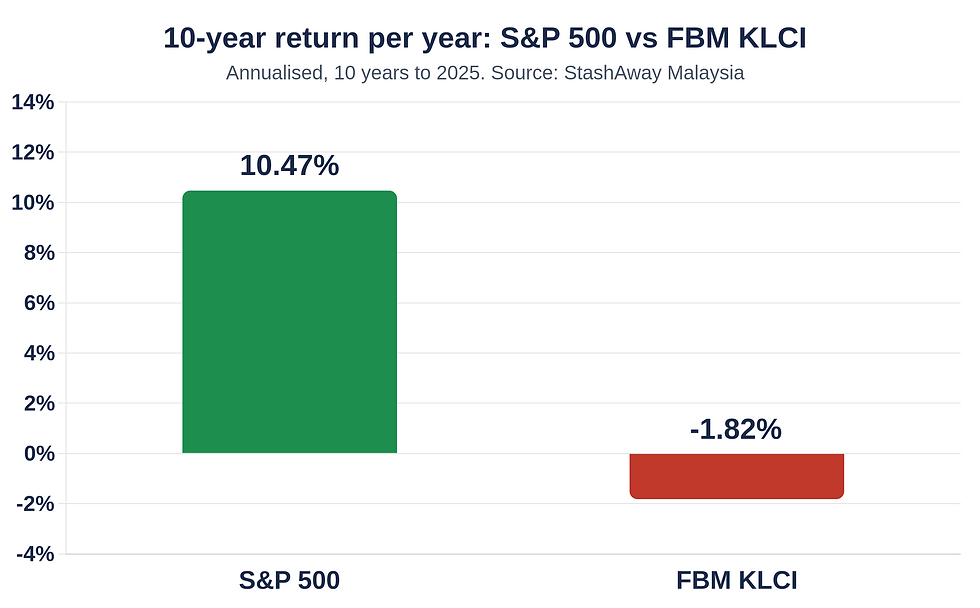
Professionals rarely beat it either. S&P Dow Jones Indices found that 79% of active large-cap US funds trailed the S&P 500 in 2025 alone. Over the 15 years to the end of 2024, about 89.5% of them fell behind.
That's why Warren Buffett told most investors to own a low-cost S&P 500 index fund, and why he won a million-dollar bet against hedge funds with one. If you want the full numbers, read stock picking vs. the S&P 500 over 20 years.
It is not a straight line up. The index can fall 20%, 30% or even 50% in a bad year. But it has never lost money over any rolling 20-year period since 1926. Time is the ingredient that makes it work.
The 3 ways to invest in the S&P 500 from Malaysia
You have three main doors. Each has a different mix of cost, convenience and protection.
Route | Examples | What you buy | Best for |
1. Local SC-licensed app | Moomoo MY, Webull MY, Rakuten Trade, M+ Global | US-listed ETFs (VOO, IVV, SPY) | Beginners who want a Malaysian-regulated app |
2. Global broker | Interactive Brokers (IBKR) | US-listed or Irish-domiciled ETFs (CSPX, VUAA) | Larger, long-term portfolios that care about tax |
3. Done-for-you | Robo-advisers such as StashAway, or S&P 500 feeder unit trusts | A managed portfolio or fund | People who want zero decisions and accept higher fees |
Route 1 is the most popular. Moomoo Securities Malaysia, for example, holds a Capital Markets Services Licence from the Securities Commission Malaysia. You fund it in ringgit, convert to US dollars inside the app and buy.
Route 2 gives you the widest choice. Interactive Brokers accepts Malaysian residents but isn't licensed by the SC. Your account is held with Interactive Brokers LLC in the US, which is regulated by the SEC and FINRA and is a SIPC member (protection up to US$500,000, including US$250,000 in cash, if the broker fails). That's not protection against market losses.
Route 3 is the "set and forget" option. Robo-advisers charge an annual management fee on top of the fund fees, and many unit trusts charge more still. Over 20 years, that difference can add up to tens of thousands of ringgit.
To put a number on it, StashAway Malaysia's published management fee runs from about 0.8% a year on smaller balances down to 0.2% on very large ones, before the underlying ETF costs. That's a fair price for convenience and automatic rebalancing. Just know you're paying it every year, and that a do-it-yourself ETF costs a fraction of that.
Smart move If you're unsure whether a broker or "fund manager" is legitimate, search its name on the Securities Commission's Investor Alert List and its list of licensed entities before you send a single ringgit. Scam groups often clone the names of real firms. |
Step-by-step: how to invest in the S&P 500 from Malaysia
Here's the exact order I'd follow if I were starting from zero tonight.

Step 1: Make sure you're ready
Before you buy anything, have three to six months of expenses in an emergency fund. Pay off credit card debt first, because no index fund reliably beats an 18% interest rate.
Only invest money you won't need for at least five to ten years. If you've been hurt by the market before, read index funds for people who've been burned first.
Step 2: Check your Bank Negara limit
Bank Negara Malaysia's foreign exchange rules matter here. If you have no "domestic ringgit borrowing", you can generally invest any amount abroad.
If you do have it, you can convert up to RM1 million a year into foreign currency assets. Good news: one home loan, one car loan and credit card balances don't count. A second mortgage or a personal loan does. Most people investing monthly will never come close to the limit, but your broker will ask you to declare your status.
Step 3: Choose your S&P 500 ETF
All of these track the same 500 companies. The differences are cost, where the fund is legally based, and how dividends are handled.
ETF | Where it's based | Annual fee | Dividends | US estate tax exposure |
VOO (Vanguard) | United States | 0.03% | Paid out in cash | Yes, above US$60,000 |
IVV (iShares) | United States | 0.03% | Paid out in cash | Yes, above US$60,000 |
SPY (SPDR) | United States | about 0.09% | Paid out in cash | Yes, above US$60,000 |
CSPX (iShares) | Ireland, traded in London | 0.07% | Reinvested inside the fund | No |
VUAA (Vanguard) | Ireland, traded in London | 0.07% | Reinvested inside the fund | No |
Irish-domiciled funds look slightly more expensive on paper. After tax, they often come out ahead for Malaysians. I'll show you exactly why in the tax section.
Step 4: Choose your broker
Fees change often, so check each broker's own pricing page before you sign up. Here's the picture as of October 2026.
Broker | Regulated in Malaysia? | US trading fee (summary) | Can buy Irish ETFs like CSPX? |
Moomoo MY | Yes (SC licence) | 0% for the first 180 days, then 0.03% plus US$0.99 platform fee per order | No |
Webull MY | Yes (SC licence) | 0% commission on US trades promo until 31 Dec 2026 | No |
Rakuten Trade | Yes (SC licence) | Flat tiers from RM1 up to an RM100 cap (or US$0.88 to US$25) | No |
Interactive Brokers | No (US-regulated) | From US$0.005 per share, US$1 minimum on the fixed plan | Yes |
Two extra Malaysian costs catch people out with local brokers. First, 8% SST applies to commission, platform and clearing fees from 1 October 2025. Second, Malaysian stamp duty applies to US trades through local brokers: RM1 for every RM1,000, capped at RM200 per contract note for foreign ETFs at Moomoo MY.
Step 5: Open your account and sign the W-8BEN
You'll need your MyKad, a selfie, proof of address and a Malaysian bank account. Most apps approve you within a day.
During sign-up, you'll sign a US tax form called the W-8BEN. It tells the US you're not an American taxpayer.
Here's what many Malaysian blogs get wrong: the W-8BEN does not cut your dividend tax to 15%. Malaysia has no income tax treaty with the US, so the default 30% rate still applies to your dividends. The form simply keeps you correctly classified.
Step 6: Fund your account and convert ringgit
Transfer ringgit from your bank (DuitNow or FPX in most apps), then convert to US dollars. Compare the exchange rate the app gives you with Bank Negara's rate for the day. The gap is a hidden fee.
Don't try to time the ringgit. In 2026 alone, it has swung between about RM3.88 and RM4.15 to the US dollar. Nobody can predict those moves reliably, so regular buying smooths them out.
Step 7: Place your first order
US markets open at 9:30pm Malaysian time during US daylight saving (roughly March to early November) and 10:30pm the rest of the year. They close at 4am or 5am our time.
Use a limit order at or near the current price, so you never pay a silly price in a fast market. Many local apps also let you buy fractional shares, so you can start with a few hundred ringgit.
Step 8: Automate it and leave it alone
Pick a fixed day each month or quarter to buy. That habit, called dollar-cost averaging, takes emotion out of the decision. If you have a lump sum, read lump sum or monthly before you commit it.
Then the hardest step of all: do nothing when headlines scream. Save what calm investors do after a 20% drop for the day you'll need it.
The real cost of buying RM1,000 a month
Small fees feel harmless. Let's put real numbers on a RM1,000 monthly purchase at about RM4.08 to the US dollar (Bank Negara's rate in early October 2026), using Moomoo MY's standard pricing after its free period.
Cost item | Buy RM1,000 every month | Buy RM3,000 every quarter |
Amount in US dollars | about US$245 | about US$735 |
Commission (0.03%) | US$0.07 | US$0.22 |
Platform fee | US$0.99 | US$0.99 |
8% SST on fees | US$0.09 | US$0.10 |
Stamp duty (RM1 per RM1,000) | about US$0.25 | about US$0.74 |
Total per purchase | about US$1.40 (0.57%) | about US$2.05 (0.28%) |
See the difference? Because the platform fee is fixed, buying every quarter instead of every month cuts your trading cost roughly in half. Use the free-commission periods while they last, then consider buying less often in bigger chunks.
The fund's own annual fee is the cost that never stops. At 0.03% to 0.07% a year, an S&P 500 ETF costs RM30 to RM70 a year on RM100,000. A fund charging 1.5% a year would take RM1,500 from the same amount, every single year.
Smart move Before you pick any fund, write down its total yearly cost in ringgit on RM100,000. Seeing "RM70" next to "RM1,500" makes the right choice obvious. |
Taxes: the part most Malaysians get wrong
Taxes are where a Malaysian investor can quietly lose a big slice of returns. There are two countries to think about: Malaysia and the United States.
Malaysian tax: mostly good news
Malaysia doesn't tax individuals on gains from selling listed shares. So if you buy an S&P 500 ETF and sell it later at a profit, there's currently no Malaysian capital gains tax on that.
Foreign-sourced income received in Malaysia by resident individuals is exempt until 31 December 2036, subject to conditions set by LHDN. The exemption was extended from 2026 by a gazette order published in December 2024.
That exemption has a story worth remembering. In Budget 2022, the government proposed taxing foreign income from 1 January 2022, which caused real alarm among investors. Two months later, it reversed course and granted the exemption. Rules can change, so build a plan that still works if they do.
US dividend tax: the 30% you may not have noticed
Every time a US-domiciled ETF like VOO pays a dividend, 30% is withheld before the money reaches you. You pay no US tax on capital gains as a non-resident. The withholding only bites on dividends.
An Irish-domiciled ETF works differently. Thanks to the US–Ireland tax treaty, the fund pays only 15% US withholding on the dividends it receives, and Ireland doesn't withhold anything further from non-resident investors.

On a US$100,000 portfolio yielding around 1.2%, that's roughly US$180 a year saved. CSPX's slightly higher fee (0.07% vs 0.03%) costs about US$40 a year. The tax saving wins.
The Edge Malaysia compared Vanguard's US-domiciled S&P 500 ETF with its Irish twin from 2013 to 2024. The Irish fund's cumulative return was 183.89% against 180.71% for the US fund. Small, but it went the right way, and the next tax is far bigger.
US estate tax: the trap that hits your family
This is the one almost nobody talks about. If you die holding more than US$60,000 (about RM245,000) of US-situs assets, which includes US shares and US-domiciled ETFs like VOO, your estate can owe US estate tax at rates up to 40%.
That US$60,000 exemption for non-residents has been frozen since 1976. US citizens get millions. Malaysians get US$60,000. And there's no Malaysia–US estate tax treaty to soften it.
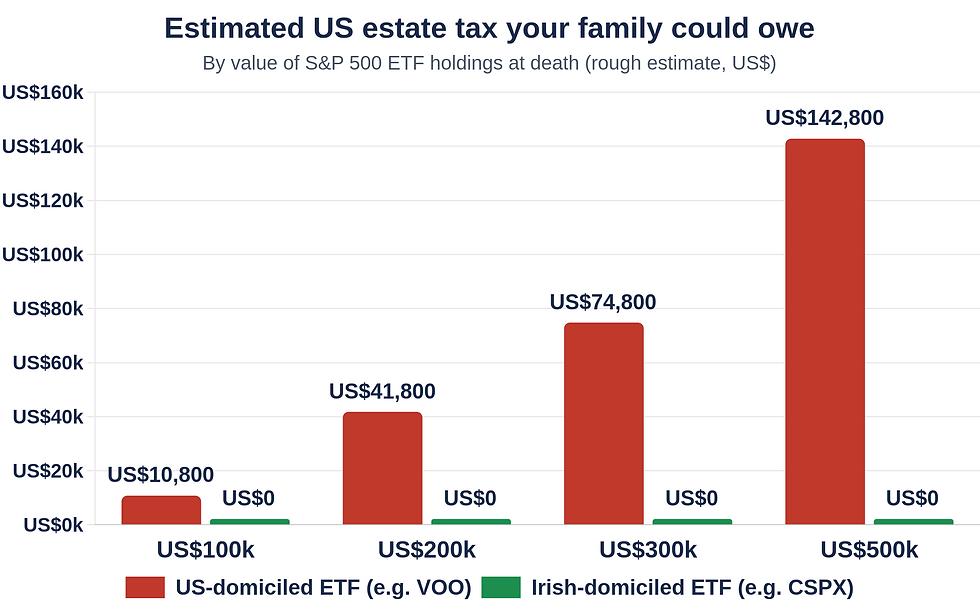
US-domiciled holdings at death | Estimated US estate tax | Irish-domiciled ETF |
US$60,000 | US$0 | US$0 |
US$100,000 | about US$10,800 | US$0 |
US$200,000 | about US$41,800 | US$0 |
US$300,000 | about US$74,800 | US$0 |
US$500,000 | about US$142,800 | US$0 |
Your family would also have to deal with a US filing (Form 706-NA) within nine months of death before the broker releases the money. Irish-domiciled ETFs are not US-situs assets, so they sit outside this tax completely.
Keep this in mind This is general education, not tax or legal advice. Tax rules for your situation can differ. If your US holdings could pass US$60,000, speak to a licensed Malaysian tax adviser about domicile, nominations and your will. |
VOO or CSPX: which one should a Malaysian choose?
Here's a calm way to decide.
Choose a US-listed ETF like VOO or IVV if you're starting small, you want a Malaysian-regulated app, and your US holdings will stay well under US$60,000 for now. It's simple, cheap and liquid.
Choose an Irish-domiciled ETF like CSPX or VUAA if you expect your portfolio to grow past US$60,000, you're investing for 10 years or more, and you're comfortable with a global broker like Interactive Brokers. You'll keep more of your dividends, and your family avoids the US estate tax trap.
Some investors start with VOO in a local app, then switch new money to CSPX once their US holdings approach US$60,000. That's a reasonable middle path. For more on the safety of these fund giants, see what happens if Vanguard goes bankrupt.
What RM1,000 a month could grow into
Nobody knows future returns. But here's what steady monthly investing has looked like at different average yearly returns, so you can see the power of time.

After 25 years, RM300,000 of contributions could become around RM693,000 at 6% a year, RM951,000 at 8% or RM1.33 million at 10%. Most of the final figure comes from growth, not from your deposits.
That's why starting late isn't a reason to give up. Even 15 years gives compounding real room to work. If you're over 50 and worried, read is it too late to retire comfortably. You'll also find more figures in what $500 a month becomes after 10, 20 and 30 years.
What about the ringgit? Currency risk explained
When you own an S&P 500 ETF, you own US dollar assets. So your result in ringgit depends on two things: how the 500 companies do, and how the ringgit moves against the US dollar.
If the ringgit strengthens, your US holdings are worth fewer ringgit. If it weakens, they're worth more. Over a single year, currency moves can add or subtract several percentage points from your return.
Here's the calm way to think about it. Over 10 or 20 years, company earnings growth usually matters far more than currency swings. And for many Malaysians, holding some wealth in US dollars is a useful balance to having your salary, EPF savings, home and bank deposits all in ringgit.
Don't convert everything at once and don't wait for a "perfect" rate. Regular monthly or quarterly conversions mean you buy at a spread of exchange rates, high and low, so no single bad day decides your result.
7 costly mistakes Malaysians make with the S&P 500
Trusting a chat-group "trader". No legitimate investment needs you to join a WhatsApp or Telegram group run by a stranger. If someone blocks your withdrawals and asks for "processing fees", it's a scam. Call the National Scam Response Centre on 997.
Using an unlicensed platform. Check the SC's Investor Alert List first. If a platform isn't licensed in Malaysia, know exactly which regulator protects your money instead.
Buying leveraged S&P 500 ETFs. Products that promise two or three times the daily move can lose far more than the index in choppy markets. They are trading tools, not retirement investments.
Ignoring US estate tax. Letting a VOO holding drift to RM800,000 without a plan could hand a big cheque to the US government instead of your children.
Paying 1% to 2% a year when 0.07% is available. High-fee funds don't buy you better results. They buy someone else's holiday.
Trying to time the ringgit or the market. Waiting for "the right exchange rate" or "the next crash" usually means buying later at a higher price.
Selling in a panic. The S&P 500 has recovered from every crash in its history. The investors who lost money were often the ones who sold at the bottom.
Your "do this tonight" checklist
Confirm you have an emergency fund and no high-interest debt.
Decide your monthly or quarterly amount (start with what you can keep up for 10 years).
Pick your route: a local SC-licensed app with VOO or IVV, or Interactive Brokers with CSPX or VUAA.
Check the broker on the SC website and read its current fee page.
Open the account, sign the W-8BEN and declare your domestic ringgit borrowing status.
Transfer ringgit, convert to US dollars and place a limit order after 9:30pm.
Set a calendar reminder for your next purchase date, then close the app.
Frequently asked questions
Can Malaysians legally invest in the S&P 500?
Yes. Malaysian residents can buy S&P 500 ETFs through SC-licensed brokers such as Moomoo MY, Webull MY or Rakuten Trade, or through global brokers like Interactive Brokers. If you have domestic ringgit borrowing, Bank Negara limits conversions into foreign assets to RM1 million a year.
What is the minimum amount to start?
With fractional shares on many local apps, you can start with a few hundred ringgit. But fixed per-order fees eat into very small purchases, so many investors buy every quarter instead of every month once any free-commission period ends.
Is there an S&P 500 ETF on Bursa Malaysia?
As of October 2026, no ETF tracking the S&P 500 is listed on Bursa Malaysia. Malaysians buy S&P 500 ETFs listed in the US or London through a broker, or use robo-advisers and unit trusts that invest in them.
Do I pay tax in Malaysia on S&P 500 profits?
Currently, Malaysia doesn't tax individuals on gains from selling listed shares, and foreign-sourced income received by resident individuals is exempt until 31 December 2036, subject to LHDN conditions. The main taxes come from the US side: dividend withholding and estate tax.
Does the W-8BEN reduce my US dividend tax to 15%?
No. Malaysia has no income tax treaty with the United States, so US dividends paid to Malaysians are withheld at 30% even with a W-8BEN. The 15% rate applies inside Irish-domiciled ETFs, thanks to the US–Ireland treaty.
Which is better for Malaysians, VOO or CSPX?
VOO is simple and very cheap for smaller amounts. CSPX usually suits larger, long-term portfolios because it pays 15% instead of 30% US dividend tax inside the fund and isn't exposed to US estate tax above US$60,000.
What happens to my US shares if I die?
If your US-situs assets, including US-domiciled ETFs, exceed US$60,000, your estate may owe US estate tax of up to 40% and must file a US return before the broker releases them. Irish-domiciled ETFs avoid this US tax.
A calm way forward
If the market has hurt you before, I understand why "invest in the S&P 500" might feel like one more promise. But this isn't a hot tip or a trading system. It's the opposite: owning a tiny piece of 500 real businesses, paying almost nothing in fees, and letting time do the heavy lifting.
You don't need a WhatsApp guru. You need a licensed broker, a low-cost ETF, a monthly habit and the patience to leave it alone. If you'd like the global version of this guide, read how to invest in the S&P 500 if you live outside the United States.
About the author
Stephen Loke has been a student of the market for more than 15 years. He is also an agritourism entrepreneur whose farm has been featured in Bloomberg News and Asahi Shimbun.
This article is general education, not personal financial, tax or legal advice. I'm not a licensed financial adviser. Fees, tax rules and broker offers change, so check the latest details with each provider and a licensed professional before you invest.
Before you invest another ringgit, find out what really went wrong last time. My free 38-page report, "Why You Lost Money in the Stock Market (And Why It Wasn't Your Fault)", reveals the 7 Wall Street traps that quietly drain ordinary investors, and the one boring strategy the industry hopes you never discover.
Sources
Bukit Aman CCID via Malay Mail: Investment fraud losses hit RM1.47b (April 2026)
The Vibes: Over 9,000 Malaysians lose RM1.37 billion to non-existent investment scams (Jan 2026)
StashAway Malaysia: How Malaysians can start investing in the S&P 500
Ritholtz Wealth Management: SPIVA large-cap data to Dec 2024
Malaysia4U: Moomoo Malaysia review 2026 (SST and licence details)
Malaysia4U: Investment brokers guide 2026 (Rakuten Trade, StashAway and IBKR fees)
Investing in the Web: Interactive Brokers regulation for Malaysian residents
Fintech News Malaysia: BNM RM1 million foreign currency asset limit
Bloomberg Tax: Malaysia gazettes order extending foreign income exemption
iMoney: US stocks from Malaysia, the 30% you may not have accounted for
StashAway Singapore: Dividend withholding tax and estate tax on US equities
The Sun: Bursa Malaysia ETF line-up and foreign ETF listing plan


Comments