Buffett Has Handed Over the Keys to His Trillion-Dollar Empire. Is His Famous Advice Now Out of Date?


It was the last few minutes of a long Saturday in Omaha. On 3 May 2025, a 94-year-old Warren Buffett told a packed arena that "the time has arrived" for Greg Abel to take over as chief executive of Berkshire Hathaway at the end of the year.
Thousands of people stood and clapped for minutes. On the next trading day, Berkshire shares fell as much as 7%.
Then, on 18 September 2026, came the last step. Buffett, now 96, gave up the chairman's seat too, with four words that every investor over 50 felt in their stomach: "Father Time always wins."
If Buffett is the reason you finally stopped gambling on hot stocks and bought a boring index fund, you may be asking a quiet, worried question tonight.
Is his famous advice now out of date?
The short answer No. Buffett's advice to ordinary people was never "buy Berkshire". It was "own a low-cost index fund and hold it for decades". That advice does not depend on Buffett being alive, in charge, or even right about any single stock. His exit actually proves the point. Even the greatest stock picker in history had to retire. The S&P 500 does not retire, does not need a successor, and does not care who runs Berkshire. What does need an update in 2026 is how you apply his advice: the index is more top-heavy than ever, investors outside the US face taxes he never mentioned, and his famous 90/10 split was written for a billionaire's widow, not for you. |
What actually happened: the handover, date by date
Many pages about this were written in 2025 and are now out of date. Some still say Buffett is chairman. He isn't.
Here is the full handover, in order.

3 May 2025: the surprise announcement
At the very end of the 2025 annual meeting, Buffett said he would ask the board to make Greg Abel CEO at year end. The board agreed the next day, and also decided Buffett would stay on as chairman.
10 November 2025: "going quiet"
In his Thanksgiving letter, Buffett said he would no longer write Berkshire's famous annual letter or talk for hours at the annual meeting. In his words, he was "going quiet". He promised to keep writing a Thanksgiving message each year.
1 January 2026: Abel becomes CEO
For the first time since 1965, someone other than Warren Buffett ran Berkshire Hathaway. Abel was 63. Buffett stayed on as chairman and kept coming to the office five days a week.
28 February 2026: Abel's first letter
The annual letter, read by investors for 60 years, was written by someone new for the first time. Abel promised continuity, kept the no-dividend policy, and said the giant cash pile was ammunition kept ready for opportunities, not a sign that Berkshire had stopped investing.
2 May 2026: Abel's first annual meeting
Buffett sat in the audience instead of on stage. The arena was about half as full, according to Fortune, but long-time shareholders gave Abel good reviews for his grip on the businesses.
14 July 2026: the 2034 deadline
Buffett announced he would give away all of his remaining Berkshire shares, worth roughly $140 billion, to four family foundations by 31 December 2034.
18 September 2026: the final step
Buffett stepped down as chairman and became chairman emeritus, an honorary title. He stays on the board. His son Howard Buffett, a Berkshire director since 1993, became chairman.
So, is Buffett still chairman of Berkshire Hathaway? No. Since 18 September 2026, Buffett has been chairman emeritus and remains a director. Howard Buffett is chairman. Greg Abel has been CEO since 1 January 2026. |
Who is running the trillion-dollar empire now
Berkshire is worth roughly $1 trillion. It owns GEICO, the BNSF railway, a huge energy business, dozens of manufacturers and shops, and a stock portfolio of more than $250 billion. Here are the people now holding the keys.
Greg Abel, CEO (born 1962)
A Canadian accountant from Edmonton, Abel spent years building Berkshire Hathaway Energy into one of North America's biggest utility groups. Buffett made him vice chairman of all the non-insurance businesses in 2018.
Abel is an operator, not a stock picker. That matters, and we'll come back to it.
Howard Buffett, chairman (born 1954)
Howard is a farmer, conservationist and philanthropist. He has no management role. His job is to guard Berkshire's culture. When the Wall Street Journal asked him about that culture in 2025, he said: "It's not rocket science." Keep things simple, treat people fairly, tell the bad news first.
Ajit Jain and Adam Johnson
Vice chairman Ajit Jain still runs insurance, the heart of Berkshire. Adam Johnson, who led NetJets, is now president and oversees the consumer, services and retail businesses.
What Abel has actually done in his first 10 months
Investors feared Abel would sit on Buffett's cash forever, or do something reckless with it. So far he has done neither.
He restarted buybacks. Berkshire bought back $235 million of its own shares in the first quarter of 2026, its first buybacks since 2024, then about $4.5 billion in the second quarter.
He became a buyer of stocks again. In the second quarter, Berkshire bought nearly $20 billion more stock than it sold, its first quarter of net buying after 14 straight quarters of net selling.
He made his first big deal. Berkshire bought the homebuilder Taylor Morrison, and added billions to its stake in Alphabet, Google's parent company.
The cash pile came down, a little. Cash and short-term Treasury bills fell from a record $397.4 billion at the end of March 2026 to $365.5 billion at the end of June.
He kept the old rules. No dividend, no quarterly earnings calls, and no break-up. Asked at the May meeting whether Berkshire should ever be split up, Abel answered: "Absolutely not."
In his first letter, Abel wrote that "we will always aim for ownership of productive businesses over U.S. Treasuries." That is pure Buffett. Berkshire's third-quarter numbers are due in early November, so watch that space.
What this means for you If you own Berkshire shares, the company is being run carefully, by people Buffett chose himself. If you don't own Berkshire shares, none of this changes a single thing in your retirement plan. Keep reading to see why. |
The scoreboard nobody likes to show you
Here is the uncomfortable part, and most articles skip it.
Over six decades, Buffett's record is the best of any large investor in modern history. From 1965 to 2025, Berkshire shares rose 19.7% a year, against 10.5% a year for the S&P 500 with dividends. Over the whole period, that is a gain of 6,099,294% for Berkshire against 46,061% for the index.
But look at the recent years.
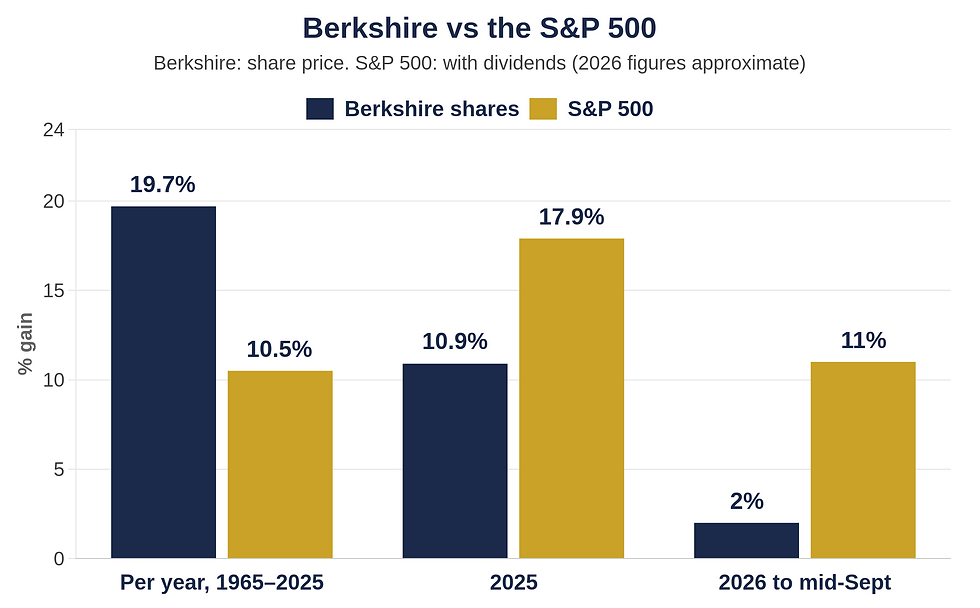
In 2025, Buffett's final year as CEO, Berkshire rose 10.9% while the S&P 500 returned 17.9%. In 2026, by mid-September, Berkshire's B shares were up about 2% for the year while the S&P 500 was up about 11%.
Is that a disaster? Not necessarily. The Motley Fool counted nine years since 1990 when Berkshire finished 10 or more points behind the index. In seven of those nine, Berkshire beat the index the following year.
But here is the lesson that matters for you.
Buffett himself never promised to beat the market by much
For years, Buffett and Charlie Munger wrote that their goal was for Berkshire's value to grow at a rate that would, over time, modestly exceed the S&P 500. Modestly. From the greatest investor alive.
Now ask yourself: if Berkshire itself only hopes to beat the index by a little, what are the odds that a stock tip from a WhatsApp group, a Telegram "signal" or a unit trust agent will do better?
That is exactly why Buffett gave ordinary people completely different advice from what he did himself. If you want the full story of that contradiction, read why the world's greatest stock picker tells ordinary people not to pick stocks.
The advice Buffett actually gave you
Strip away the headlines and Buffett's advice to non-professionals comes down to three moments, all in his own words or his own money.
No. 1: The 1996 letter
In his 1996 letter to shareholders, Buffett wrote that the best way for most people to own stocks is through an index fund with very low fees. He said those who follow this path will beat the net results of most investment professionals.
No. 2: The instructions in his will (2013)
In his 2013 letter, Buffett revealed the instructions he left for the trustee who will manage his wife's inheritance: put 10% in short-term government bonds and "90% in a very low-cost S&P 500 index fund."
He also explained the thinking behind it. The goal of a non-professional, he wrote, should not be to pick winners, but to own a cross-section of businesses that, taken together, are bound to do well.
Read that again. When the world's greatest stock picker planned for the people he loves most, he did not tell them to buy Berkshire. He told them to buy the index.
No. 3: The $1 million bet (2008 to 2017)
In 2007, Buffett bet $1 million that a plain S&P 500 index fund would beat a group of hedge funds, chosen by the professionals at Protégé Partners, over the 10 years from 2008 to 2017, after all fees.
It wasn't close. The index fund returned 7.1% a year. The five funds of hedge funds averaged 2.2% a year. The winnings, which had grown to about $2.2 million, went to Girls Inc. of Omaha.

Notice something about all three. None of them depends on Buffett running Berkshire. You could hand the keys to anyone at all, and the bet would still have been won, and the will would still say "index fund".
If you want the full, dramatic story of the bet, here it is: how a boring index fund beat five teams of Wall Street's highest-paid money managers.
Five reasons his retirement makes the advice stronger, not weaker
Reason No. 1: The advice was about the market, not the man
Buffett's career is a story about one man's skill. His advice is a story about the market's power. Those are two different things.
Berkshire needs a great leader. The S&P 500 doesn't. It is simply about 500 of the largest US companies, and if one of them is badly run, it shrinks in the index, and eventually is replaced.
Reason No. 2: An index fund has no "key person" risk
For decades, analysts talked about a "Buffett discount": the fear that Berkshire's value depended on one man's heartbeat. Since he announced he would step down as CEO, the price-to-book value of Berkshire shares has slipped from about 1.62 to 1.53, according to LSEG data.
Your S&P 500 fund has never had that problem, and never will. No single person's retirement, illness or mistake can sink it. That is the whole point of owning the whole market. To understand how safe that structure is, see what happens to your money if a company, or even Vanguard, goes bankrupt.
Reason No. 3: The professionals are still losing
You might think that, with Buffett gone, a new generation of clever fund managers will finally beat the index. The data says otherwise.

According to S&P Dow Jones Indices, 79% of active large-cap US funds trailed the S&P 500 in 2025, the fourth-worst year in the 25-year history of its SPIVA scorecards. Even in the first half of 2026, when conditions were friendlier to stock pickers, 67% still fell behind.
And the longer you measure, the worse it gets for the pros. See the long-term picture in stock picking vs the S&P 500: what 20 years of results say.
Reason No. 4: Costs still decide who wins
Buffett's message was never just "index". It was "low-cost index". He said again and again that fees quietly destroy returns over decades.
That is as true in 2026 as it was in 1996. A 1% yearly fee sounds small. Over 30 years it can eat about a quarter of your final pot. Here's how to check, in five minutes, whether you're paying it: the tiny 1% fee that can steal a quarter of your retirement.
Reason No. 5: Buffett chose it for his own family
In July 2026, Buffett set a hard deadline. All his Berkshire shares will go to his family's charitable foundations by the end of 2034.
Almost all of his Berkshire fortune goes to philanthropy. And for the money his wife will inherit, the plan he described is not Berkshire stock. It is the index fund. The man who knows Berkshire better than anyone alive chose the index for the person he loves.
The bottom line so far Buffett's retirement changes who runs Berkshire. It does not change how markets work, how fees compound, or how badly most professionals do against a simple index fund. The advice was built to outlive him, and it has. |
Three parts of his advice that DO need a 2026 update
Being honest with you is more important than telling you what you want to hear. Buffett's core advice still stands, but three details need adjusting for an investor reading this in 2026, especially one over 40 and especially one living outside America.
Update No. 1: The S&P 500 is more top-heavy than ever
At the end of 2015, the 10 biggest companies made up about 19% of the S&P 500, according to RBC Wealth Management. By the end of 2025, the top 10 reached a record of about 40% of the index, according to data compiled by Pensions & Investments. In March 2026, they were still close to 38%.
That means close to 40 cents of every dollar in your "500-company" fund sits in just 10 giant companies, most of them in technology.
This doesn't make the index a bad idea. But it does mean "just buy the S&P 500" is a bigger bet on a handful of US tech giants than it used to be. Many investors now pair it with a world index fund, or use a simple three-fund mix.
Read more here: are index funds a bubble?, what the Mag 7 vs the "boring" 493 means for your money and the lazy 3-fund portfolio for investors outside the US.
Update No. 2: If you don't live in America, Buffett's advice has a hidden tax problem
Buffett was speaking to Americans. If you live in Malaysia, Singapore, the UK or most other countries, buying a US-listed S&P 500 fund directly can cost you in two ways he never mentioned.
The 30% dividend tax. US-domiciled funds usually have 30% withheld from dividends paid to many non-US investors. Many Irish-domiciled S&P 500 funds pay a 15% rate at fund level instead, thanks to the US–Ireland tax treaty.
The US estate tax. If you are not a US citizen or resident and you hold more than $60,000 of US-based assets, such as US-listed ETFs, when you die, your family may face US estate tax filings and tax of up to 40%.
The fix is usually simple: the same index, held in a different wrapper. Start with CSPX vs VOO for investors outside the US, then read the 30% dividend tax you didn't know you pay and the US estate tax trap. Rules differ by country, so check with a qualified tax adviser where you live.
Update No. 3: The 90/10 split was written for a billionaire's widow
The 90/10 instruction is famous, but remember who it was for. A trust worth many millions can ride out a 40% crash without anyone skipping a meal. Your retirement savings may not have that cushion.
Let's run real numbers through the worst recent year: 2008, when the S&P 500 lost 36.55% including dividends and three-month Treasury bills earned 1.40%, according to data kept by NYU Stern professor Aswath Damodaran.
Portfolio on 1 Jan 2008 | Stocks | Short-term bonds | Value on 31 Dec 2008 | Loss |
100% stocks | $100,000 | $0 | $63,450 | -36.6% |
Buffett's 90/10 | $90,000 | $10,000 | $67,245 | -32.8% |
60/40 | $60,000 | $40,000 | $78,630 | -21.4% |

If you are 58, plan to retire at 62, and you watch a third of your savings disappear in a single year, will you hold on? Many people don't. They sell near the bottom and lock in the loss, which is the single most expensive mistake in investing. Here's why smart, hard-working people sell at the very bottom.
The right mix for you depends on your age, your other income, and how you will actually behave in a crash, not how you think you'll behave. If you're close to retirement, read the 4% rule every retiree should know before you decide.
Should you sell your Berkshire shares now?
I can't tell you to buy or sell any stock, and nobody who doesn't know your full situation should. But I can give you a calm way to think it through.

Ask yourself three honest questions.
Why did I buy it? If the honest answer is "because Buffett ran it", the reason you bought it has now gone. That doesn't mean sell. It means decide again, on today's facts.
Would I buy it today, under Greg Abel? Abel's Berkshire is a conservative giant with huge cash, careful buybacks and no dividend. If that suits you, fine. If you need income, it never paid one and still won't.
How much of my savings is it? Any single company, even a wonderful one, is a single point of failure. If one stock is a big slice of your retirement, that is a concentration problem whoever runs it.
One more thing. Berkshire's B shares have been part of the S&P 500 since 2010. If you own an S&P 500 index fund, you already own a small slice of Berkshire, along with roughly 500 other companies, without having to bet on any one of them.
What to do tonight (20 minutes)
You don't need to react to headlines. You need a plan that doesn't depend on any one person. Here's a simple checklist.
List what you actually own. Open your broker or fund statement and write down every holding and its share of your total. Most people are surprised.
Find your total yearly cost. Add up fund fees, platform fees and any adviser fees. If it's above about 1% a year, that's your first fix.
If you live outside the US, check where your funds are domiciled. Look for "Ireland" or "IE" at the start of the ISIN code if you hold an S&P 500 or world fund. If you see "US", read the tax articles linked above.
Decide your stocks-to-safety split. Write down the most you could lose in one bad year without selling. Use the 2008 table above to pick a mix you could truly live with.
Automate it. Set a monthly transfer into your chosen index fund on the day after payday. Then stop checking prices every day.
If you've already been burned and feel nervous about starting again, this guide walks you through it step by step: index funds for people who've been burned. And if you're curious what steady monthly investing can grow into, see what $500 a month in an S&P 500 index fund becomes after 10, 20 and 30 years.
A warning about the "next Buffett" With Buffett gone, expect a wave of people online calling themselves "the next Buffett", selling courses, signals or "Buffett-style" stock picks. Buffett's own advice is the best defence: if even he told his family to buy the index, be very sceptical of anyone who says they can do better with your retirement money. Before you trust anyone, read 7 signs you're gambling in the stock market, not investing and Buffett's warning that investors have become gamblers. |
Frequently asked questions
Is Warren Buffett still the chairman of Berkshire Hathaway?
No. Buffett stepped down as chairman on 18 September 2026 and became chairman emeritus, an honorary title. He remains a member of the board. His son Howard Buffett, a director since 1993, is now chairman, and Greg Abel has been CEO since 1 January 2026.
Who is Greg Abel?
Greg Abel is Berkshire Hathaway's chief executive. Born in Edmonton, Canada, in 1962, he ran Berkshire Hathaway Energy and became vice chairman of Berkshire's non-insurance businesses in 2018. Buffett chose him as successor, and he took over as CEO on 1 January 2026.
What does Buffett's retirement mean for ordinary investors?
For most people, very little. Buffett's advice to ordinary investors was to own a low-cost S&P 500 index fund and hold it for decades. That advice never depended on Buffett running Berkshire. It depends on low costs, broad diversification and patience, which have not changed.
Does Buffett still recommend S&P 500 index funds?
Yes, as far as anything he has said shows. His 2013 letter told the trustee of his wife's inheritance to put 90% in a very low-cost S&P 500 index fund and 10% in short-term government bonds, and he repeated the index fund advice for years afterwards. He has never withdrawn it.
Is Buffett's 90/10 rule right for me?
Not automatically. It was written for a very large trust that can ride out deep crashes. In 2008, a 90/10 mix lost about 33% in one year. People nearer retirement often hold more bonds or cash. The right split depends on your age, income and how you behave when markets fall.
Should I sell Berkshire Hathaway stock now that Buffett has retired?
That depends on why you bought it, how much of your savings it is, and whether you would buy it today under Greg Abel. Abel has kept Buffett's approach, restarted buybacks and ruled out a break-up. This is general education, not a recommendation to buy or sell.
Will Berkshire Hathaway start paying a dividend under Greg Abel?
Not for now. In his first annual letter, Abel said Berkshire would not pay a dividend while each dollar it keeps is likely to create more than a dollar of market value, and that the board reviews this policy every year.
Buffett's quiet final lesson
Go back to those four words in his September letter. Father Time always wins.
Buffett wasn't only talking about himself. He was reminding all of us that no person, however brilliant, lasts forever. Fund managers retire. Star stock pickers lose their touch. Gurus disappear.
What lasts is the system Buffett pointed ordinary people towards for 30 years: own a slice of hundreds of great businesses, pay almost nothing in fees, add a little every month, and leave it alone through the scary years.
That advice isn't out of date. It was designed for exactly this moment, the day the man who gave it finally walked off the stage.
If you've lost money in the past, this is genuinely good news. You don't need the next Buffett. You never did. You just need a simple plan you can stick to, and the patience to let time work for you instead of against you.
About the author
Stephen Loke has been a student of the market for more than 15 years. He is also an agritourism entrepreneur whose farm has been featured in Bloomberg News and Asahi Shimbun.
This article is general education, not personal financial advice. I'm not a licensed financial adviser, and nothing here is a recommendation to buy or sell any investment. Please speak to a licensed adviser about your own situation.
Free report: why you lost money in the stock market
If you've lost money in the market before, it probably wasn't your fault. My free 38-page report, Why You Lost Money in the Stock Market (And Why It Wasn't Your Fault), shows you:
The 7 Wall Street traps that quietly drain ordinary investors, and why you were probably never warned about a single one of them.
The "small" yearly fee that can swallow $209,813 of a $100,000 nest egg. Most investors never even notice it.
Why 93% of professional fund managers lost to a simple index over 20 years, and what that tells you about the "expert" advice you've been paying for.
What Warren Buffett told his own family to do with their inheritance. Hint: it isn't stock picking.
Over 40? The honest answer to "Is it too late for me?" The math may surprise you.
It's free. Just tell me where to send it.
Sources
Berkshire Hathaway, 2025 annual letter to shareholders, by Greg Abel (February 2026)
Berkshire Hathaway, 2013 letter to shareholders, by Warren Buffett
Berkshire Hathaway, second-quarter 2026 earnings release (8 August 2026)
Warren Buffett, Schedule 13D/A filing on his July 2026 share donation, SEC
TechCrunch, "Warren Buffett will step down as Berkshire Hathaway CEO" (3 May 2025)
AOL/Business Insider, Berkshire stock falls after Buffett's retirement plan (May 2025)
PBS NewsHour/AP, Buffett will remain chairman after Abel takes over (May 2025)
Fortune, Buffett's farewell "going quiet" letter (10 November 2025)
Yahoo Finance/AP, Greg Abel's first shareholder letter (28 February 2026)
Fortune, investors' verdict on Abel's first annual meeting (4 May 2026)
CNBC, Buffett plans to give away his Berkshire shares by 2034 (14 July 2026)
CNBC, Berkshire second-quarter 2026 earnings and buybacks (8 August 2026)
The Washington Post, Buffett steps down as chairman (18 September 2026)
The Business Standard/Reuters, Howard Buffett succeeds his father as chairman (18 September 2026)
The Motley Fool, Berkshire trailing the S&P 500 in 2026 and what history says (September 2026)
S&P Dow Jones Indices, U.S. Persistence Scorecard Year-End 2025
24/7 Wall St., Buffett's 1996 letter on index funds (May 2026)
Walnut Invest, stock market concentration statistics citing Pensions & Investments (July 2026)
RBC Wealth Management, "The narrowing of focus" (top 10 share of the S&P 500 in 2015 and 2025)
ChartRow, S&P 500 top 10 weight from fund filings (March 2026)
Aswath Damodaran, NYU Stern, historical returns on stocks, bonds and bills
IRS, Estate tax for nonresidents not citizens of the United States


Comments