The Mag 7 Lost the Race to the "Boring" 493 in 2026. Here's What That Means for Your Retirement Money


The short answer: The Magnificent 7 did not crash in 2026. They lost the race. At the close on 30 October 2026, the seven giants, averaged together, were up about 3.1% for the year. The S&P 500 was up 10.7%, and the equal-weight S&P 500, where the other 493 companies carry the load, was up 14.0%. Only one of the seven, Apple, beat the market. The lesson is not "sell the giants." It is "stop guessing which giant wins." |
Picture an orchard with 500 trees. Seven of them are giants.
Everyone photographs the giants. Everyone buys the giants. The evening news talks about nothing but the giants.
Now picture walking the orchard at the end of October. Three of the seven giants have dropped their fruit. Only one of them grew faster than the orchard as a whole. And the 493 trees nobody talks about at dinner quietly fed the farm.
That is exactly what happened in the stock market in 2026.
If you bought the famous names, and your account feels flat or worse while the news says "the market is up," you are not imagining it. And it may not be your fault.
In this article you will see the full 2026 scoreboard, why the giants stumbled, the true story of the most valuable company on earth and how long its believers waited to get their money back, and the one simple idea that meant you never had to guess. I call it Own the Orchard.
In this article
The 2026 Scoreboard: Mag 7 vs S&P 493
First, who are they? The Magnificent 7 are Apple, Microsoft, Nvidia, Alphabet (Google's parent), Amazon, Meta and Tesla. Bank of America strategist Michael Hartnett gave them the name in 2023, borrowing it from the 1960 Western.
The "S&P 493" is simply everyone else in the S&P 500. Banks. Drug makers. Oil companies. Railways, supermarkets, insurers, factories. The businesses that make the things you use every day, and rarely make the headlines.
Here is where the race stood at the close on Friday, 30 October 2026.

Who | 2026 return (1 Jan to 30 Oct) |
Equal-weight S&P 500 (every company gets the same slice) | +14.0% |
S&P 500 (the normal index, weighted by size) | +10.7% |
The Magnificent 7, averaged together | +3.1% |
These are price returns, without dividends. With dividends added back, both versions of the S&P 500 were roughly one point higher.
You can measure this race several ways, and the answer keeps coming out the same. Weighted by size, Opening Bell Daily calculated that through 23 October the other 493 were up about 12.3% against about 9.7% for the seven. On 29 October, Yahoo Finance reported that a fund holding the S&P 500 minus the seven was up more than 15% for the year, while a fund holding only the seven was up less than 6%.
However you slice it, the boring 493 won.
Inside the seven: it's seven separate bets
The "Magnificent 7" sounds like one team. In 2026 it behaved like seven strangers.

Stock | 2026 return (to 30 Oct) | Beat the S&P 500's +10.7%? |
Apple | +27.1% | Yes |
Nvidia | +10.0% | No, just short |
Microsoft | +8.6% | No |
Amazon | +4.1% | No |
Meta | −6.6% | No |
Alphabet | −10.4% | No |
Tesla | −11.1% | No |
Between the best of the seven and the worst, there is a gap of 38 percentage points.
So the Magnificent 7 is not one bet anymore. It is seven separate bets. And to win, you had to guess which ones.
What most headlines get wrong: The Mag 7 did not lose money as a group in 2026. Three of them did: Alphabet, Meta and Tesla. The group as a whole is still up. What it did was lose the race to a crowd of companies most people never think about. That difference matters, because it is not a story about a crash. It is a story about guessing. |
How the Giants Carried the Market, and Then Didn't
To understand why 2026 surprised so many people, you have to remember the three years before it.
In 2023, these seven companies delivered about 60% of the S&P 500's entire 26% return, according to First Trust. In 2024 and 2025 they beat the index again. Ask almost anyone at a dinner party in January 2026 which stocks to own, and you would have heard the same seven names.
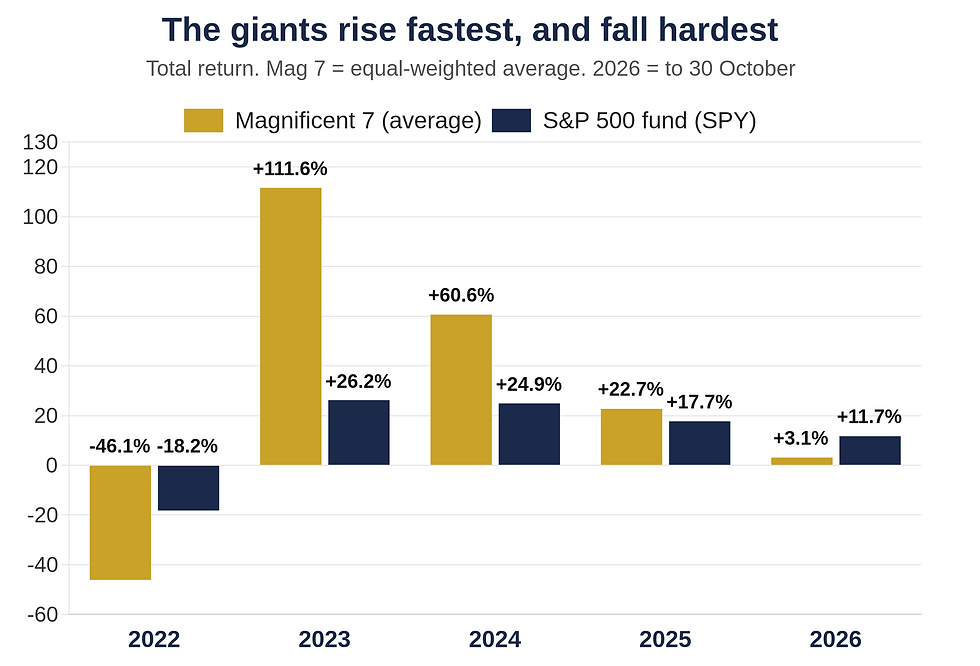
But look at the left side of that chart. In 2022, the seven giants, averaged together, lost about 46%, while an S&P 500 fund lost about 18%. The brightest stars rise fastest. They also fall hardest.
Then came 2026.
By July, a fund holding only the Magnificent 7 was down 3.7% for the year, while a fund holding everything in the large-company market except the seven was up 12.9%, Benzinga reported. A gap of nearly 17 points.
The giants clawed back some ground over the summer. Then came the last week of October, and the gap widened again.
Why the Giants Stumbled in 2026
Here is the strange part. They did not stumble because they are bad companies.
Meta grew its revenue 26% in its third quarter, to $64.6 billion. That beat expectations. The next day, 22 October, the stock fell almost 7%. Why? Spending. Meta spent about $34.9 billion on data centres and equipment in that single quarter, expects to spend $135 to $145 billion this year, and told investors it plans to "continue investing aggressively" in 2027.
Alphabet reported on 29 October. Its sales came in below expectations, and investors worried about how much cash its AI build-out is eating. The stock fell more than 12% in one day, its worst session since it listed in 2004, putting close to half a trillion dollars of market value on the line.
Amazon reported the same week. Over the twelve months to September, its free cash flow, the cash left after paying for data centres, warehouses and equipment, turned into an outflow of $42.4 billion. That was the deepest in the company's history, nearly double the previous record set in 2022.
See the pattern? For three years, Wall Street clapped every time a giant said "AI." In 2026 it started asking a harder question: where is the profit from all this spending? Truist's chief investment officer noted that technology and communication services were the only two sectors of the market to fall in October. The rest of the orchard was fine.
And here is the part that matters for you. None of this was printed in the newspaper in January. The professionals did not see it coming either. If they could not pick the winners among seven famous companies, why should you have to?
The Most Valuable Company on Earth
Let me tell you a true story.
On 27 March 2000, a company called Cisco Systems, which made the routers that ran the internet, closed at $80.06 a share. For a moment, it was the most valuable company in the world, worth more than $500 billion. Its stock had soared nearly 600% in two years. Fund managers owned it. Pension funds owned it. Your neighbour owned it. It was the backbone of the internet. What could go wrong?
Picture it. You are 45. You put your retirement savings into the safest tech giant in America.

Then the dot-com bubble burst, and Cisco fell more than 85%.
Here is the part nobody tells you. Cisco did not go bust. The business survived. It kept selling equipment. It kept making money.
But the stock did not come back. Not in five years. Not in ten. Not in twenty.
It finally closed above that March 2000 price on 10 December 2025. Twenty-five years, eight months and thirteen days later. That 45-year-old investor was now 70. And over the same stretch, the S&P 500 rose almost 350%, according to Business Insider.
If you are holding a fallen giant right now and waiting to "just get back to even," this is worth reading: Should You Sell at a Loss or Wait to Break Even? A Calm Way to Decide. And if you want to see Cisco's 25-year wait with your own eyes, type Cisco and March 2000 into my free Stock Time Machine.
Before Cisco, There Was Polaroid
Cisco is not alone. In the early 1970s, Wall Street fell in love with the "Nifty Fifty," the famous growth companies of that era. Fund managers called them "one-decision stocks." Buy them. Never sell.
Polaroid was the Apple of its day. In 1972, investors paid almost 95 times earnings for it, when the S&P 500 traded at about 19 times.
Then the 1973 to 1974 bear market arrived. Polaroid fell about 91%. Avon fell about 86%. Xerox, about 71%.
The long run did not rescue them either. Wharton professor Jeremy Siegel measured what happened to investors who bought at the end of 1972 and simply held on.

From December 1972 to June 1997, Polaroid returned 1.7% a year. Avon, 4.7%. Sears, 8.3%. The S&P 500? 12.9% a year. Same 25 years. One decision.
Great companies. Wrong price. Too much faith in a handful of names.
I am not saying the Magnificent 7 are the next Cisco or the next Polaroid. Nobody knows that, and anyone who tells you they know is guessing. I am saying this: when everyone tells you a few stocks can't lose, that is the moment to remember Cisco.
Own the Orchard: The Boring Way Out
Any farmer will tell you the same thing. You never bet the whole harvest on your seven biggest trees. A storm, a disease, one bad season, and any tree can fail. The orchard keeps feeding you.
The old way | The new way | |
What you buy | The stars everyone is talking about | The whole orchard, through one low-cost index fund |
How you choose | Chase the news, hope you guessed right | Let the market decide which trees grow |
In a year like 2026 | You might have picked Tesla, Meta and Alphabet | You owned Apple, and all 493 boring winners too |
Who does the work | You, every day | Nobody. That's the point |
Think about a harvest. In January, you do not know which trees will fruit best. Nobody does. But if you own the whole orchard, you are guaranteed to own the best trees every single year. Yes, you will own the worst ones too. But you will never miss the winners.
Look at what that did in 2026. An S&P 500 index fund owned all seven giants and all 493 boring trees. It did not have to guess. It was up 10.7% to the end of October, even after a rough final week. And as the winners grow, the index automatically owns more of them. As the losers shrink, it owns less. No meetings. No predictions.
The professionals can't pick the winners either
Every year, S&P Dow Jones Indices keeps score on professional fund managers in its SPIVA reports. These are full-time, well-paid stock pickers with research teams.

In 2025, 79% of actively managed large-company US stock funds did worse than the S&P 500. In the first half of 2026, even in a year when the smaller stocks did well, 67% still did worse.
So if you have ever felt stupid for not picking the winners, please don't. Two out of three professionals could not do it either. I go deeper into the long-run numbers in Stock Picking vs. the S&P 500: What 20 Years of Results Say, and into one famous real-life test in Warren Buffett's $1 Million Bet.
What this is NOT: I am not telling you to sell Apple or Nvidia. The Magnificent 7 are wonderful businesses, and Apple alone is up 27% this year. I am saying: don't bet your retirement on guessing which ones. |
"But Isn't the S&P 500 Itself a Mag 7 Bet?"
Fair question. And yes, the index is top-heavy right now. As of 29 October 2026, the seven made up about 33.2% of SPY, the biggest S&P 500 fund. Nvidia alone was 7.7%. So roughly one dollar in every three you put into an S&P 500 fund goes into these seven companies.
But you still own all 500. When the seven stumbled in 2026, the 493 carried you. That is the whole point of owning the orchard: it doesn't need every tree to fruit.
If that weight still worries you, there is an equal-weight version of the S&P 500 that gives every company the same slice. The best-known fund that tracks it is RSP. It was up 14.0% in 2026 through 30 October, or about 15.3% with dividends.
It is not a free lunch, though. An equal-weight fund usually costs a bit more, trades more often, and falls behind in the years when the giants lead. In 2023, for example, it gained about 13.7% while the regular S&P 500 fund gained about 26%. Neither version is "right." They are two different ways to own the orchard. If you are wondering whether you need both, read How Many Index Funds Should You Own?. And if you worry that index funds themselves have become a bubble, I covered that here: Are Index Funds a Bubble?
"So Should I Just Buy the 493 and Skip the Seven?"
No. That is just another guess, pointed the other way.
Remember 2023? The seven delivered about 60% of the whole market's gain that year. Anyone who skipped them missed the biggest winners. Next year, it could flip again. Nobody knows.
The whole point of the orchard is this: you stop guessing. Whether the giants win or the boring trees win, you own the orchard. You are not betting on which tree.
Your 15-Minute Mag 7 Check: What to Do Tonight
Reading this won't change your portfolio. Doing something will. Here is a simple check you can do tonight with a cup of tea.

List everything you own. Every stock and every fund, in every account. Write down what each one is worth today.
Count your Mag 7 exposure, twice. Add up any Apple, Microsoft, Nvidia, Alphabet, Amazon, Meta or Tesla shares you own directly. Then add about one third of whatever you hold in S&P 500 funds, because that is how much of those funds sits in the same seven. Many people discover they own the giants twice without realising it.
Ask the 2022 question. In 2022, the seven giants, averaged together, lost about 46%. If your Mag 7 money fell that much next year, would your retirement plan still work? If the honest answer is no, your plan is really a bet.
Decide where new money goes before the next headline. Write it down. One sentence. People who decide in advance are far less likely to chase whatever is hot, or to panic and sell at the bottom.
Then tell me in the comments below: how many Magnificent 7 stocks do you own directly? Zero, one to three, or four or more? I read every comment.
If you live outside the US and want to own the whole American orchard in one fund, start here: How to Invest in the S&P 500 If You Live Outside the United States.
Frequently Asked Questions
What are the Magnificent 7 stocks?
The Magnificent 7 are Apple, Microsoft, Nvidia, Alphabet (Google's parent), Amazon, Meta Platforms and Tesla. Bank of America strategist Michael Hartnett coined the nickname in 2023. Together they made up about 33% of the S&P 500 as of October 2026, which is why almost every index fund investor owns them.
What is the S&P 493?
The S&P 493 is a nickname for every company in the S&P 500 except the Magnificent 7. It covers banks, healthcare, energy, industrial, retail and utility companies. There is no official S&P 493 index, so analysts measure it with the equal-weight S&P 500, ex-Mag 7 funds, or their own calculations.
Did the Magnificent 7 lose money in 2026?
Not as a group. At the 30 October 2026 close, the seven averaged together were up about 3.1%. Three of them, Alphabet, Meta and Tesla, were down for the year. What the group did was lose the race: the S&P 500 rose 10.7% and the equal-weight S&P 500 rose 14.0%.
How much of the S&P 500 is the Magnificent 7?
About one third. As of 29 October 2026, the seven made up 33.2% of SPY, the largest S&P 500 fund, with Nvidia the biggest single holding at 7.7%. The S&P 500 weights companies by market value, so the biggest companies take the biggest slices.
Why did the Magnificent 7 underperform in 2026?
Mainly because investors began questioning their huge spending on artificial intelligence. Meta's stock fell almost 7% after strong results because of its spending plans, Alphabet fell more than 12% in a day after sales missed, and Amazon's free cash flow turned deeply negative. Investors now want proof the spending will pay off.
Is the equal-weight S&P 500 better than the regular S&P 500?
Neither is always better. The equal-weight version beat the regular index in 2026 because the smaller companies did well. In 2023 it badly lagged, gaining about 13.7% against about 26%. It usually costs a little more and trades more often. Both are ways to own the whole market rather than guess.
Should I sell my Magnificent 7 stocks?
That depends on your own situation, and this article is not personal advice. A useful first step is to add up how much of your money depends on these seven, including through index funds, and ask whether a 2022-style fall would wreck your retirement plans. If unsure, speak to a licensed adviser.
The Bottom Line
So let's go back to the orchard one last time.
Seven giant trees. Everyone staring at them. In 2026, three of them dropped their fruit. Only one grew faster than the orchard. And the boring trees quietly fed the farm.
Let's recap:
The famous seven didn't crash. They lost the race to the boring 493.
They stumbled because Wall Street now wants proof that their giant AI spending will pay off.
Cisco and Polaroid show what happens when everyone trusts a handful of names. Great companies, long waits.
Own the orchard, and you never have to guess. The index owns the winners automatically, whichever trees they turn out to be.
If you have lost money in the market before, maybe by buying the stock everyone was talking about just before it fell, I wrote something for you.
My free report, "Why You Lost Money in the Stock Market (And Why It Wasn't Your Fault)," shows you the 7 Wall Street traps that quietly drain ordinary investors, and the one boring strategy the industry hopes you never discover. Why is it free? Because I would rather you learn this from a free report than from another painful loss.
Don't chase the giants. Own the orchard.
About the Author
Stephen Loke has been a student of the market for more than 15 years. He is also an agritourism entrepreneur whose farm has been featured in Bloomberg News and Asahi Shimbun.
This article is general education, not personal financial advice. I am not a licensed financial adviser, and nothing here is a recommendation to buy or sell any security. Figures are as of the 30 October 2026 close unless stated; markets move. Past performance does not predict future returns.
Sources
ChartRow, "Magnificent 7 (2026)": 2026 returns for each stock and the equal-weighted Mag 7 basket to 30 Oct 2026; calendar-year total returns 2022–2025. https://chartrow.com/lists/magnificent-7
ChartRow, "S&P 500 Equal Weight YTD Return 2026": RSP price and total return to 30 Oct 2026; 2023 full-year return. https://chartrow.com/sp500-equal-weight/ytd
Yahoo Finance, market close 30 Oct 2026 (S&P 500 at 7,580.07); Amazon free cash flow; Truist on October sector moves. https://finance.yahoo.com/markets/live/stock-market-today-friday-october-30-dow-sp-500-nasdaq-amazon-intel-ai-sell-off-191429143.html
Yahoo Finance, 29 Oct 2026: Alphabet's one-day fall; ex-Mag 7 fund vs Mag 7 fund returns. https://finance.yahoo.com/markets/live/stock-market-today-thursday-october-29-dow-sp-500-nasdaq-alphabet-microsoft-earnings-130305714.html
S&P Dow Jones Indices, December 2025 market attributes (S&P 500 2025 close of 6,845.50). https://www.spglobal.com/spdji/en/documents/commentary/market-attributes-us-equities-202512.pdf
Opening Bell Daily, "The Magnificent 7 stocks drive the S&P 500, but not together" (weights as of 29 Oct 2026; size-weighted 493 vs Mag 7). https://www.openingbelldailynews.com/p/magnificent-7-stocks
Gotrade, Meta stock news 23 Oct 2026, citing Meta's Q3 2026 results filed with the SEC. https://www.heygotrade.com/en/news/meta-meta-stock-news-october-23-2026/
Meta Platforms, Q3 2026 results (SEC exhibit 99.1). https://www.sec.gov/Archives/edgar/data/0001326801/000162828026066700/meta-09302026xexhibit991.htm
Benzinga, July 2026: Mag 7 ETF vs ex-Mag 7 ETF performance gap. https://www.benzinga.com/markets/equities/26/07/60669594/magnificent-seven-sp-493-xmag-mags-2026-performance-gap
First Trust, "S&P 500 Index in 2023": Mag 7 share of the 2023 return. https://ftportfolios.com/Commentary/EconomicResearch/2024/1/25/three-on-thursday---sp-500-index-in-2023
S&P Dow Jones Indices, SPIVA U.S. Year-End 2025. https://www.spglobal.com/spdji/en/spiva/article/spiva-us-year-end-2025/
S&P Dow Jones Indices, SPIVA U.S. Mid-Year 2026. https://www.spglobal.com/spdji/en/documents/spiva/spiva-us-mid-year-2026.pdf
Slashdot, summarising the Financial Times on Cisco's 25-year recovery. https://tech.slashdot.org/story/25/12/11/2013233/
Yahoo Finance / Bloomberg on Cisco's record close. https://finance.yahoo.com/news/cisco-systems-inc-csco-shares-174059535.html
Business Insider via AOL, "Cisco's 25-year comeback". https://www.aol.com/articles/ciscos-25-comeback-ultimate-cautionary-130659506.html
Tiger Brokers on Cisco's 2000 market value and run-up. https://www.itiger.com/news/1166753772
AAII Journal, "Valuing Growth Stocks: Revisiting the Nifty Fifty" (Jeremy Siegel). https://www.aaii.com/journal/article/valuing-growth-stocks-revisiting-the-nifty-fifty
Hub for Finance, "This has happened before" (Nifty Fifty drawdowns). https://hubforfinance.substack.com/p/this-has-happened-before
The Motley Fool (2000), "Sears and Avon Circa 1972", citing Siegel's Stocks for the Long Run. https://www.fool.com/archive/portfolios/rulemaker/2000/07/25/sears-and-avon-circa-1972.aspx


Comments